
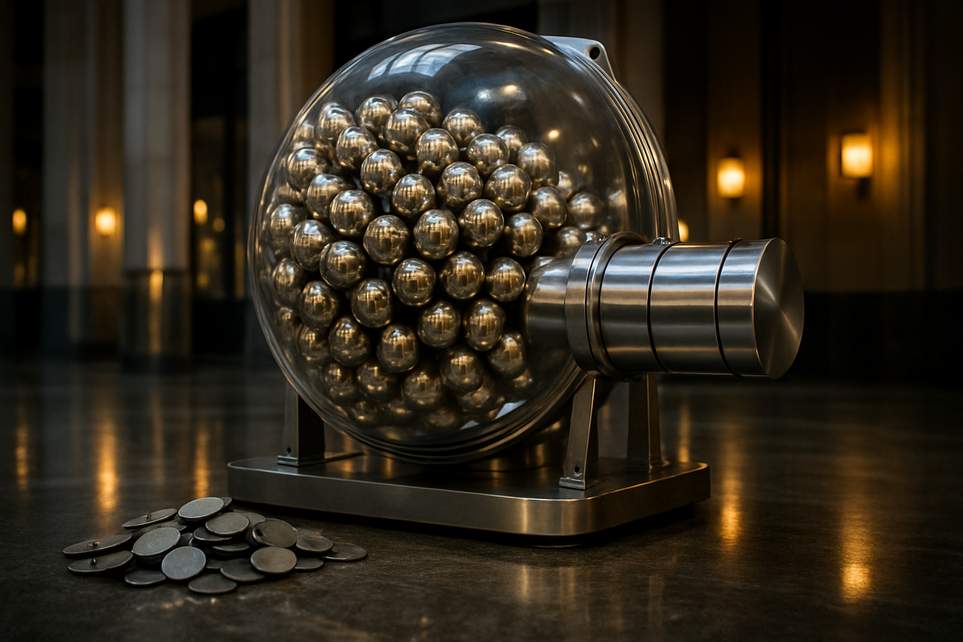
The trillion-dollar Bitcoin lottery you can play for free — and you’ll never win
Bitcoin can feel like a $1.5 trillion lotto where the jackpot is sitting out in the open, waiting for someone to guess the secret number. Enter sites that randomly spit out batches of private keys and addresses on refresh, like a perpetual stream of digital scratchcards. Tempting, right? Refresh, refresh, refresh — and maybe, someday, you hit a wallet with actual money in it.
The gimmick: a flashy number generator that’s more lesson than loophole
These pages don’t contain a hidden treasure chest of stolen keys. They generate private keys deterministically (often based on a page number), show the matching addresses, and check whether those addresses have balances. It looks like a shortcut because you’re watching real-looking keys and real-looking addresses fly by, but in reality it’s a theatrical demonstration of how huge cryptographic number spaces are.
If you hit “refresh” and a site shows you 90 addresses at once, it’s basically handing you ninety free lottery tickets from a universe-sized raffle. That casino vibe is intentional — it’s meant to make the improbability obvious. The site will even try to slow you down with captchas if you spam refresh, because automated brute force attempts are expected even if they’re doomed by math.
Why you won’t win (and why that’s a feature, not a bug)
Let’s be blunt: your chance of randomly generating a private key that controls a funded Bitcoin address is astronomically small. There are about 58 million addresses with non-zero balances. That sounds like a lot until you compare it to the size of the address space (derived to about a 160-bit value). The funded addresses are a microscopic speck — a rounding error — in a sea of possibilities.
For the site that shows 90 addresses per refresh, the odds of any one refresh hitting a funded wallet are roughly 1 in 2.8 × 10^38. Written-out, that’s an unimaginably huge number (think: undecillions). Even if you could somehow do a billion such refreshes every second, the expected time to find just one funded address would be on the order of 10^12 years — about a trillion times older than the universe. So you’re not merely unlikely to win. You’re living in a reality where “never” is the practical answer.
Crunching the money side: the average funded address holds roughly 0.126 BTC, which at current prices is several thousand dollars. But that average only matters if you actually land on a funded address — and the probability is so tiny that the expected value per 90-address refresh is effectively zero. To expect to get even a dollar of value from random guessing, you’d need an absurd number of tries (on the order of 10^34 refreshes).
There’s also a moral and legal line here. If you somehow did find a private key to a wallet with funds and tried to move the money, that action would be taking someone else’s assets without permission. In plain terms, that’s theft, and it can carry legal consequences depending on where you are. “I guessed it” is not a legal shield.
So what is the point? Sites that generate keys and show balances are excellent thought experiments. They make the improbable feel tangible and drive home why Bitcoin’s security model works: not because secrets are mysterious, but because the math makes brute-force guessing functionally impossible. If anything, watching thousands of empty addresses scroll by is a quick way to cure the “what if” part of gambling thinking.
