
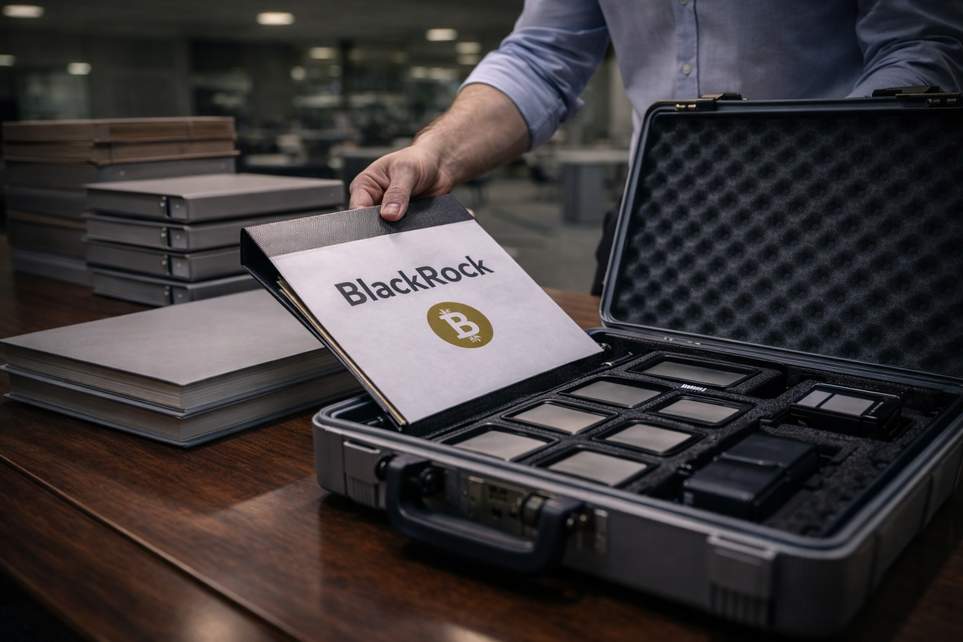
BlackRock Wants ETFs and Stocks to Live in Your Crypto Wallet After $150B Push
Wallets: the new front door for your money (according to BlackRock)
Imagine your phone as a tiny bank, investment shop, and vending machine all rolled into one — and all of it sitting inside a digital wallet. That’s the idea being floated: not just crypto coins, but ETFs, tokenized bonds, fractional private-credit slices, and even digital euros living in the same app you check for memes and groceries.
The pitch is simple and a little cheeky: most people already carry a smartphone, so why not turn the wallet on that phone into a mainstream place to hold regulated investments? The company at the center of this plan says wallets are an underused distribution channel and wants to be the one to build the bridge.
Why they think they can actually do it
They’re not just talking big — they’ve already parked serious assets where the digital world meets traditional finance. Think of it as building a house on land you already own: stablecoin reserves measured in tens of billions, nearly $150 billion tied to digital-assets initiatives, and roughly $80 billion in digital ETPs. Those are the heavy bricks that make the wallet idea seem less like science fiction and more like a roadmap.
There are live pieces of the puzzle today: tokenized Treasury funds with billions in exposure, stablecoin reserves that act like on-chain cash, and experiments that let token holders trade through decentralized mechanisms — but usually with guardrails like whitelists and accredited-investor rules. There are also real-world precedents: some fund groups already offer mobile apps where tokenized fund shares and yield land directly in users’ wallets and can even be transferred peer-to-peer.
In short, the plumbing exists. What’s changing is the plan to connect that plumbing to everyday investor distribution, not just institutional back rooms.
What’s still foggy — and why it matters
Before you ditch your broker and go full self-custody, there are some big question marks. There’s no launch date, no branded wallet announced, and no single blockchain chosen as the vehicle. More practically, many tokenized products today are sold under strict rules: accredited-only sales, multi-million-dollar minimums, and allowlists that keep retail investors away.
That means two possible futures. One is wallet-native investing for the masses — easy, fast, and on your phone. The other is the same old experience, but with faster settlement and fancier backend tech; everyday users still buy through brokers and advisers, while the on-chain improvements happen behind the curtain.
Either way, if wallet delivery of regulated products takes off, the advantages of crypto rails — programmable compliance, near-instant settlement, and around-the-clock markets — could move from nerdy developer features to actual user benefits. And if it fails, the whole experiment will have mostly improved institutional plumbing while retail investors barely notice.
So keep your eyes peeled: this could be the start of wallets becoming actual investment hubs, or it could just be another upgrade to the machines behind the scenes. Either way, it’s going to be fun to watch — popcorn recommended.
