
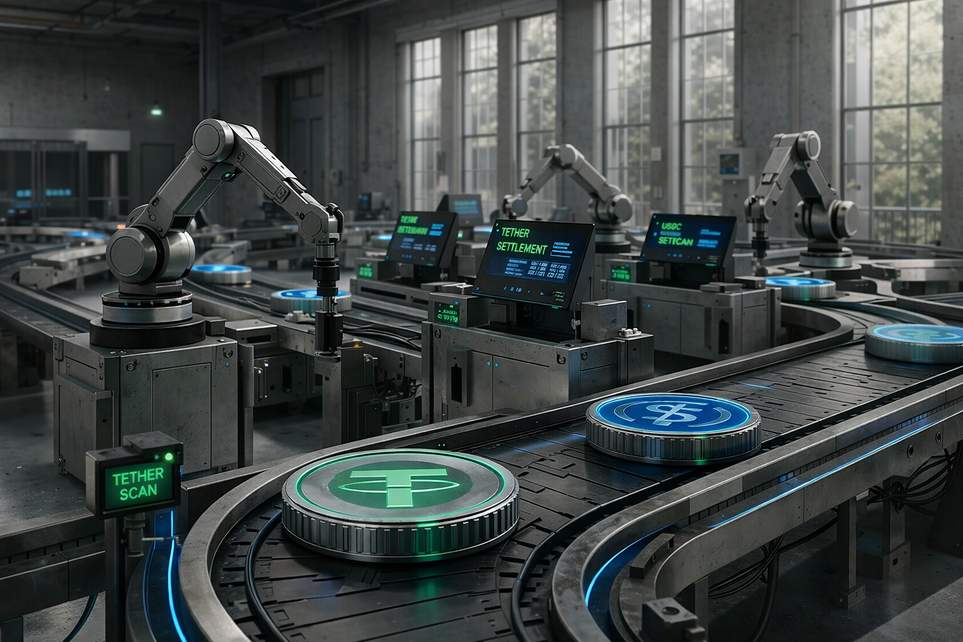
Inside the $28T Bot Shuffle: Why the ‘Agent Economy’ Is Mostly Machines Moving Stablecoins
There’s a mind-bending amount of money zipping around crypto rails — roughly $28 trillion in stablecoin transfers in the latest quarter — and the funny thing is most of it looks less like autonomous AI shopping and more like automated plumbing. About three-quarters of that stablecoin activity comes from bots and automated systems shuffling tokens back and forth, not from humans buying coffee with a wallet app.
The bot hustle: what’s actually happening
Reports from market trackers and industry research show that machine-driven activity has become a major part of on-chain volume. One analysis put “agentic” activity at around one-fifth of all on-chain transactions and counted thousands of new software agents launched since 2025. Meanwhile, quarter-by-quarter data shows stablecoin transfers surging — up more than half in a single quarter — with roughly 76% of that volume tied to automated flows.
So what does “automated” mean here? Think high-frequency routing, liquidity juggling, exchange arbitrage, treasury movements, and internal operational transfers — a lot of mechanical money-moving that keeps markets and platforms humming. These systems prefer stablecoins because they behave like digital dollars: steady price, programmable rails, and easy for software to reason about. If you’re a robot that needs to move value without betting on volatility, a stablecoin is your snack of choice.
At the same time, everyday retail transfers have actually dropped, signaling that these machine flows aren’t the same thing as consumer payments. Instead, they look like infrastructure traffic: programmatic wallets, trading bots, automated liquidity strategies and centralized gateways moving tokens between custodians and exchanges.
Some blockchains — the ones built to move dollar-like tokens quickly — are seeing the heaviest machine-driven traffic. The stablecoin ecosystem’s market size sits in the low hundreds of billions, distributed across chains that favor settlement speed and liquidity, and many of the emerging machine-payment standards being announced are still tiny compared with the trillions already flowing through stablecoins.
Two possible futures: rails ruled by crypto or by the usual suspects
There’s a choice ahead, and it’s less about clever code and more about who controls the pipes. On one hand, proponents imagine standards, regulated issuers, and interoperable protocols converging to let machines pay each other natively — real machine-to-machine commerce that scales. In that optimistic future, stablecoins grow substantially, trusted identity and reputation layers appear, and the agent economy becomes a mostly invisible payments infrastructure that hums under everyday apps.
On the other hand, the grimmer-but-realistic scenario is that most of the bot volume stays plumbing: card networks, banks, and big payment companies absorb the demand and settle through fiat rails. Big incumbents that can handle compliance, custody, and relationships end up owning the rails, and much of the “agent economy” simply becomes another way to extend dollar-denominated settlement around the globe.
There are good reasons to be skeptical about full autonomy today. True agent autonomy at scale needs verifiable identities, custody that survives model mistakes, reputation systems, credit mechanisms, and execution fail-safes — layers that aren’t production-ready across the ecosystem. In narrower tasks, automated agents can outperform humans, but in messy, real-world trading and risk scenarios, people still have the edge.
Macro effects are worth watching too. Stablecoin issuers hold a lot of short-term government debt as reserves, so bigger machine-driven adoption pushes demand for those instruments and further ties automated settlement to dollar-denominated standards. In short: this looks more like a story about extending the dollar through programmable rails than about machines overthrowing payment incumbents overnight.
So enjoy the show: the agent economy is real, noisy, and increasingly important — but for now it’s mostly bots doing back-office ballet. Whether that ballet leads to a truly autonomous machine marketplace or just makes the existing financial giants more central depends on which players win the race to provide identity, compliance, and trusted settlement.
