
Bitcoin’s New Macro Quiz: Warsh’s 54% and the $80K Drama
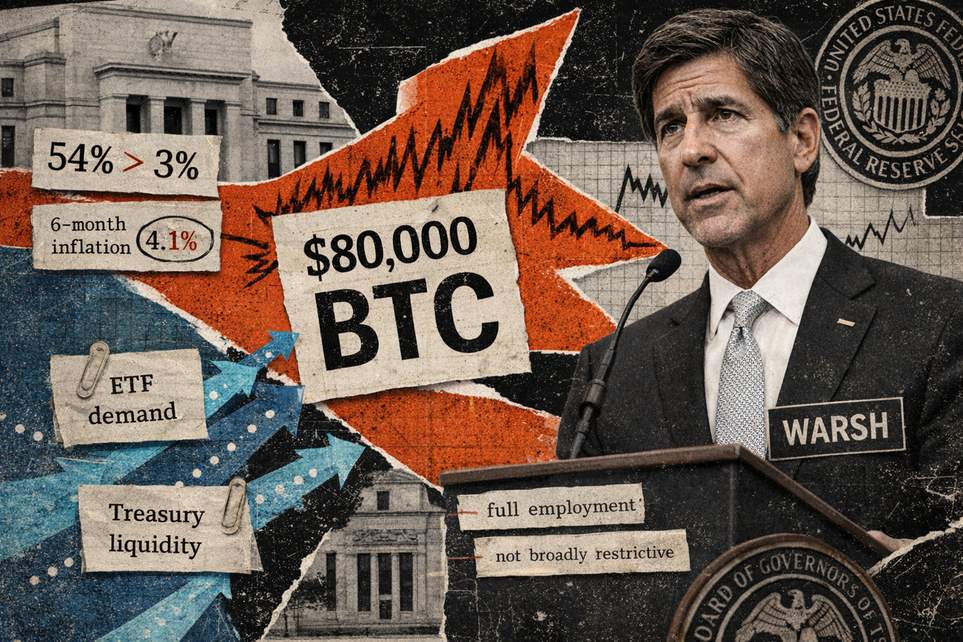
Bitcoin had a brief flirtation with $81K before sulking back under $80K and settling near $79K — cue the popcorn. The market’s next plot twist isn’t just about buyers and sellers anymore; it’s been handed a macro exam by Federal Reserve chatter. Fed Chair Kevin Warsh tossed out a tidy (and kind of terrifying) stat: more than half of consumer-price items are rising faster than 3% over the last year. That number gives traders a concrete yardstick to decide if the Fed will stay patient or tighten its fists a bit longer.
Warsh’s 54% test — what it actually means
In plain English: 54% of the components of the personal consumption expenditures (PCE) basket grew faster than 3% year-over-year, and on a six-month annualized basis about 49% were above that same threshold. Warsh also pointed to a six-month annualized headline inflation reading around 4.1%, while official data showed monthly PCE nudged up 0.2% in July and about 3.7% over the past year. Translation: inflation is still too broad for comfort.
Why should crypto folks care? Because Bitcoin doesn’t pay interest. When inflation looks sticky, investors give the Fed permission to keep rates higher for longer. Higher short-term rates make cash and short-dated government bonds relatively more attractive, and that tightens the discount rate applied to risk assets — which includes BTC. So the burden of proof is now on data to show price pressures are easing across many goods and services, not just headline numbers.
ETFs, Treasury buybacks and the $80K test
On the demand side, spot Bitcoin ETFs have been busy: over four trading sessions through Aug. 27 they scooped up roughly $1.1 billion. A handful of product flows accounted for most of that activity, with one large fund taking a particularly big share. That concentration helps explain why the recent rally looked powerful but also somewhat fragile — if most inflows are funneled through a single vehicle, a reallocation there could quickly remove liquidity support.
Practical indicators to watch if you’re rooting for a lasting comeback: do ETF inflows keep showing up after the policy talk, do they diversify across more funds (not just one superstar), and can BTC actually hold and push past $80K on its own? Passing all three would make the bounce look like something that can stick. Failing any makes it feel like a short-lived positioning move.
There’s also a Treasury angle. Starting in September, the Treasury will expand certain buyback operations, increasing the maximum size for some longer-dated maturities. Bigger buybacks can smooth trading in less-liquid parts of the curve and reduce frictions at the long end, which indirectly helps market functioning. That may calm volatility a bit, but it’s not a magic wand. The operations are labeled debt-management — not monetary stimulus — and they don’t remove the front-end rate risk highlighted by Warsh’s inflation readings.
Finally, watch the two-year yield: it’s the part of the curve most sensitive to near-term Fed expectations. Small moves there matter more for Bitcoin’s near-term mood than noisy swings at the long end.
The bottom line: Bitcoin’s case for reclaiming and holding $80K is credible but conditional. ETF flows and smoother Treasury markets can buffer shocks, yet Warsh’s breadth numbers make clear what’s required for a real, sustainable rally — broader, lasting signs that inflation is cooling across the board. Until that evidence arrives, consider any rebound a skirmish, not final victory.
