
Aave V4 Arc Has $76M in USDC — And Almost Nobody Is Borrowing It
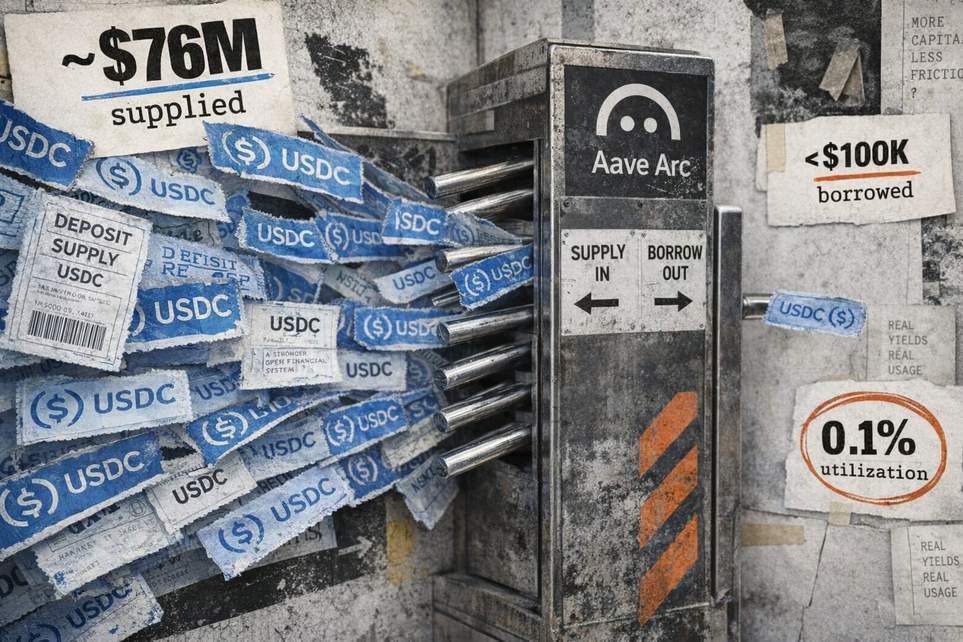
Short version: Aave V4’s Arc launch scooped up a giant pile of USDC fast, but almost none of that cash is being used as loans. Deposits hit roughly $76 million right after launch, while borrowing barely registered — think under $100K — leaving utilization near basically zero.
Big deposits, tiny borrowing
The Arc Layer-1 network went live with Aave V4 on Sept. 16, and folks rushed to park USDC. In the first day or so the main USDC pool ballooned to about $76 million supplied, yet borrowers only tapped a sliver of it, leaving utilization around 0.1%.
Aave V4 organizes funds with a hub-and-spoke model: hubs hold the cash and spokes control how much can flow in or be drawn out. When Arc’s Main Spoke opened it had an add cap of 56 million USDC and a draw cap of 51 million USDC. The supply-side cap filled up in hours, prompting a proposal to raise the add cap to 150 million — which would give more room for deposits without changing how much could be borrowed.
To keep things in perspective, the early Arc numbers were part of a bigger V4 picture that spans several hubs. Snapshot comparisons showed total V4 deposits rising from about $577.1 million to $708.6 million around launch time, but that aggregate covers six hubs — Arc’s core bucket was roughly $57.6 million of that haul.
Because hardly anyone was borrowing, the protocol’s rate engine priced liquidity accordingly: with utilization near zero, displayed supply and borrow APRs were effectively 0.00% during the early checks.
Why this matters — and what to watch
More deposit capacity is like widening a parking lot: it lets more cars (USDC) enter, but it doesn’t force anyone to drive. Raising the add cap to 150 million would almost triple the amount that can be funneled into the Main Spoke, yet the draw cap staying at 51 million means the maximum credit available through that route wouldn’t grow.
The real test for Arc isn’t how many tokens sit idle — it’s whether borrowers start using them. Look for a steady increase in borrowed balances, rising utilization percentages, and upward pressure on rates. If those things happen, Arc moves from “pretty piggy bank” to “actual credit market.” If not, it’s a very tidy pool of parked USDC waiting for something to ping the market into life.
So for now: big supply, sleepy demand. The next headlines will tell us if borrowers decide that Arc’s liquidity is worth drawing on — otherwise it will just be a very well-funded nap.
