
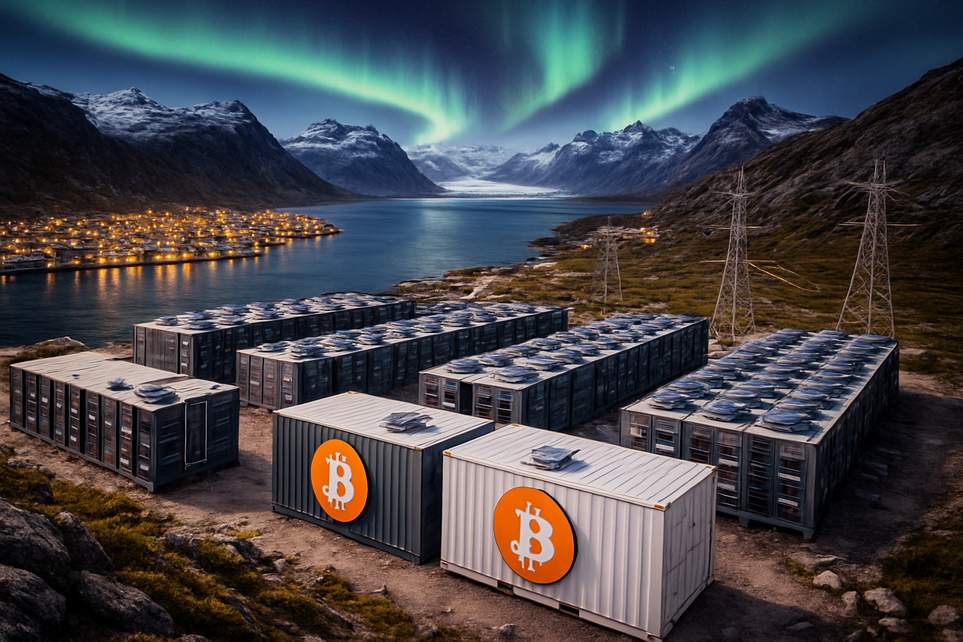
Could Greenland Become a Bitcoin Mining Superpower (If the U.S. Bought It)?
What’s the idea — and why miners are rubbing their hands
Okay, imagine this: a headline about the U.S. buying Greenland pops back into the news feed and suddenly Bitcoin miners are peeking at maps and power plans like kids eyeing an all-you-can-eat candy buffet. Greenland has huge renewable potential — lots of hydropower projects on the drawing board and wind resources that make engineers whistle — so the fantasy goes: harness stranded or surplus power, plug in racks of ASICs, and crank out exahashes like it’s going out of style.
Short version: on paper Greenland could supply a ton of clean juice. In practice, turning that into a giant mining hub is a long, logistically spicy saga involving shiploads of equipment, new cables, consent from locals, and more paperwork than a tax prep marathon.
Greenland’s power math — how much hashing are we talking?
Let’s do the nerdy part without getting too dull. Two big hydropower sites that Greenland plans to tender could together produce around 9,500 gigawatt-hours a year. If you spread that energy out, it’s roughly equal to an average power output of about 1.08 gigawatts. Now translate watts into Bitcoin-hash-speech: at current miner-efficiency figures (think 15–22 joules per terahash and a modest PUE of ~1.1 for cooling and overhead), every megawatt of facility power gives you roughly 0.04–0.06 exahashes per second. Do the multiplication and a fully utilized 1.08 GW buildout looks like it could deliver on the order of 45–66 exahashes — call it mid-50s if you use a middle-of-the-road efficiency number.
To put that in context, the whole Bitcoin network today is measured in the low zettahash range (about 1 ZH/s = 1,000 EH/s). So a one-gigawatt-class mine in Greenland could be something like 4–6% of today’s global hashrate. Not world domination, but sizable enough to make people at big mining firms sit up and take notes.
Smaller, realistic early moves are more modest. Tapping leftover capacity near existing plants in 5–25 MW chunks gives you pilots in the 0.2–1.5 EH/s range — fine for tests and pilots, not enough to shift global power balance. Upgrading Nuuk’s Buksefjord from its current tens of megawatts toward 121 MW would get you into the low-single-digit exahashes — a valuable step, but still short of headline-grabbing scale.
And then there’s wind. One systems study estimates Greenland’s onshore wind technical potential as huge — hundreds of gigawatts nameplate, translating to something like 170 GW average if you extrapolate conservatively. Absorb that average with efficient miners and, in pure theoretical terms, you could be talking multiple zettahashes of capacity. But that’s a mountains-of-‘ifs’ claim: variability, storage, overbuild, transmission lines, ports, turbines, and astronomical capex all get in the way.
Reality check: logistics, politics, and sticker shock
If you’re thinking “great, just put a fence around a fjord and fire up the Antminers,” slow down. Industrial hydroplants take years to build, remote sites need roads and ports, and you need reliable subsea and terrestrial data links to make a mine resilient. Greenland does have a subsea cable backbone linking some towns and Iceland, but that won’t magically move power from a remote mountain river to a miner’s container without extra infrastructure.
Local grid topology matters too. Greenland’s electricity systems are often local island-and-settlement networks rather than one big national grid, so scaling up requires either huge interconnections or colocating mining where the generation actually sits. That’s why early mining plays are usually about behind-the-meter deals or exclusive industrial offtakes rather than just buying retail power.
Political and social consent are huge. If any large project were tied to foreign strategic interests, expect diplomats and local communities to weigh in. Greenlandic sovereignty and local consent are not decorations — they’re central to whether big builds get financed and permitted.
Finally, the money. Big wind builds and hydro projects are expensive. Using rough industry averages, hundreds of gigawatts of new wind capacity would cost hundreds of billions of dollars before you even buy a single ASIC. And the miners? Procuring millions of machines (if you wanted zettahash-level scale) would be a logistical nightmare and cost many tens or hundreds of billions more. So yes, the raw energy potential is enormous, but the capital required to turn maps into humming data halls is also enormous.
The tl;dr: Greenland has astonishing renewable capacity on paper, and a gigawatt-scale mining operation there would be meaningful to the Bitcoin network. But turning theoretical energy into actual hash means clearing technical, logistical, political, and financial hurdles. In other words: exciting potential, steak-sized practical problems, and a very long timeline — perfect fodder for headlines, less perfect for instant empire-building.
