
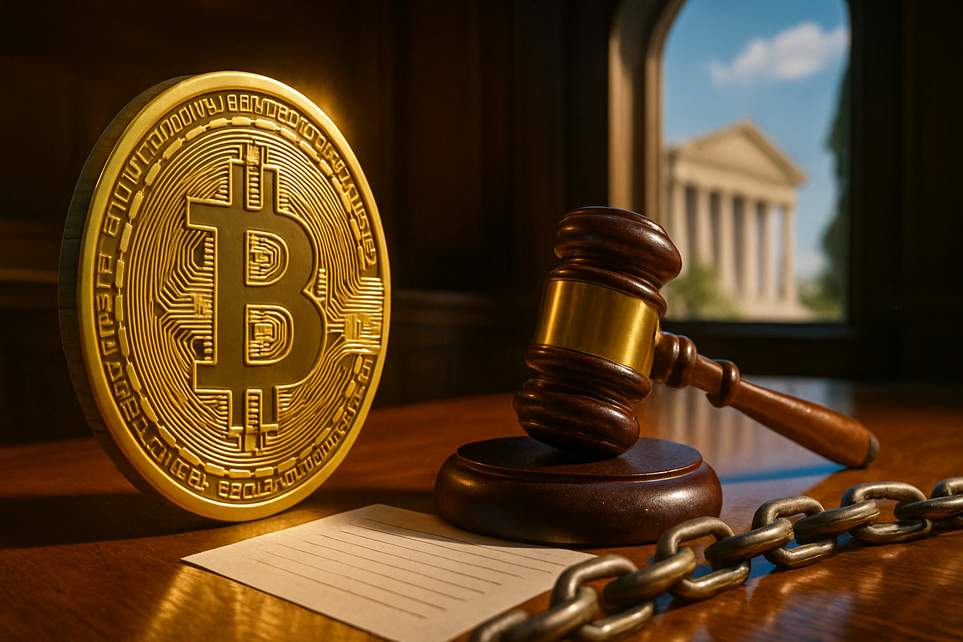
Bitcoin is quietly becoming the ultimate expert witness, forcing judges to accept a new standard of truth
When a transaction ID beats a deed (in a future you didn’t expect)
Picture this: it’s 2075, a courtroom, and the judge asks for a transaction ID instead of a paper deed. The landlord’s lawyer trots out a Bitcoin record from years ago showing a token that supposedly represented the apartment. The tenant’s lawyer shrugs and says the signature was coerced. The room accepts that the transaction happened, but they bicker about what it actually proved.
That little drama sums up a growing headache — or convenience, depending on your fondness for ledgers — for courts and institutions everywhere: when does a monetary network stop being just money and start acting like the world’s most stubborn public record?
Bitcoin as the world’s stubborn notary
Traditional title systems — land registries, corporate ledgers, dusty index books, scanned PDFs — all depend on people, offices, and sometimes optimism. Fires, wars, corrupt officials, or plain old sloppy bookkeeping can erase or twist those records. In many places, billions of people lack solid, state-backed proof of land rights and are vulnerable when disputes arise.
Bitcoin offers a different trick: every roughly ten minutes a block of transactions is cemented into a global, replicated log. Each block points to the previous one, forming a linked, time-ordered chain. Changing history means redoing an enormous amount of work across the network, which is why the ledger is often described as hard to rewrite. That makes it an oddly resilient timestamping machine.
On top of that, Bitcoin’s UTXO model — the technical system that tracks which little digital coins can be spent — naturally creates a chain of custody for satoshis. In protocol speak, ownership equals control of the key that can spend a particular output. That spending graph reads a lot like a title chain: from coinbase to the present, you can trace who moved what and when.
People have used that structure to anchor all sorts of outside claims. Tiny tokens, file hashes, and other markers can be embedded in transactions so a satoshi can stand in for a share, a document, or a pointer to a land entry in some other database. Suddenly you’ve got a permanent index of when those markers changed hands — whether or not any court clerk was paying attention back then.
Why judges want the chain — but still ask follow-up questions
Courtrooms have already warmed to blockchain-based facts. Law enforcement and civil cases have used blockchain tracing to show that specific payments occurred and where funds flowed. Some jurisdictions have even created legal rules that give blockchain records a presumption of authenticity for certain uses. But that doesn’t mean a transaction ID is a magic wand.
Blockchains prove a few narrow things very well: that at a particular block height a valid-looking set of digital signatures and outputs existed and that the network accepted them. They do not prove who actually held the hardware wallet, whether a signature was coerced, or whether malware made someone sign without their knowledge. Those human facts — identity, consent, intent — still live in testimony, emails, forensic reports and the messy world of evidence law.
So courts treat on-chain entries as solid pieces of factual plumbing: useful, verifiable, and hard to erase, but still challengeable. A judge might cite a transaction ID to establish that a token moved on a certain date and then spend pages debating whether that move was legally valid under local rules. In short: the chain helps tell the story, but it rarely tells the whole story.
How the chain becomes the default — slowly, quietly, and mostly because it’s convenient
The shift from novelty to default won’t come from one blockbuster law or a single headline case. It will creep in as judges, registrars, auditors, and corporate lawyers find it easier to check the timechain than to pry open a swamp of paper records. When looking up a transaction becomes routine and cheap, and when undoing it is harder than accepting it, the chain will start to act like the go-to source.
For some situations, the conversion makes obvious sense: multinational asset portfolios, fragile or failed states where registries are unreliable, and timelines that outlast governments. A fund embedding hashes of its ownership tree into Bitcoin every quarter gives anyone a public anchor to check. Human-rights groups and journalists already use similar timestamping to protect photos and reports from censorship or tampering. In those contexts, the chain can be more trustworthy than the local clerk.
But the ledger’s permanence cuts both ways. It’s a blessing for whistleblowers and archivists and a headache for people who want a legal clean slate. Courts lack the tools to literally erase a block; remedies will instead operate at the edges — ordering banks to freeze assets, recognizing that a particular on-chain transfer lacks legal effect, or awarding damages rather than rewriting history.
There’s also the thorny question of forks and emergencies. Bitcoin’s history shows rare moments when social coordination and code patches rewrote parts of the ledger. That proves immutability depends on both software and people. Legislatures and courts may eventually have to spell out which chain or version counts if a split happens, or contracts may need to say explicitly which chain controls for legal purposes.
At the end of the day, the chain won’t declare itself the global archive. It will get there by being the most verifiable, the easiest to check, and the hardest to fake. When a judge glances at a transaction ID, nods, and moves on to the real legal questions, Bitcoin has quietly graduated from a niche payment system to one more institutional record in a world where paper and memory too often fail.
About the author: Liam Wright (aka Akiba) — reporter and podcast producer who enjoys watching bureaucracies meet cryptography.
