
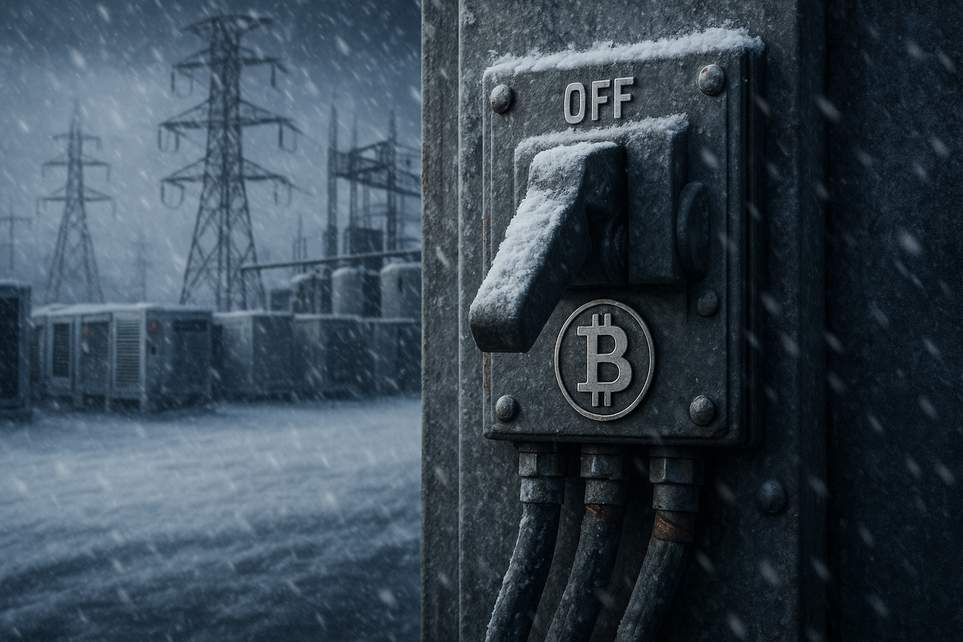
When Bitcoin Miners Pull the Plug: How a Winter Storm Turned Rigs into Snowmen
Big storms do dramatic things: trees fall, traffic snarls, and apparently bitcoin miners decide it’s nap time. A recent U.S. winter blast knocked a big slice of American mining power offline in just a few days—roughly a 40% dip in hashrate at peak, and enough rigs idled that block times crept from the usual ~10 minutes toward about 12 for a while. The culprit wasn’t a mysterious hacker or a protocol bug—just cold weather, stressed grids, and an industry built to be, oddly enough, very cooperative when the lights get tight.
Why miners can—and do—switch themselves off
Shutting machines down sounds dramatic, but for many miners it’s a rational, almost boring business move. There are three common reasons operators flip the switch:
– Economics: When wholesale power prices spike, the math changes minute by minute. If the cost of a megawatt makes the revenue from hashing look tiny in comparison, it’s cheaper to stop and wait. Think of it as stopping a noisy money-losing factory during a blackout of profits.
– Contracts and demand-response deals: Some mining sites have agreements with grid operators to act like giant, instant-on/off loads. In exchange for being able to cut when the grid needs it, miners can collect credits or payments. That turns a mine into a weird hybrid: part data center, part power-plant mercenary.
– Emergency rules and interconnection requirements: Grid operators increasingly insist that big new power users be curtailment-ready before they get plugged in. That means turning off during emergencies isn’t optional—it’s part of how these sites are allowed to exist.
So when a brutal cold snap hikes heating demand and fry’s reserve margins, miners who can throttle down do so quickly. Pools with lots of U.S.-based machines show it instantly: their reported hashing contribution falls, and the global network feels the dip even though the rest of the world keeps chugging along.
What the shutdown means for Bitcoin, the grid, and your impatient transaction
People panic a little when they see hashrate dive because a lower hash rate means the cost of brute-forcing the chain drops in the abstract. In practice, Bitcoin has built-in patience. The protocol targets a block every 10 minutes and only tweaks mining difficulty after 2,016 blocks. That delay creates a short-term consequence—call it the “storm tax”: if lots of miners pause, blocks slow until the difficulty gets a chance to adjust.
Slow blocks = slower confirmations and the possibility of a fatter mempool. Fees can rise if transaction demand stays steady, but if demand is light the delay can pass with barely anyone noticing. If miners come back quickly when prices and grid conditions normalize, the network sails through with minimal long-term impact. If the outage stretches on, difficulty drops at the next adjustment and pace returns to normal.
History shows this isn’t new, but the scale is getting bigger. Past cold-weather events proved that large clusters of miners can and will curtail en masse; what’s different now is how many big compute users—miners and AI/data centers alike—are competing for interconnection and political goodwill. That competition changes the conversation: miners used to argue they were special-case flexible loads; now they’re one of many massive customers asking to plug in.
The tidy takeaway: the protocol is resilient and built for opportunistic, transient hashing. Miners can even profit from stepping back in stressed conditions. The messy part is local politics and grid planning—residents and regulators will keep asking whether these giant power users truly make the system better when they promise to leave the switch flipped on only when it suits them. Expect more of these short, headline-grabbing slowdowns as extreme weather and hungry compute demand collide.
