
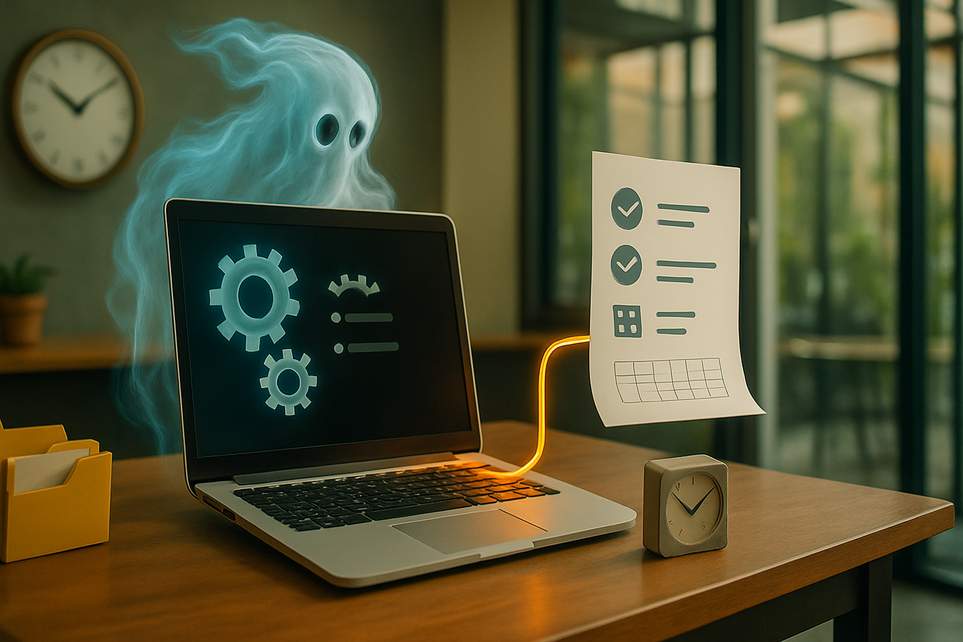
You don’t need to learn vibe coding: Build an AI ghost app in 30 mins and reclaim weeks of your life
Meet the AI ghost app (no spooky stuff, promise)
Five years ago you basically had two options to make an app: learn to code until your brain smoked or hire someone who already had the smoke. Both routes demanded time, cash, and emotional resilience. Fast-forward to today: if your job is mostly words in, words out, you can spin up a focused little helper that behaves like an app without being an app. I call these contraptions “AI ghost apps.” They’re unglamorous, brilliant, and extremely lazy in the best possible way.
At its heart a ghost app is tiny and specific: one large language model, a clear instruction set that says “do this,” and a handful of reference files that show what good looks like. No UI, no server to babysit, no architecture diagrams. It’s basically you distilled into a checklist that a model follows obediently.
Because the scope is narrow, the model becomes reliably useful. You’re not asking it to reinvent art or cure procrastination — you’re asking it to do one repeatable task really well. Hand it the rules and examples, and it returns work that’s already 80–95% done. You still check the results, but most of the dragging and grunt work evaporates.
Build one in 30 minutes — and why you’ll never go back
Setting one up is practically therapeutic. Write a single instruction document explaining what success looks like, toss in a few example files or templates, test with a few inputs, and iterate. In under an hour you can have a dependable worker that handles the boring bits of a job you’ve been doing forever.
Need something concrete? Imagine a mid-sized sales team. One ghost app triages inbound leads against the company’s qualification checklist. Another turns messy discovery notes into a tidy summary of needs and blockers. One drafts proposals with the right templates and pricing. Another flags compliance risks. Each worker is tiny, focused, and willing to do the repetitive thankless stuff all day long.
The trick is clarity. The real leverage isn’t magic code — it’s the rules you encode. If you can say what “good” means in your field, you can teach the model to mimic that judgment. That judgment-as-infrastructure compounds every time the app runs: tiny improvements add up fast.
Maintenance is pleasantly low-key. Treat your ghost app like a garden not a construction project: check outputs, tweak examples, update guidance when reality changes. You don’t need elaborate ML pipelines or A/B labs — just a habit of reviewing and refining.
The payoff is real. In writing-heavy work, those minutes saved per task become weeks saved per year. You get to be the editor instead of the factory worker. The first draft arrives faster, routine decisions stop stealing focus, and your energy goes to the parts of the job that actually require your brain.
There’s also a bigger cultural shift: productivity tools used to make us faster; ghost apps actually start to do parts of the work. Instead of one hulking tool that promises to do everything, the future looks like many small, precise helpers that each do one thing very well. That pattern scales in a way that single-monster solutions rarely do.
Best bit? You don’t need to be an engineer. If you can describe the thinking you’d use on a task, you can build a ghost app to replicate it. Once you’ve bottled your own judgment a few times, you’ll wonder why you ever treated every task like a blank page.
Build one, iterate, repeat. Before long you’ll have a tiny invisible team that frees up time, saves sanity, and makes your workday feel a lot less like a treadmill.
