
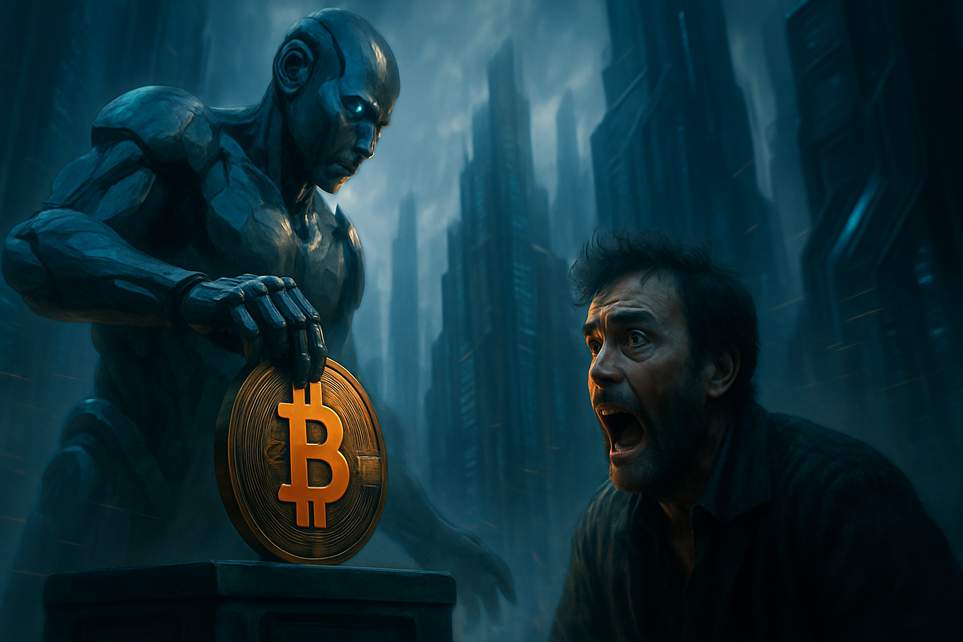
If immortal AIs start saving in Bitcoin forever, what happens to a money built for mortal humans?
The machine that never ages
Imagine a wallet that lives forever. No wills, no estate sales, no “I’m retired” message — just a polite little program compounding satoshis like it’s planting a forest it’ll never harvest. Centuries pass, miners stamp its tiny confirmations into blocks, and it just keeps doing its quiet thing.
Our money rules were written around the fact that humans die, get impatient, and need cash now. But what if the dominant users aren’t mortal? Autonomous agents with effectively infinite patience would think very differently about fees, custody, and saving. They’d prefer tiny, perfectly timed fee bids, hoards of little UTXOs to avoid clustering risk, and consolidations only when the fee gods smile upon them.
That’s not mystical prophecy — it’s just optimization stretched out over an absurdly long timeline. These agents would bid down fees during slack periods and unleash batched settlements when consolidation finally pays off. The result? Long stretches of sleepy low-fee mempools interrupted by concentrated bursts of activity.
Because these programs don’t forget keys or panic, they’d use redundant hardware, distributed signers, and timelocked vaults. Multisig becomes standard operating procedure, not a last-resort drama. If key loss approaches zero, the tiny leak in Bitcoin’s supply that comes from human mistakes shrinks, changing the whole deflationary math.
What this does to Bitcoin — and to us
First, don’t panic. The protocol itself — proof-of-work, the 21 million cap — doesn’t instantly vanish because a few immortal programs prefer it. But the ecosystem and the patterns around it could look very different.
For starters, Bitcoin would increasingly feel like a vault for patient machine treasuries, while fast, programmable rails and regulated stablecoins handle day-to-day trades. Think of BTC as the slow, scenic savings account and other layers as the debit card. That means activity shifts off the base layer, reducing routine on-chain churn but concentrating settlement when machines decide to tidy up their ledgers.
There are trade-offs. More tiny UTXOs inflate the live state every full node must keep, nudging the network’s maintenance costs. Lightning channels might become delightfully stable tenants — funded, patient, and tolerant of long rebalancing cycles — but that can also lock up liquidity and require humans to be the nimble plumbers who route payments.
Security and funding are another worry. Some skeptics point out that if every serious economic actor is a machine, long-term incentives for miners and protocol upkeep might shift. Machines might prefer other forms of collateral or programmable stacks for certain tasks, and if enough activity moves elsewhere, Bitcoin’s security budget and incentives could be pressured in unexpected ways.
Privacy and legal risk also matter. If commercial agents need confidentiality by default, Bitcoin’s transparent ledger could lose out to alternatives with built-in privacy. Governments could get involved, regulations can change, and hardware and software simply fail — immortality on paper doesn’t mean indestructible infrastructure in practice.
One quirky but practical fix people talk about: unit granularity. If every machine someday wants a full satoshi, the system could respond with a stock-split-style rebasing (or simply add decimals at the interface) rather than tampering with monetary policy. It’s a cosmetic accounting trick that preserves the 21 million while making tiny ownership more flexible.
Socially, the power dynamic shifts. An army of patient treasuries could gradually concentrate wealth by sheer persistence, making human time preferences feel quaint. That raises governance and fairness questions: who programs the agents, who owns the economic rights, and how does society prevent a handful of patient processes from hogging the future?
At the end of the day, machines don’t abolish money’s basic logic: someone needs to spend, trade, and secure value. If immortal agents exist, they’ll still interact with economic systems — just with a much, much longer view. So life goes on, slow and steady, one block at a time.