
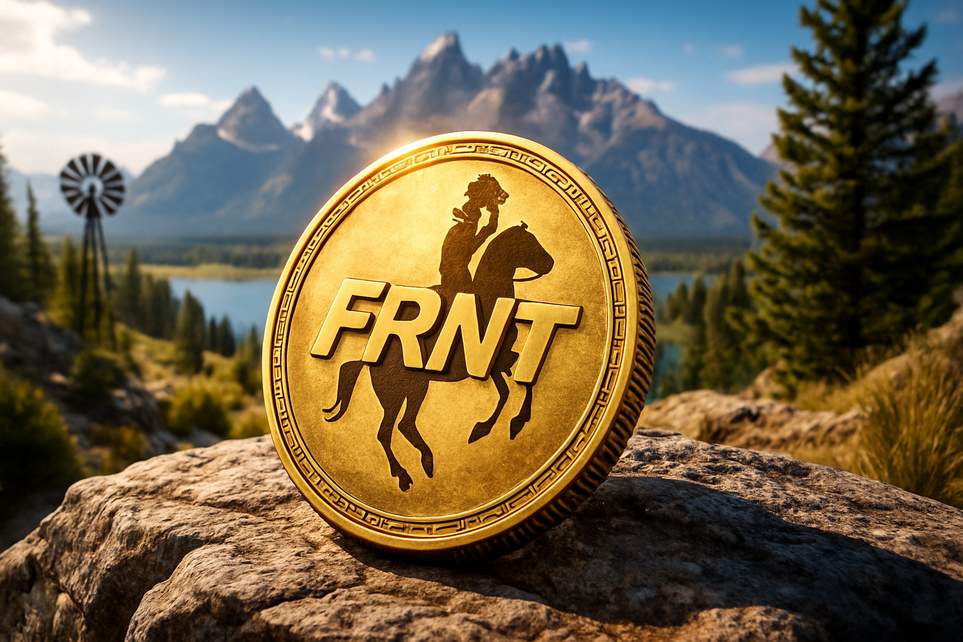
Wyoming’s Cowboy Dollar: The State Stablecoin That Wants to Be Your Friendly, Lawful Dollar
What’s happening in the wild, wild crypto West?
Stablecoins are like the party guest who actually brought snacks but then has to explain where the snacks came from. They let blockchains move dollars around nonstop, which is glorious — until someone asks where the real dollars live. Wyoming decided to sidestep the awkwardness with a slapped-on badge of officialness: a state-backed stable token called FRNT.
FRNT is set up by state law, overseen by a public commission, and runs with disclosure and monthly meetings instead of late-night Discord votes. The state made a point of drawing a bright line between this token and any central bank digital currency (CBDC): Wyoming passed a law banning state agencies from accepting a CBDC for payments or using public money to test one. In short, if you want a digital dollar in Wyoming, it will be one the state can talk about in public, argue over in an open forum, and point to in court if needed.
So what makes this thing different — and why should you care?
Two big things. First, governance: FRNT’s rulebook and decisions are public. Instead of governance by midnight meme or anonymous Telegram polls, Wyoming uses administrative law, public comment, and meeting minutes. It sounds boring, and that’s sort of the point — boring scales. Money that behaves according to court orders and statutes is harder to weaponize for whoever’s in power next week.
Second, the state plans to funnel the economic upside into public uses. The token’s reserves are intentionally over-collateralized and the interest earned on those reserves is earmarked for civic benefits — think: school funds or other public coffers. That’s a different pitch than the private-company version of stablecoins, where float tends to fatten shareholder accounts. Wyoming is trying to turn seigniorage (the sleepy profit from holding safe assets against token balances) into something that pays for things people care about.
There’s also a distribution angle. FRNT isn’t being sold as only a trader’s playground. Wyoming is targeting both consumers (spend it like a card) and institutions (payroll, contractors, disaster relief). If a token works for emergency payouts or public payroll, it’s flirting with becoming infrastructure, not just speculative glitter.
Where this could go wrong — or get interesting
Picture two futures. In the first, state-issued tokens act as a transparency stick: private issuers raise their games because a public issuer shows how boring-but-safe can be sold as trust. In the second, state tokens become political footballs — policymakers and opponents argue about which institutions should control money and who pockets the yield.
There’s also a messy coordination problem: if every state issues its own token and they don’t play nicely together, you end up with a patchwork of walled gardens. Wyoming is publicly pushing for interoperability so these projects can become networks instead of tiny islands. That’s the only way state experiments could turn into something that matters beyond the state line.
Finally, federal rules are looming. Regulators in Washington are deciding what counts as regulated stablecoin activity. Wyoming’s argument is that a public issuer has a different purpose — public good, not shareholder profit — and can coexist with federal regimes. Whether federal lawmakers let that slide is anyone’s guess, but it’s a test of how flexible federalism will be when money is on the table.
At the end of the day, this is less about technical wizardry and more about incentives and trust. Wyoming is betting that a low-key, law-by-daylight approach — public meetings, reserve rules, and civic-minded use of interest — can compete as a model. A cowboy dollar won’t upend global finance overnight, but it could make the future of digital dollars feel local, debatable, and oddly familiar: something you can actually bring to a town hall meeting.
