
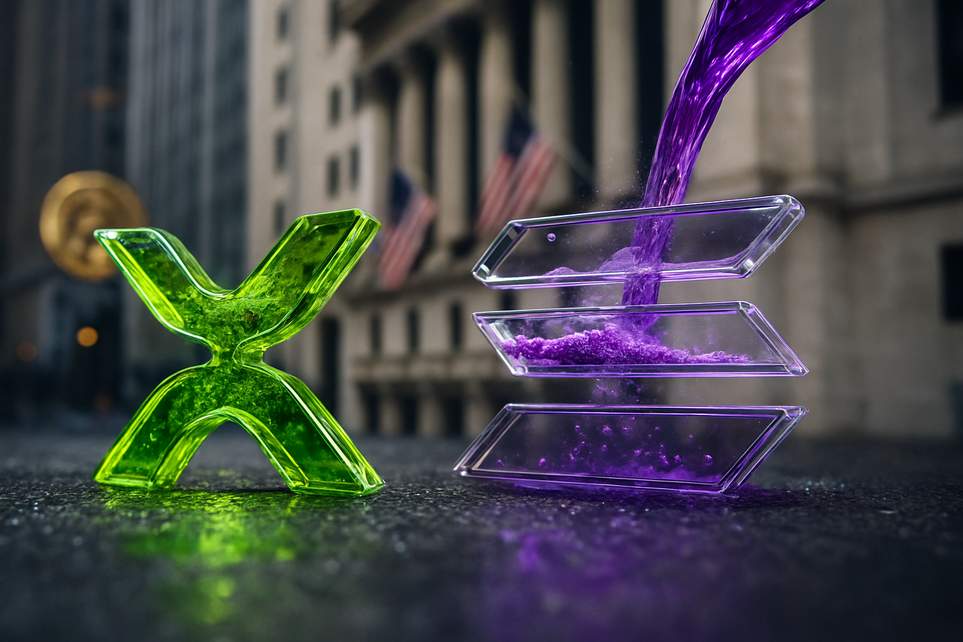
XRP and Solana dethrone Bitcoin and Ethereum as institutional favorites in 2025
2025 did a thing: big institutions decided to stop playing the same old tune of “just buy Bitcoin (maybe a sprinkle of Ethereum)” and started shoving fresh piles of cash into some surprising new favorites. Bitcoin stayed king in sheer size, but smart money re-drew the map — and XRP and Solana quietly elbowed their way into the VIP section.
The big money moved — numbers that make your spreadsheet gasp
Here’s the cold, delicious math. Bitcoin investment products still brought in a ton of cash — about $26.98 billion in inflows for the year — but that was about 35% less than the fireworks of 2024. So yes, BYOB (bring your own Bitcoin), but fewer people were showing up to the party.
Ethereum went from being the perennial understudy to a co-star. Institutional flows into Ethereum jumped to roughly $12.69 billion in 2025, up around 138% from the prior year, and its total assets under management ended the year around $25.7 billion. That’s the kind of growth that makes advisors stop saying “it’s too speculative” and start saying “we should probably have some.”
Now for the plot twist: XRP and Solana exploded. XRP pulled in about $3.69 billion in 2025 (versus roughly $608 million in 2024), roughly a fivefold increase. Solana’s climb was even steeper: roughly $3.56 billion in inflows compared to about $310 million the year before — roughly a tenfold jump. For both of them, the year’s new flows were roughly equal to their total ending AUM, which is financial-speak for “they basically replaced their entire book in one year.” That’s a ~100% replacement rate — wild growth and lightning-fast onboarding of new institutional holders.
The rest of the market didn’t enjoy the same spotlight. Excluding the big four (Bitcoin, Ethereum, XRP, Solana), multi-asset products, and short-Bitcoin hedges, the “other altcoins” bucket pulled in only about $318 million in 2025 — down roughly 30% from the prior year. So while a few chains ballooned, hundreds of smaller projects watched the party from the sidewalk.
One more notable stat: institutions are hedging more cleverly. Short-Bitcoin products saw inflows (about $105 million) and a modest total AUM (around $139 million), implying that more managers are performing relative-value trades — hedging the market leader while chasing upside in higher-beta satellites.
Why this matters — risks, rewards, and the future of crypto portfolios
Short version: we’re moving from a messy, many-headed speculative jungle to a curated, liquid-focused playground where a handful of networks dominate institutional attention. The regulated investment wrappers and liquidity requirements that come with ETFs and exchange-traded products create big gates. If a token doesn’t have clear regulatory standing or deep liquidity, managers are reluctant to build a product for it — and that leaves the long tail thirsty for capital.
This produces a winner-take-most dynamic. Solana and XRP attract flows because they have products and liquidity; they gain deeper liquidity because flows arrive; rinse and repeat. Meanwhile, projects without that infrastructure struggle to get noticed. That’s great if you own one of the lucky few, less great if you’re rooting for broad innovation across hundreds of smaller chains.
There are also new fragilities. Rapid institutional onboarding means a chunk of holders might be price-sensitive and prone to exiting quickly if narratives shift or regulatory pressure returns. The same standardized products that invited money in can make for a fast exit door. Plus, concentrating huge value on a few networks raises systemic risk for the whole space: when four chains carry most of the weight, any shock to one can ripple a lot farther.
Practically speaking for 2026 and beyond, financial advisors are leaning toward multi-sleeve allocations: Bitcoin as the anchor (the digital commodity), Ethereum as the smart-contract foundation, and assets like Solana and XRP as higher-beta satellites. That model acknowledges the new reality — size and liquidity win — but it also changes how new projects will need to play if they want institutional attention: deeper liquidity, clearer compliance, and convincing use cases.
So yes, the landscape looks tidier and more institutional, but also a bit more top-heavy. Expect safer-sounding allocations, cleverer hedges, and a whole lot more pressure on lesser-known chains to either bulk up or fade into the background. Buckle up — 2026 will be where we find out whether this concentrated wave lifts all boats or just the yachts.
