
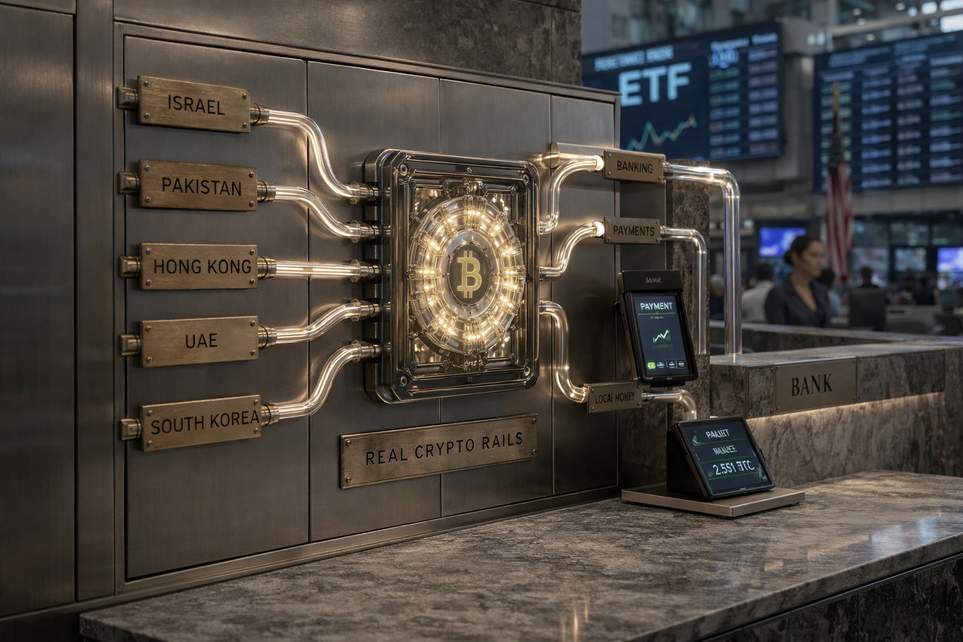
America’s crypto circus is loud — the real experiment might be happening in Israel and Pakistan
Quiet moves, big plumbing
While headlines scream about ETFs and Wall Street, two relatively sleepy policy tweaks halfway across the globe are quietly trying to turn crypto from a speculative toy into usable finance. Israel just signed off on a shekel‑pegged stablecoin after a pilot program, and Pakistan’s central bank relaxed a ban so regulated firms and licensed crypto platforms can open bank accounts under defined compliance rules. Translation: one is trying to put local money on‑chain; the other is trying to reconnect crypto firms to normal banking plumbing. Not flashy, but potentially huge.
Why does this matter? Because there are two different adoption games. One is the investment game — ETFs, tickers, and headline prices. The other is the utility game — payments, bank accounts, merchant checkouts, and everyday settlements. The first makes crypto easier to trade. The second makes crypto actually useful for boring things like paying rent, settling a trade, or moving money between banks without losing track.
Think of it this way: a Bitcoin ETF hands you a ticket that says “I own Bitcoin exposure.” A regulated, local‑currency stablecoin hands you a digital version of your national cash that could, if all goes well, live in your wallet and be used at a shop or between banks. And a central bank letting licensed crypto firms open ordinary accounts means those firms can stop living in the shadows and start operating in monitored, auditable channels.
Global patchwork: rails, rules, and the next test
This rails‑first story isn’t confined to Israel and Pakistan. Hong Kong has started issuing stablecoin licenses to named entities, moving from rulemaking to actual license grants. Japan’s regulators are nudging crypto toward the stricter side of financial law — think disclosure, market‑abuse rules, and stronger supervision — which makes market entry conditional on behaving like a financial firm. The UK has a long lead time but is building a new regime that will pull crypto into authorisation, prudential and consumer‑duty frameworks. Across Europe, broader rules already exist and serve as a baseline for how things should work.
Out in the Gulf, there’s also talk — and some institutional projects — to launch local‑currency token efforts for settlement and treasury workflows. South Korea is experimenting at the checkout level, with merchant integrations and bank partnerships designed to test whether consumers and shops will actually use digital‑asset payments. Taken together, these moves push the conversation from “Is crypto an asset?” to “Can crypto become part of everyday finance?”
There’s reason to be curious. Global adoption studies put several emerging markets near the top for crypto usage, and that’s not a coincidence: places with strong mobile habits, large remittance flows, or limited banking options have more to gain from on‑chain rails. But the IMF caution is real: once stablecoins start acting like another slice of the FX market, flows can affect exchange rates, create pressure on local currencies, and raise financial‑stability questions. Regulators know this, which is why rules, reserve practices, and monitoring matter.
Bottom line: the real experiment in 2026 isn’t just “who gets the digital dollar.” It’s which countries can stitch together token issuers, licensed platforms, banks, and merchants so that digital assets actually touch local money and supervised financial plumbing without blowing up the rest of the system.
What needs to happen next? The shekel token needs to be issued and used beyond a pilot. Pakistan needs licensed platforms that actually operate through bank accounts, not just paper permission. Hong Kong’s licensees must launch products. Japan, the UK and the EU need to prove their rules work when volumes spike. The Gulf needs clear issuer‑register mapping. South Korea needs transaction data, not press releases. If those pieces click, the global map will start to look less like a US‑led investment wave and more like a set of regional systems absorbing crypto under local rules.
So, until the next headline about ETFs grabs your attention, keep an eye on the quieter plumbing: local stablecoins, bank accounts for crypto firms, merchant integrations, and the rulebooks that make them safe(ish). That’s where crypto either becomes useful money or stays a headline generator for speculators. Either way, the plot is way more fun when the boring stuff — banks and rules — gets interesting.
