
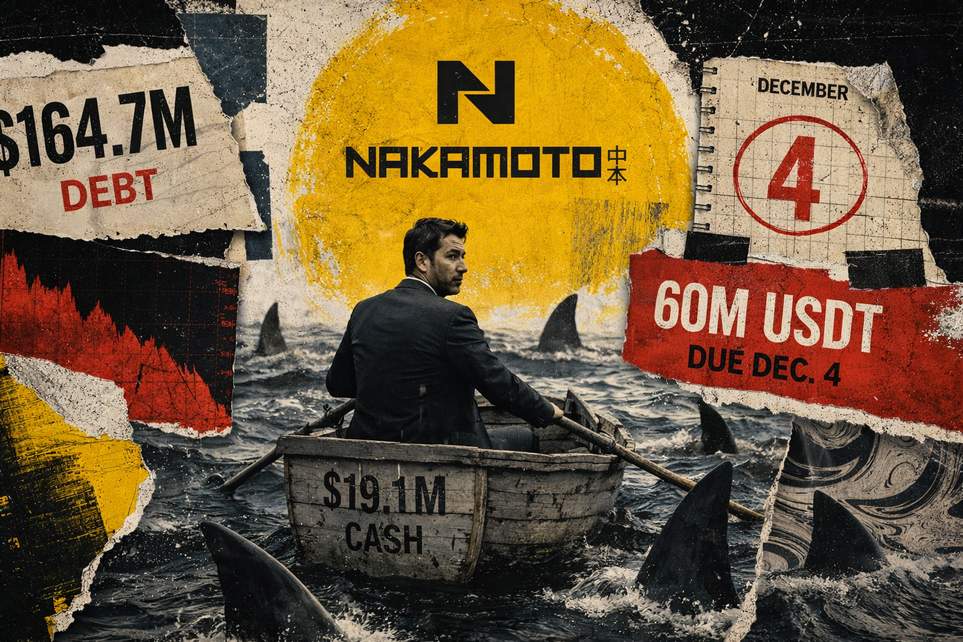
Nakamoto Sold 600 BTC but Still Has ~$60M Due in December
Nakamoto — the company behind Bitcoin Magazine — trimmed its Bitcoin stash this summer by selling roughly 600 BTC, but that tidy haircut didn’t quite solve the bigger problem: about 60 million USDT is coming due in early December, and the company’s immediately available cash and free Bitcoin are playing a tense game of financial limbo.
Quick rundown: the numbers you actually care about
Here’s the situation in plain(ish) English. As of June 30, Nakamoto reported about $19.1 million in cash on hand. The company held a total of 4,467 BTC, which was worth roughly $261.5 million at quarter-end. Sounds comfy — until you realize most of that stash is already promised to someone else.
About 3,805 BTC (roughly $222.7 million) are pledged as collateral on a crypto-backed credit facility, leaving only 662 unencumbered BTC — about $38.7 million — that the company could freely use. Combine that unencumbered Bitcoin with cash and you get roughly $57.8 million, which is just shy of the ~60 million USDT loan payment due on December 4.
To chip away at the debt, Nakamoto sold about 600 BTC in June for roughly 35.6 million USDT and also unwound certain derivative hedges. Together those moves produced about $48 million in net proceeds. The company applied some of that — around 45 million USDT — to pay down the facility, reducing the outstanding balance from 210 million USDT to 165 million USDT and pushing a 105 million USDT tranche out to mid-2027.
The credit terms matter: the annual fee on the facility is 7.75% so long as Nakamoto keeps at least 2,000 BTC in a specified account; if balances fall below that threshold, the fee ticks up to 8%. That 2,000 BTC threshold is a pricing breakpoint rather than an automatic margin call, but the lender’s actual maintenance and liquidation triggers weren’t disclosed.
Why this could get interesting before December
Short version: Nakamoto’s near-term survival depends on a few moving parts — a modest cash cushion, a small pool of unencumbered Bitcoin, and the fact that most of its BTC can be sold if needed to cover the loan. That’s a lot of pressure on Bitcoin’s price and on the timing of any sales or renegotiations.
Quarterly results showed a GAAP net loss of about $133 million, driven mainly by a $105.2 million non-cash goodwill hit and about $48.7 million in mark-to-market losses on digital assets. The company did report an adjusted operating income of $7.3 million, but that number leaned on roughly $10.4 million from derivatives — not exactly rock-solid runway.
If Bitcoin falls sharply, the pledged collateral could lose value and put the company in a bind: the lender could demand more collateral, force principal repayment, or — in the worst case — liquidate pledged coins if a contractual liquidation trigger is breached. If markets behave, Nakamoto can likely manage the December payment by selling pledged tokens at maturity or using available cash and free BTC. If markets don’t play nice, options include negotiating more time, selling more coins, or raising new capital — none of which are painless.
So, the headline is cute: they sold 600 BTC to reduce debt. The punchline is less cute: with most BTC tied up as collateral and only a narrow cash-and-free-BTC buffer, December’s payment looks like a close call that hinges on Bitcoin’s mood and some lender flexibility.
