
Visa’s Stablecoin Sneak-In: Quiet Moves in the Payment Back Office
Quick recap: Visa is expanding stablecoin settlement — quietly
Visa has been testing stablecoins as a settlement option behind the scenes, and the experiment just got a lot wider. The company’s pilot now touches nine blockchains — the original group (Avalanche, Ethereum, Solana, Stellar) plus five newbies: Arc, Base, Canton, Polygon and Tempo. The program is being touted at about a $7 billion annualized settlement run rate, roughly up 50% from the previous quarter. Translation: money is moving, but Visa isn’t handing out a detailed map of which chain handled how much.
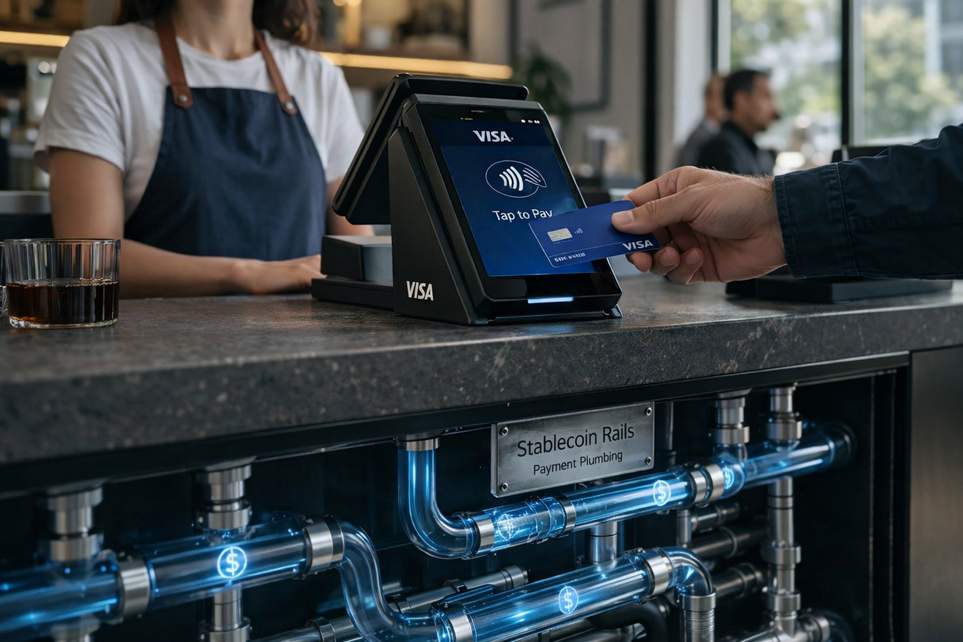
This isn’t about you paying with a crypto wallet at checkout (yet). It’s about the settlement plumbing — the invisible transfers that happen after a purchase is authorized, when money travels between issuers, acquirers, banks and treasury systems. Visa is testing whether stablecoins can be offered as optional rails inside existing payment infrastructure so partners don’t have to invent their own crypto back office from scratch.
Some earlier milestones are worth remembering: Visa moved meaningful USDC value between partners over networks like Solana and Ethereum in prior years, and in late 2025 some U.S. issuer and acquirer partners gained the ability to settle with Visa in USDC (initial activity ran over Solana). Visa also links stablecoin settlement to card programs — the company has pointed to a large roster of programs and planned expansions that tie these rails to real-world payment products.
Why this matters (even if you don’t want to read blockchain whitepapers)
Think of stablecoins as a new set of pipes in an existing plumbing system. Different pipes have different strengths: some are cheap, some are private, some connect directly to exchange liquidity. By supporting multiple blockchains, Visa is building a toolbox so banks, card issuers and acquirers can pick the option that fits their rules and risk appetite.
Quick tour of why those five recent additions matter: Arc is built around stablecoin-native design and Circle integration, offering predictable fee models and fast finality; Base brings Coinbase-linked tooling and low-cost USDC flows; Canton is oriented toward privacy-preserving, need-to-know settlement for regulated players; Polygon and Tempo emphasize low-cost global payments, stablecoin-native gas and features that help reconciliation. Put another way: Visa isn’t betting on a single blockchain, it’s offering a buffet.
That buffet matters because the adoption question has shifted. It’s less about convincing consumers to swap cards for wallets and more about convincing payment firms and treasuries that stablecoins are a reliable way to move value after the customer has already paid. The $7 billion run rate shows the pilot isn’t just a demo — it’s being used — even if the company hasn’t disclosed chain-by-chain splits.
What’s next: niche experiment or silent new normal?
The pilot label matters. Visa is adding optional settlement rails rather than ripping out the old ones, so nothing about your checkout experience is likely to explode overnight. The next big test is whether these rails remain specialist tools for a handful of partners, or whether they turn into routine back-office plumbing across the industry.
Regulation and partner economics will steer the play. Clarity from policymakers makes it easier for banks and issuers to experiment; demand from card programs and treasury teams will decide whether the rails get heavy use. For now, expect more quiet activity in the back office: your receipt will still look the same, but the money moving around after that might increasingly ride on stablecoins.
So don’t panic, don’t ditch your credit card, but do peek at your bank’s developer docs next time you’re bored — the payments world is getting quietly weird and interesting, and it’s happening out of sight.
