
When Markets Never Sleep: CPI, Oil and the 24/7 Trading Circus
Markets that never sleep
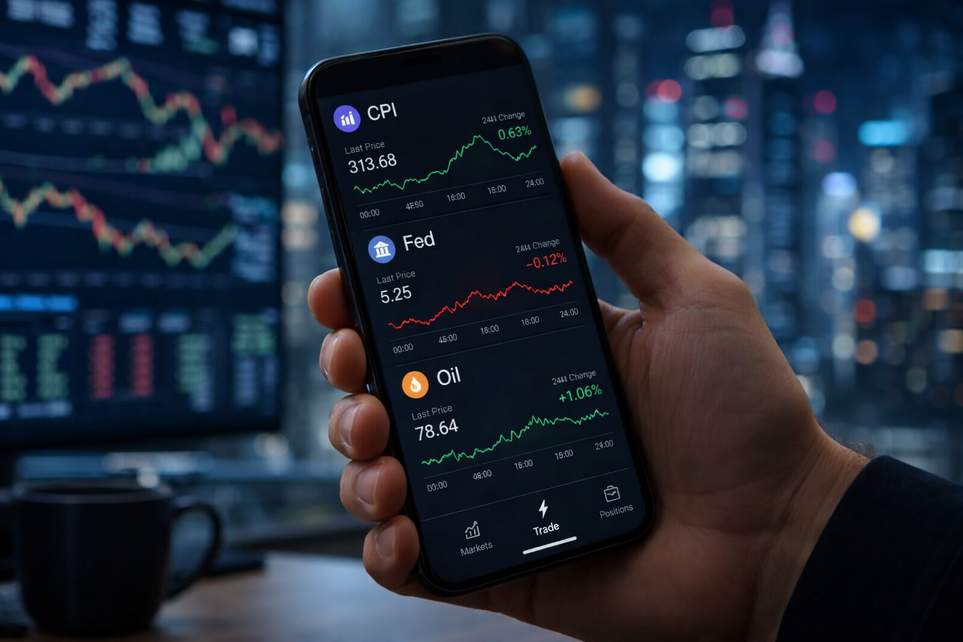
Imagine a world where you can bet on inflation, oil prices, or whether your favorite private tech unicorn finally goes public — at 3 a.m. on a Tuesday. That world is arriving fast. Crypto exchanges have started turning macro events and private-company milestones into tradeable contracts that never expire, letting retail traders stake stablecoins on outcomes that used to live only on institutional terminals.
Two flavors dominate the new menu. First, prediction markets turn yes-or-no questions into prices: if a contract trades at $0.43, the market is effectively saying there’s about a 43% chance that the event happens. Second, perpetual futures let people hold synthetic exposure indefinitely, with periodic funding payments keeping the contract aligned with whatever benchmark it’s tracking. Mix those together and you get continuous, leveraged ways to express views on things like CPI prints, central-bank moves, and oil benchmarks.
We’ve seen platforms launch inflation markets pegged to the official consumer-price release, exchanges roll out never-expiring oil perps tied to major benchmarks, and prediction sites offer contracts on whether private giants will hit trillion-dollar valuations. Some of these instruments have attracted huge flows in short order, turning the macro calendar into a 24/7 playground for retail traders — and creating a new sort of liquidity that traditional exchanges don’t provide on weekends and holidays.
Why regulators are twitching (and other messy bits)
Unsurprisingly, this has regulators and policy folks squinting at their rulebooks. Are these products derivatives governed by federal rules, or are they consumer-facing gambling services that should be policed by states and national gambling authorities? Different places are answering that differently, and those answers matter: one regulator’s hedging tool is another regulator’s unlicensed bet.
That legal tug-of-war has real consequences. Some jurisdictions have moved to ban or investigate prediction-style markets, citing missing licences, weak identity checks, and concerns about underage players. Other authorities view aggressive state bans as stepping on federally regulated territory. The result: court fights and policy gymnastics in multiple countries at once.
Market integrity is another headache. Official data releases like inflation reports are straightforward to settle against, but private-company valuations, geopolitical events, and corporate milestones are fuzzier. Who gets the data first? How do you adjudicate conflicting sources? There have even been puzzling clusters of bets that look statistically unlikely without inside information, raising alarms about whether sensitive stuff could be priced before it’s public.
Weekend trading makes things wilder. When traditional commodity markets are closed, crypto platforms keep running. During geopolitical flare-ups traders have pushed massive volumes into synthetic oil and gold contracts over weekends, effectively setting the market’s first post-crisis reference price before legacy exchanges reopen. For some traders that’s a feature (faster price discovery); for others it’s a bug (front-running, gaps, and regulatory headaches).
So what’s the endgame? These products could improve forecasting, offer new hedges for people who were previously excluded, and democratize access to macro instruments. Or they could scale into instruments that confuse retail customers, leak sensitive information into prices, and trigger a patchwork of regulatory crackdowns. For now, the tech is sprinting ahead of the rulebook — and everyone else is trying to keep up without tripping over the tape.
Either way, it’s entertaining to watch: markets that used to sleep are now caffeinated and tweeting at 4 a.m. Buckle up, and maybe don’t check your portfolio at midnight unless you’re ready for a surprise.
