
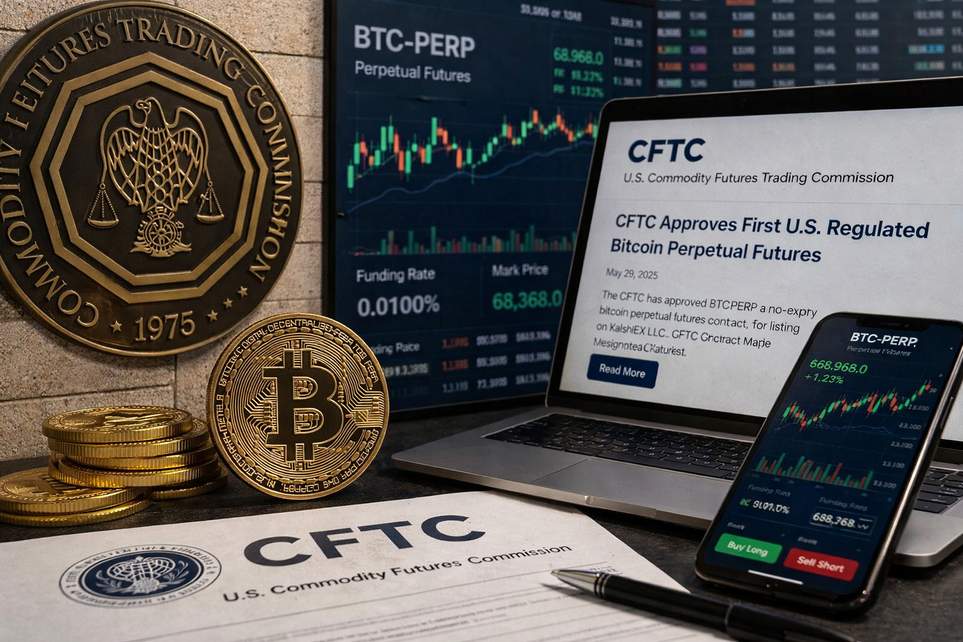
Bitcoin perps just got a US green light, but one catch could decide everything
Big news: U.S. regulators just handed the green light to a true no-expiry Bitcoin perpetual on a U.S. exchange, while also giving a separate, staff-level route for a major crypto exchange to funnel clients into offshore derivatives. Translation: there are now two very different ways for U.S. traders to access perpetual futures — one that’s stamped by the Commission and another that’s a conditional, technical workaround. Which wins out depends on a single nagging question: will the liquidity follow?
Two roads into U.S. perpetuals
First route: a U.S. designated contract market got formal Commission approval to list a Bitcoin perpetual that never expires. This product is cash-settled, tracks the dollar spot price of one BTC via an established benchmark, trades in tiny BTC increments, and can run 24/7 (subject to exchange halts). Because it has no expiry, the contract uses periodic funding payments between longs and shorts to nudge the perpetual price back toward the spot price — if the contract drifts above spot, longs pay shorts, and vice versa.
Second route: CFTC staff issued a narrow, no-action-style letter allowing a registered futures commission merchant to give U.S. customers supervised access to certain offshore derivatives. That path is operationally layered: the customer order moves through a U.S. affiliate, touches an affiliated foreign broker, and lands on an offshore trading venue. Staff said it won’t recommend enforcement under specific conditions around margin, disclosures, affiliate controls, and how customer digital assets and stablecoins are used as collateral — but that relief is limited to the facts and controls presented and can be changed.
Why it matters — and the giant “if”
Perpetuals are crypto’s superstar instruments because they let traders hold bets indefinitely without rolling expirations. The regulatory question wasn’t only about labeling; it was whether that structure can live inside U.S. futures rules while keeping leverage, liquidations, and collateral risks in check.
Here’s the rub: approval on paper doesn’t equal instant liquidity. Offshore venues have long been where the bulk of perpetual volume lives, so the real test is whether U.S. products or supervised access routes can match the offshore combination of deep order books, cheap funding, and broker reach. If the U.S. product launches with competitive funding rates, broad broker distribution, and efficient margining, some flow may move onshore. If it’s slower, pricier, or narrower, the win is mostly legal precedent rather than a flood of trading.
Practically speaking, watch a few things: the exchange’s launch terms and funding schedule, whether the staff-cleared route scales from institutions to wider customers, whether retail traders get a path in, and whether regulators widen the comfort zone beyond Bitcoin to other digital assets with truly continuous spot markets. Those signals will decide whether this is a regulatory revolution or a polite trial run.
Bottom line: we now have two working models — a Commission-approved domestic perpetual and a staff-permitted foreign-access channel. Both could bring some perpetual action under U.S. supervision, but only the markets (and the math of funding and margin) will tell which one actually wins traders’ hearts and orders.
