
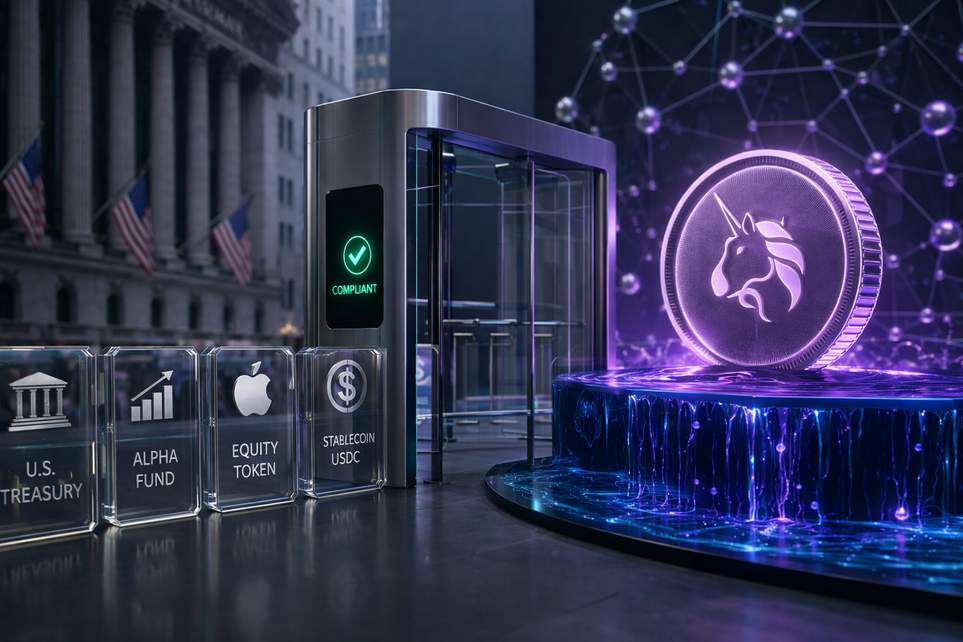
Can Uniswap Reach $100? Standard Chartered’s Bold Bet — And Why It Depends on Open DeFi Liquidity
The bet, translated into plain English
Here’s the headline: a big bank has tossed out a $100 price target for Uniswap’s governance token by the end of the decade. That’s eyebrow-raising because UNI currently lives in the low single digits and has a market cap far below what a $100 price would imply. So what’s the math and fantasy behind this cheerily optimistic number?
Put simply, the thesis goes like this — tokenized versions of real-world assets (think tokenized funds, bonds, equities, and stablecoins) could balloon into a multi-trillion-dollar market. If a decent slice of that activity happens on open DeFi venues rather than inside closed, bank-run platforms, protocols that provide 24/7 trading, automated liquidity and composability could rake in meaningful fees. If that fee flow scales, the token that sits at the protocol’s heart could see much higher value.
That chain has three big assumptions: tokenization actually grows enormously; those tokenized assets move beyond merely being on-chain receipts into tradable inventory; and Uniswap (or a similar protocol) captures enough of the trading to turn fees into tangible token value. Remove any link in that chain and the $100 fantasy gets shakier.
Why this is a practical problem — not just a Twitter hill
There’s a real-world tug-of-war happening: institutions want the benefits of blockchains — programmable settlement, instant transfers, 24/7 rails — but they also crave control: KYC, transfer limits, approved counterparties, and closed distribution channels. The result is a spectrum, not a binary choice.
On one end you have fully permissioned tokenized products that live on-chain but behave like private club assets — limited transferability, pre-approved investors, and gated secondary markets. On the other end you have fully open liquidity where tokenized assets can freely trade against stablecoins, collateral and countless other instruments across DeFi. Which side wins (or how hybrid the middle ground becomes) determines whether open AMMs become core market plumbing or just a fringe execution venue.
We’re already seeing middle-ground experiments. Large asset managers have launched tokenized funds that can technically trade on DeFi rails but only through whitelisted channels and request-for-quote systems. That’s DeFi tech with institutional guardrails — a bridge, not a full highway.
If most tokenization stays trapped in those gated lanes, the work Uniswap does will be useful but limited: nice infrastructure for specific trades, not the plumbing for a $2 trillion-plus DeFi economy. If tokenized assets open up and flow into broader liquidity pools, automated market makers could become essential intersections where different tokenized values meet and swap.
There are also governance and token-economics hurdles. Even if volume shows up, a protocol needs the right fee model, governance decisions and integrations to actually funnel value to token holders. That’s a sticky mix of politics, engineering and business deals — and it’s not guaranteed.
Regulators and standard-setters add another layer of friction. Concerns about interoperability, settlement assets, platform fragmentation and limited-access structures can keep tokenized products in walled gardens. Those frictions are precisely what determine whether tokenized assets remain digital receipts or become genuinely liquid financial building blocks.
So yes, a Wall Street bank can imagine a world where Uniswap-style venues capture a huge share of tokenized trading. But getting from imagination to reality requires tokenization to scale, markets to actually open up, and protocol mechanics to be aligned with institutional needs — or the market will look very different.
Bottom line: the $100 call is a useful thought experiment that highlights the core question for institutional tokenization — will open liquidity win, or will closed rails and gated markets dominate? Until we see a string of large, open integrations (not just gated RFQs and whitelists), the answer — and the price target — will remain a bet on the eventual openness of DeFi.
