
8x Faster Than US Cash: The $1T Network Settling Millions While Banks Sleep
Supply vs throughput: two ways to count the same dollar
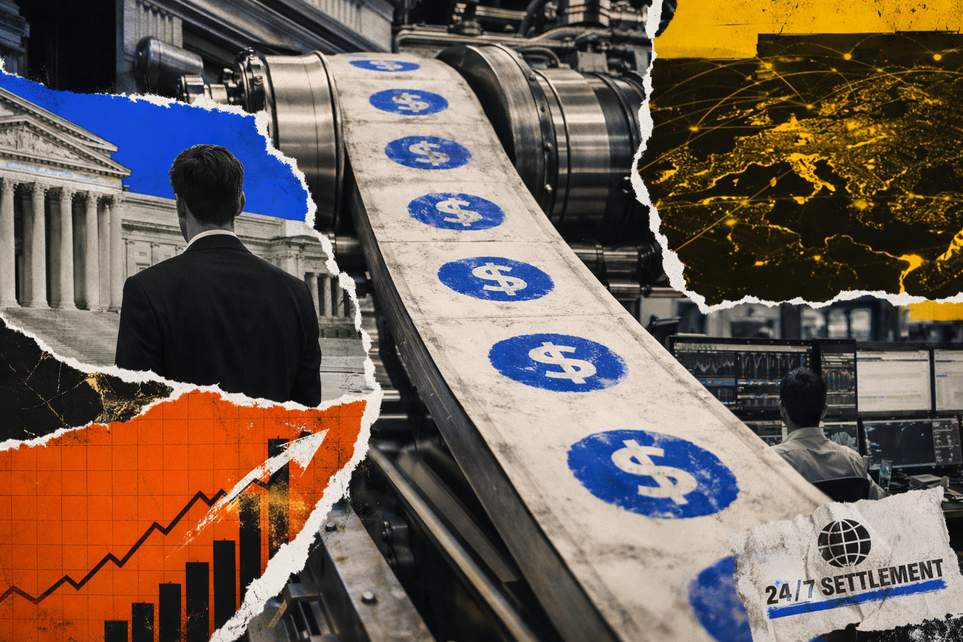
Stablecoins used to be judged by one obvious number: market cap — how many digital dollars are sitting around waiting to be used. But numbers have a way of lying by omission. Since January 2024, the stablecoin pile has roughly doubled, while the amount of activity those dollars support (when you adjust for real economic transfers) has exploded four to five times over, according to Coinbase Institutional. In plain speak: there aren’t just more digital dollars, they’re being passed around a lot faster.
Think of market cap as tank capacity and transaction throughput as traffic on the highway. A system with a giant tank that barely spills is different from a smaller tank that’s emptied and refilled nonstop. Lately, stablecoins are behaving like high-usage toll roads — the same pool of money is settling a growing stack of transactions.
That jump in activity shows up in monthly adjusted volume, which moved from a few hundred billion in 2023 to well above a trillion in recent months. The key is that these figures use entity-adjusted data: addresses under common control and robot-driven shuffles get filtered out so the measure better reflects actual economic transfers, not blockchain busywork.
What velocity, weekends, and the US dollar race mean for money-movers
Velocity is the magic metric here — how many times a dollar changes hands over a period. Visa’s research put total stablecoin velocity at about 13.56 in Q4 2025, meaning the average token turned over more than 13 times that quarter. For context, US M1 velocity was roughly 1.65 over the same period, and the big Fedwire wholesale system showed velocity near 93.84. So stablecoins are far busier than everyday cash but still not as frantic as dedicated wholesale rails.
Digging deeper: retail-style transfers (tiny purchases under $250) barely register — a retail proxy returned a velocity of around 0.08 and made up less than 1% of total stablecoin activity. Translation: most stablecoin traffic today is institutional — trading, treasury moves, arbitrage, settlement and cash management — not your latte run.
Weekends tell the tale. Roughly one-fifth of adjusted weekly stablecoin volume happens on Saturdays and Sundays, consistently. That’s huge. Banks snooze, legacy wholesale systems treat weekends like holidays, and ACH has specific processing windows. Stablecoins? They stay up and moving. For global businesses and market-makers working across time zones, that continuous access to settlement is like coffee for a night-shift trader: indispensable.
This shift is reshaping who’s winning. The biggest floating supply and the busiest settlement network aren’t necessarily the same token. One major stablecoin still holds the largest reserve by supply, while another has captured a growing share of adjusted transaction activity — think dollars held versus dollars moved. Institutions, payments platforms, custodians and networks that can offer custody, compliance, bank links and reliable rails will grab the commercial opportunities that come with high throughput.
Big companies are already experimenting. Platforms are piloting faster payouts and round-the-clock settlements so merchants, gig workers, and global treasuries can move money without waiting for Monday. Meanwhile, card and payment giants are building services to plug stablecoins into existing products, and some have rolled out platforms to manage minting, wallets and redemptions for enterprise clients.
Why should you care? Because two types of growth are at play: adding more supply (bigger tank) and making the supply move faster (more traffic). Issuers earn interest on reserve assets and grow influence by scaling supply, but service providers capture recurring value every time tokens move. The winners will be those who combine both: deep reserves plus sticky, high-quality settlement flows.
Bottom line: stablecoins are evolving from static digital balances into active payment networks. Supply still tells you how much capacity exists; throughput tells you how much work the system actually does. As the ecosystem matures, expect more institutional plumbing, faster settlement windows (yes, even on weekends), and competition focused less on who prints the most tokens and more on who moves the most value — reliably and compliantly.
