
This $163M crypto stash shrank to $15M — ZeroStack is now staking for survival
ZeroStack went from swagger to survival mode: a massive token hoard that once sat on a six-figure cost basis now looks way less impressive at market value, and management is basically betting the company’s short-term existence on staking rewards. The company’s quarterly filing paints a picture of tight cash, big accounting hits, and a strategy that depends on token yields — with a loud and unavoidable caveat that those yields might disappear.
The messy numbers
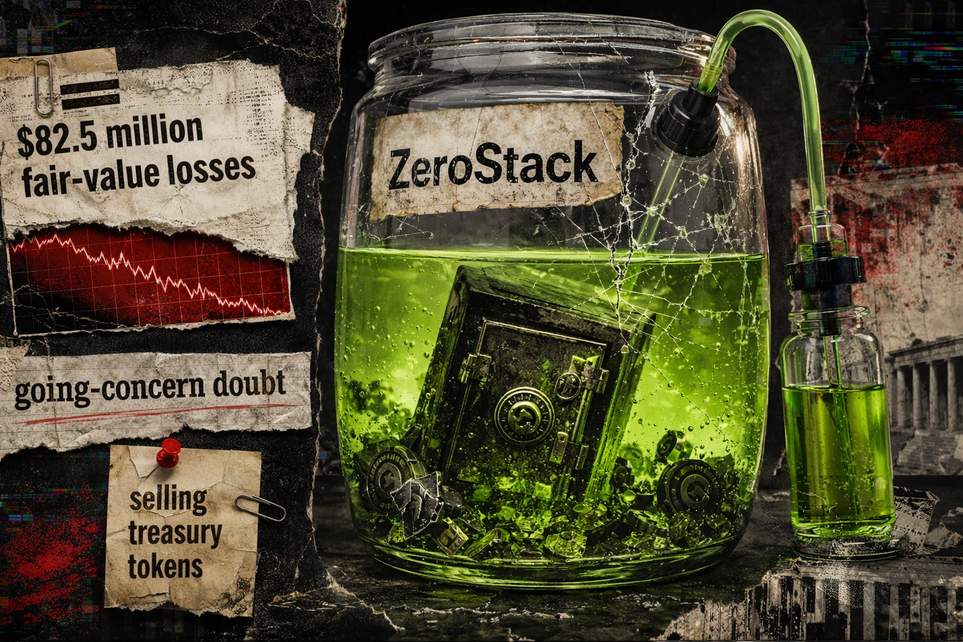
Here’s the cold math, reworded so your brain doesn’t melt: as of June 30 the company had just $2.6 million in cash, negative working capital of about $600,000, and an accumulated deficit north of $339 million. For the first half of 2026 ZeroStack reported a net loss of roughly $61.3 million and booked an $82.5 million hit from revaluing its digital assets — an accounting markdown, not cash that literally vanished into a void.
Most of the stash is a single token, 0G. On the books ZeroStack showed 75.1 million 0G tokens with a historical cost of about $163.33 million but a fair value of just $15.17 million at quarter-end. Including a tiny Bitcoin holding, the total digital-assets cost was roughly $163.43 million versus a fair value of $15.21 million. Those figures were a June 30 snapshot and don’t include a much larger token purchase that closed in July.
Staking generated some income: the company recognized about $3.78 million in digital-asset revenue from 6.62 million 0G tokens earned as staking rewards in the first half, after small validator fees. ZeroStack sold about 4.94 million of those reward tokens for approximately $2.4 million in proceeds, while using roughly $2.47 million of cash to run the business during the same period.
The plan — and the fine-print panic
Management’s game plan now appears simple and fragile: fund operations by selling staking rewards, and potentially dip into token holdings if necessary. They emphasize that staked tokens remain in company wallets and can be withdrawn, but they also warn that “can be withdrawn” is not the same as “instant cash.” Rewards can ebb or vanish entirely, and any actual cash depends on token prices and market appetite — both things you can’t call reliable.
The company’s filing explicitly flagged substantial doubt about its ability to keep going as a going concern. That’s not the same as saying they’re insolvent today, but it’s the accounting equivalent of flashing yellow lights and a loud horn.
There’s also corporate housekeeping drama: after a July acquisition involving an entity called Texas Blocker, ZeroStack reported owning about 223.77 million 0G tokens in total, which was worth roughly $40.5 million at the July 27 market price. The numbers don’t line up perfectly — about 5.76 million tokens are unaccounted for in the handoff, and public disclosures suggest some of that gap could be explained by staking happening before the takeover closed. The deal had related-party connections: the Texas Blocker vehicle was formed by ZeroStack’s CEO and CFO, another entity related to the company owned a majority stake in it, and ZeroStack’s executive chairman had been the CEO of that related firm when the transaction closed — so, eyebrow-raising ties to say the least.
For market context, 0G traded near $0.15 on Aug. 1 with daily volume in the single-digit millions, so even modest selling could have price impact and liquidity risk.
Bottom line: ZeroStack’s balance sheet looks like a vintage video game losing extra lives. The immediate survival plan is to squeeze value out of staking rewards and, if needed, sell tokens — a strategy that works okay when yields and prices cooperate, and falls apart fast when they don’t. Take that as a reminder that token-heavy treasuries can be wildly sensitive to market moves and accounting revaluations.
