
Saylor Says ChatGPT Helped Raise $15 Billion for Bitcoin (Yes, Really)
The AI-powered fundraising hack
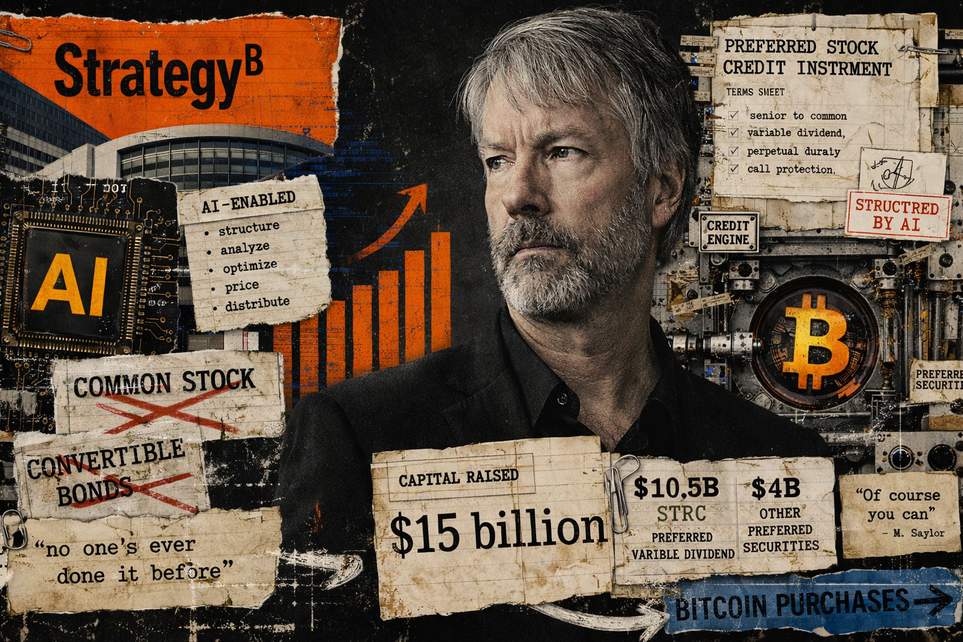
Michael Saylor says he used generative AI to help invent a brand-new financing trick that raised roughly $15 billion for the company’s Bitcoin buying binge. He revealed the experiment on a podcast, explaining that traditional routes—dumping common stock and issuing convertibles—were starting to hit capacity, so he asked an AI for alternatives. The AI-led brainstorming ended up inspiring a novel preferred-stock design that let the company pull in huge sums of capital.
The idea was to build a preferred share that behaves a bit like short-term credit and a bit like equity, with a twist: the dividend rate can change when market conditions do, which helps the security stay close to its $100 stated value. The company first tried one convertible-preferred concept and then pivoted to the variable-rate preferred that ultimately did the heavy lifting.
Numbers, because people like numbers: the variable-rate preferred raised about $2.5 billion in its initial offering and another ~8 billion in follow-ups, totaling roughly $10.5 billion. Add around $4 billion from other related preferred issues, and you get the roughly $15 billion Saylor kept talking about. He emphasized he meant securities sold to raise capital, not taking that sum as personal income or corporate profit.
Why it’s audacious, a little wild, and worth watching
First, it’s weird in a charmingly modern way: instead of using AI to trade or predict crypto prices, the company used it as a product designer—asking the model how to structure a previously uncommon security within existing rules. Some seasoned advisers were openly skeptical, saying “no one’s done it before,” but the AI-backed process helped the team work through legal and structural questions until they reached something practical.
This gave the company a fresh financing lane alongside its common-equity and convertible-debt markets, meaning another tool to raise cash for buying Bitcoin. It’s a creative example of how AI can act as a brainstorming partner for complex, rule-bound problems—accelerating ideation even when humans want to play it safe.
There are obvious follow-ups: how will regulators view AI-designed financial instruments? Who takes responsibility if a novel security misfires? And does outsourcing idea generation to a chatbot change the role of traditional bankers and lawyers? For now the results look impressive on the balance sheet side, but the governance and legal angles are only getting started.
Also, to put the scale in context: the company already holds a very large stash of Bitcoin, so this wasn’t small potatoes—it was capital raised to feed a pretty aggressive crypto strategy. Whether you find that bold, alarming, brilliant, or all of the above depends on how comfy you are with mixing AI, finance, and high-stakes crypto bets.
Either way, the story is a neat little preview of the kinds of creative, slightly chaotic things that happen when corporate ambition meets powerful AI—plus a reminder that sometimes the future arrives wrapped in a bizarre financial instrument and a snappy podcast quote.
