
Investors Plunk $82M into Canary’s XRP ETF — Market Losses Ate Twice That
The short version (it’s a bummer)
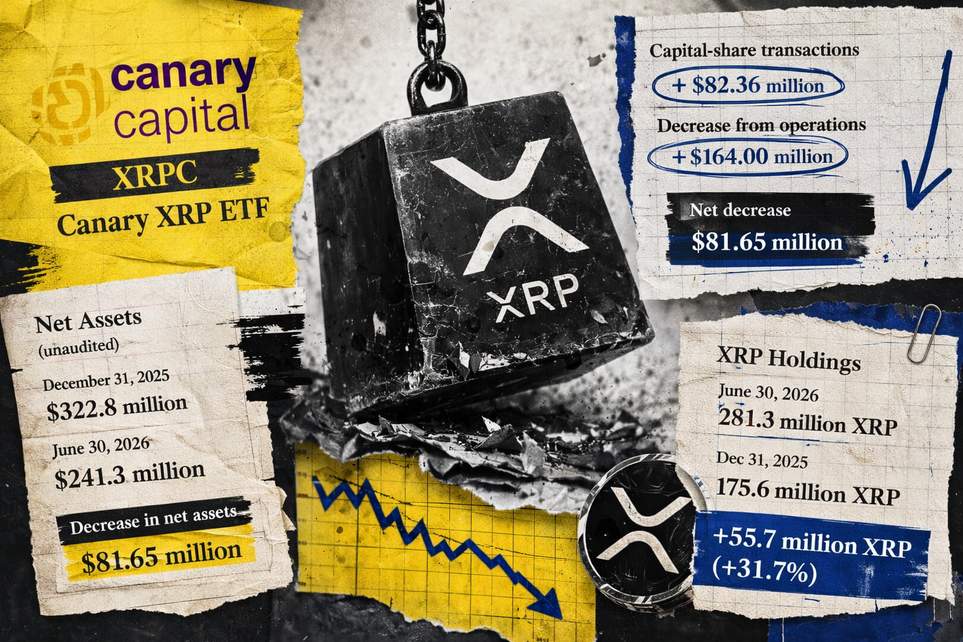
Canary Capital’s XRP ETF (XRPC) saw investors add about $82.4 million through share activity in the first half of 2026 — but falling XRP prices wiped out roughly $164 million in value, leaving the fund with about $81.6 million less in net assets at midyear. In plain English: the fund ended up with more tokens but a noticeably smaller dollar sign next to its name.
The oddball accounting story
At the end of 2025 XRPC reported $322.8 million in net assets; by June 30, 2026 that figure was $241.2 million. New share creations and redemptions produced a net increase of roughly $82.36 million (about $88.26 million from shares sold minus $5.90 million redeemed), but operating results — mainly unrealized markdowns on XRP — dragged the fund down by about $164.00 million. The net result was an $81.65 million drop over the six months.
Most of that operational hit was unrealized depreciation on XRP holdings (around $159.7 million). The rest came from about $3.59 million of realized losses and roughly $716,898 in net investment loss. These figures are unaudited and cover the full six-month period, not just the second quarter.
Another wrinkle: authorized participants can create or redeem shares in cash or in kind, so the $82.36 million of net capital-share activity doesn’t equal pure cash flowing in from retail buyers. The filing didn’t break down how much of the activity was cash versus in-kind, so you can’t treat that number as a simple popularity meter.
Holdings, redemptions, and what it all means
On June 30 the trust held about 231.3 million XRP, up from 175.6 million at the end of 2025 — an increase of roughly 55.7 million XRP (about 31.7%). So the fund increased its token count even while the dollar value of the position shrank thanks to price moves.
The fund did sell about 3.93 million XRP to meet redemptions and recorded a roughly $3.26 million realized loss on those sales. That realized loss is the fund’s bookkeeping; it doesn’t automatically translate into the exact gains or losses individual shareholders experienced when they bought or sold fund shares.
Bottom line: XRPC experienced two simultaneous forces — positive net share activity and a bigger negative from market depreciation. The capital-share activity wasn’t enough to offset the price-driven decline, so you end up with more XRP in the vault but less total asset value on the books. Financial accounting: ruthless and picky.
Takeaway for the rest of us: deposits and token accumulation can look rosy on one axis, but market moves — especially large unrealized markdowns — can still leave a fund smaller in dollar terms. Cute irony, cruel math.
