
Bakkt promised a $44 trillion payment revolution, but its key acquisition made just €5,315
The headline numbers (and yes, they’re delightfully tiny)
Bakkt picked up a fintech software group called DTR with big ambitions attached — and then the audited accounts for DTR’s first consolidated year showed something that’ll make headline writers giggle: just €5,315 of “other income” and a loss of €8,435,181 for 2025. That €5,315 is not revenue, it’s the sort of pocket-change line item you’d find behind the couch cushions.
At year-end DTR had €373,857 in cash on hand. Current liabilities of €1,136,732 outstripped current assets of €838,790, leaving a shortfall of €297,942. The company burned €7,784,190 of cash in operating activities during the year and raised €11,718,611 by issuing share capital to keep things afloat.
The accounts also recorded a €3,205,828 impairment — basically a write-off tied to a related-party balance — and showed a movement of €3,614,868 in an amount due from a related party during the year (the year-end receivable was €409,040). These quirks all point to a company still finding its feet, and finding its cash a little less often than hoped.
The deal, the drama, and the “how did that happen?” details
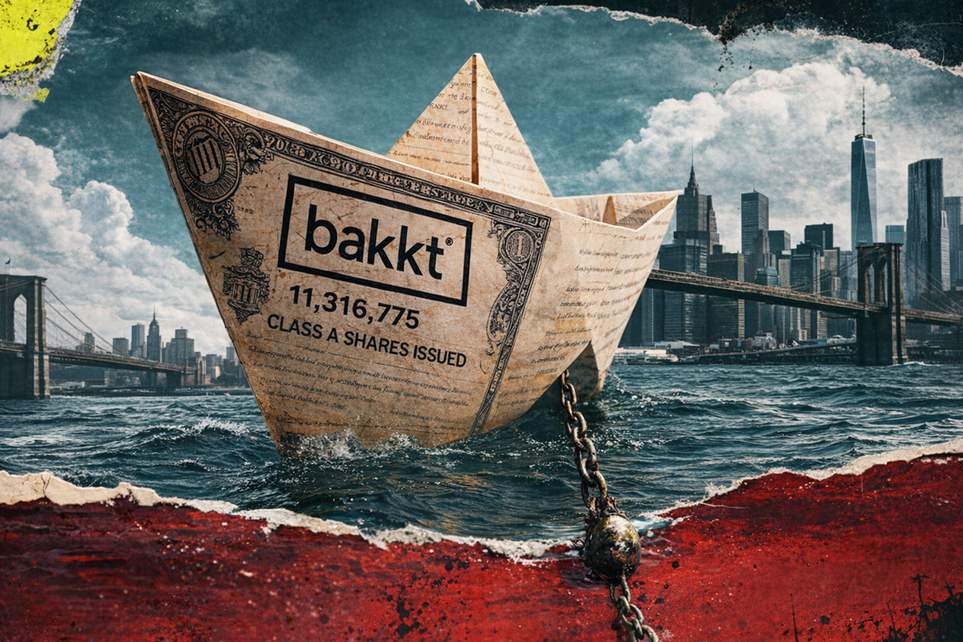
Bakkt paid for DTR mostly in shares. At closing it issued 11,316,775 Class A shares, after a small reduction for shareholder loans and transaction costs. That consideration amounted to about 23.642% of the post-close share count of 47,866,956. (There’s a slightly different percentage floating around in the paperwork — 31.5% — but that applied to a pre-close, as-converted share base, so apples and oranges.)
The purchase agreement allows for up to 725,592 additional consideration shares, but those only kick in alongside shares issued from certain warrants — so any math that adds the maximum would also need to add the matching warrant shares to the denominator. In short: the final ownership pie slice depends on a few moving pieces.
This was a related-party deal. Akshay Naheta was wearing a few hats: CEO, president and director of Bakkt, while also serving as DTR’s CEO and principal owner. He received 8,322,949 Bakkt shares as part of the consideration. An independent special committee handled the negotiations, Naheta recused himself from that committee’s decision-making, and shareholders approved the issuance before closing.
Bakkt pitched the acquisition as a route into what it called a global cross-border payments opportunity worth more than $44 trillion — a big, shiny total addressable market number. Important note: that gargantuan market figure is not DTR’s revenue, transaction volume, purchase price, or a forecast of what Bakkt will actually capture. It’s the universe of potential, not the immediate scorecard.
On the commercial side, the acquisition already faces some real-world tests. Internal materials noted DTR had lagged behind its own forecasts: several planned customer integrations were delayed and some expected large merchant signings never showed up. Put bluntly, the tech Bakkt bought looks interesting on a product sheet but hadn’t yet proven it at scale when the books were closed.
The bottom line? Eye-catching market-sizes and share-count gymnastics make for exciting press releases, but the audited numbers and the early commercial signals suggest there’s a fair amount of work ahead. Popcorn optional, due diligence recommended.
