
SkyAI’s Solana Fire Sale: $12.5M Dump at a 54% Loss and a Shrinking Balance Sheet
What went down
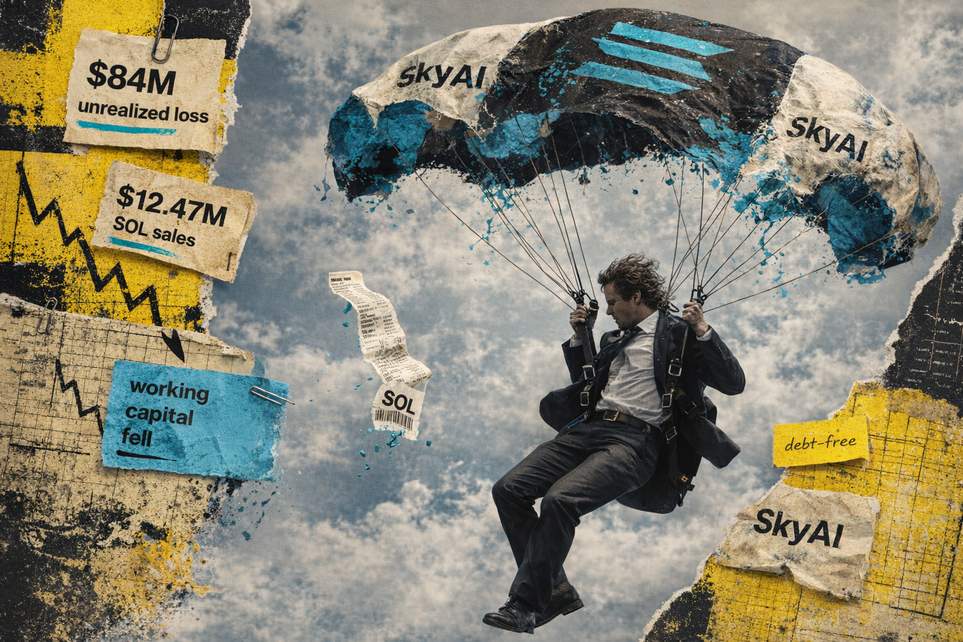
SkyAI (SKYA) quietly sold 135,399 SOL in the first half of 2026, pocketing about $12.47 million. Ouch — those tokens were sold at an average of $92.09 each against an average cost basis near $200.79, which produced roughly $14.72 million in realized losses on the trades.
On top of that, the company recorded an $84.34 million unrealized digital-asset loss for the six months ended June 30 — that’s bookkeeping pain as asset values moved, not cash disappearing from the bank. The second-quarter slice of that paper loss was around $13.49 million.
By June 30, SkyAI’s crypto holdings were carried on the books at about $144.28 million, down from roughly $250.11 million at the end of 2025. That drop reflects market moves, staking activity, and the sales mentioned above.
Why the balance sheet still got skinnier (and what management might do)
Despite the SOL sale proceeds, working capital fell from about $14.19 million to $12.63 million over the six-month stretch. Net cash used in continuing operations for H1 clocked in at roughly $5.67 million — in short, the business was burning more cash than it made.
SkyAI also paid off a $3.08 million margin loan and repurchased about $2.01 million of its own shares, moves that further tightened cash. At the same time, operating revenues were modest: first-half net revenue from the Sologard line was about $192,780, and net staking revenue came in at roughly $5.46 million. Overhead was not tiny — selling, general & administrative costs hit about $10.22 million, and the company reported $5 million in related-party consulting fees.
End of June balance highlights: roughly $12.07 million in cash, positive working capital after the margin repayment, and about $3.07 million in lingering liabilities (trade, accrued items, warrants, leases). On the crypto side they reported about 1,494,026 liquid SOL and 509,650 locked SOL (the locked chunk is set to unlock through the end of 2028). Nearly all of the treasury was staked during the period, meaning a big pile of tokens exists — but most of it isn’t the same as spare cash you can spend tomorrow.
Management’s game plan for future funding is straightforward and familiar: sell some of the SOL stash, raise new equity, or seek traditional financing until the operating business becomes self-sustaining. In plain English — the treasury is a helpful cushion, but it’s not a magic ATM.
Bottom line: SkyAI trimmed the SOL position and took both realized and big unrealized hits, paid down a loan, and still ended up with a slightly smaller working-capital cushion. The company has options, but the next moves will depend on market prices, operational progress, and whether leadership wants to dilute shareholders or dip further into the token piggy bank.
