
Bakkt Q2 2026: Paper Windfall Masks Weak Operations
Big non‑cash gains stole the spotlight
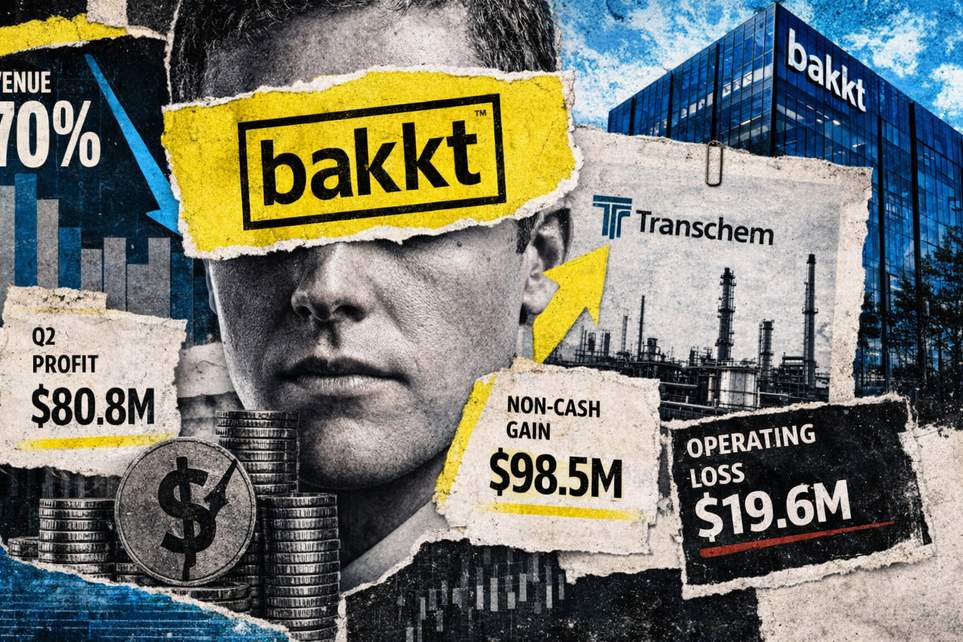
Bakkt reported an $80.8 million GAAP net income for Q2 2026 — and if that sounds like a turnaround, hold your confetti. The bulk of the headline profit came from mark‑to‑market accounting on warrant positions, not from suddenly booming crypto sales.
The biggest chunk was roughly $98.5 million in non‑cash gains tied to revaluing a set of warrants in an Indian listed company, plus about $1.4 million from a separate legacy warrant liability. Those fair‑value increases are unrealized and get booked through earnings as they’re remeasured. For context, Bakkt originally paid about $9.4 million (roughly 25% of the subscription price) for 47.5 million of those warrants, which were carried at about $107.9 million at quarter end. If Bakkt exercised every warrant within the next 18 months it would need to pony up roughly another $28.2 million.
Strip out those non‑cash marks and the company’s pre‑tax picture flips: an illustrative pre‑tax loss of roughly $18.8 million. That’s not a formal GAAP subtotal the company reports, but it’s a useful reminder that fair‑value accounting can make headlines that don’t match day‑to‑day business economics.
Operations still soft, balance sheet keeps the lights on
The operational story is less glamorous. Revenue plunged about 70%, falling to $170.1 million from $568.1 million year‑over‑year. Management blamed client transitions and weaker digital‑asset trading volumes. Because Bakkt books a lot of crypto services on a gross basis, that revenue number doesn’t equal money the company actually pockets — and the underlying economics were skinny: crypto costs and execution, clearing and brokerage fees ran about $169.3 million, leaving roughly $0.9 million before other operating expenses.
Profitability metrics backed up the cautionary tale. Operating loss from continuing operations widened to $19.6 million (versus $16.1 million a year earlier), and adjusted EBITDA showed an $11.8 million loss compared with an $9.8 million loss the prior year. Management cited weaker crypto‑services economics, higher salary and contract labor costs, and a new equity‑method loss as key drivers, partially offset by lower selling, general and administrative expenses.
Still, the balance sheet provides some breathing room. Bakkt finished June with about $50.7 million in cash and equivalents and no long‑term debt. First‑half operations consumed roughly $26.9 million of cash, while financing activities contributed about $67.2 million, mostly via equity raises. In short: the quarter produced a GAAP profit thanks to accounting marks and the company has decent liquidity, but there’s little evidence yet of a sustainable operational rebound.
On top of everything, capital allocation questions remain. A credit‑loss allowance of about $7.8 million and a roughly 109% year‑over‑year increase in share count tighten the scrutiny on how future cash and capital will be deployed. Filings also leave the door open for more token sales, equity issuance, or traditional financings until the business can reliably fund itself.
Bottom line: nice headline number, messy underlying reality. The warrants made the numbers look great on paper — the real business still needs to catch up.
