
Gemini Q2: Cards Climb, Exchange Shrinks — The New Reality
Gemini’s most recent quarter painted a mixed picture: total revenue climbed, but the traditional exchange business took a visible hit. The company pulled in $45.5 million in revenue this quarter versus $33.3 million a year earlier — yet the part that most crypto nerds care about, the exchange, shrank.
Cards on a rocket, exchange on a diet
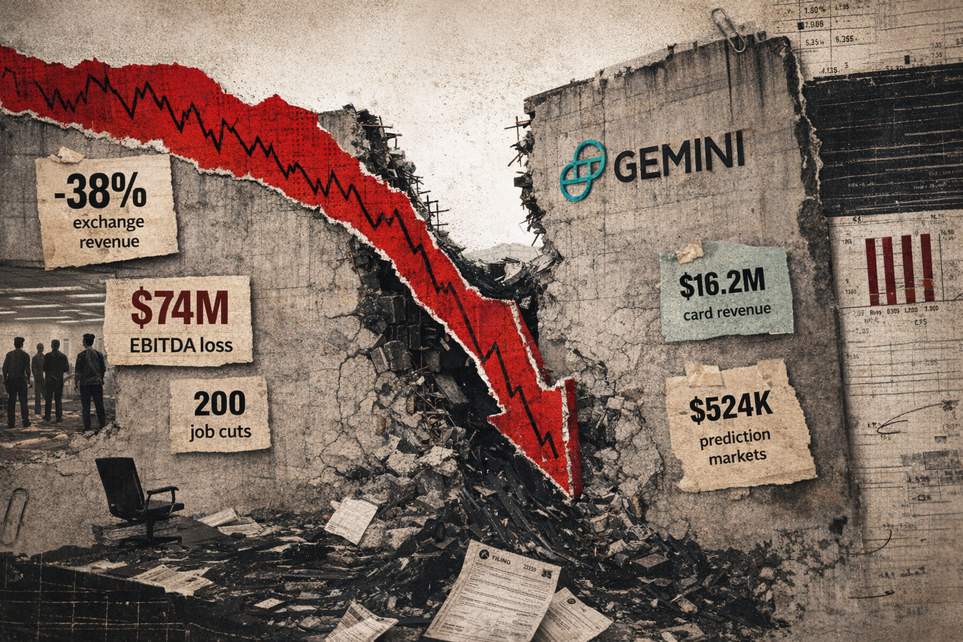
The payments arm did the heavy lifting. Credit-card revenue jumped to $16.2 million from $4.9 million, accounting for most of the roughly $12.2 million increase in overall revenue. That shiny card growth, though, came with baggage: the company reported $8.7 million in combined card rewards and promotional/ referral incentives and a $16.1 million credit-loss provision tied to an identity-fraud cohort.
Meanwhile, exchange revenue slid 38% year over year to $12.5 million (from $20.2 million). Trading activity fell harder — spot trading volume dropped to about $3.8 billion from roughly $11.3 billion, a decline in the neighborhood of two-thirds. Newer offerings like prediction markets chipped in (about $524,000 since their December launch), but they’re still tiny compared with the core exchange business.
Loss items tied to transactions also ballooned: total transaction losses rose to $20.1 million from $3.6 million. So yes, the top line improved, but the new revenue streams have meaningful costs attached.
Restructuring, costs, and the math that won’t quit
In February the company announced a sizable reset — winding down operations in the U.K., EU and Australia and trimming roughly 200 roles (around 25% of headcount at the time). The U.S. and Singapore operations remained intact.
Some cost relief showed up: employee compensation, benefits and personnel costs (excluding stock comp and restructuring items) fell about 20% year over year to $27.9 million. On a quarter-to-quarter basis, operating expenses improved roughly 15% and operating loss improved about 18% versus the prior quarter.
That said, the yearly picture is less rosy. Total operating expenses rose about 24% year over year to $122.4 million, and operating loss widened to $76.9 million from $65.4 million. GAAP net loss actually improved to $107.7 million from $133.2 million, but adjusted EBITDA loss worsened to $74.0 million from $51.9 million. The company pointed to market-related losses on bitcoin received in a May private placement as a primary driver of that EBITDA hit. Notably, the quarter’s reconciliation didn’t show a restructuring charge, so the wider adjusted EBITDA loss isn’t directly the job cuts’ fault.
The bottom line: Gemini is shifting its revenue mix — cards and newer products are stepping up while the core exchange lags. Cost-cutting moves nudged some numbers in the right direction, but they didn’t fully repair year-over-year operating performance. Short term, the story is one of a business trying to reinvent where the money comes from while patching holes in the old model. Long term? Wait and see — this pivot needs time to prove it’s more than just a fancy shuffle.
