
Canaan’s July Hashrate Headline: Ethiopia Counts, But Does It Really Hash?
The headline numbers
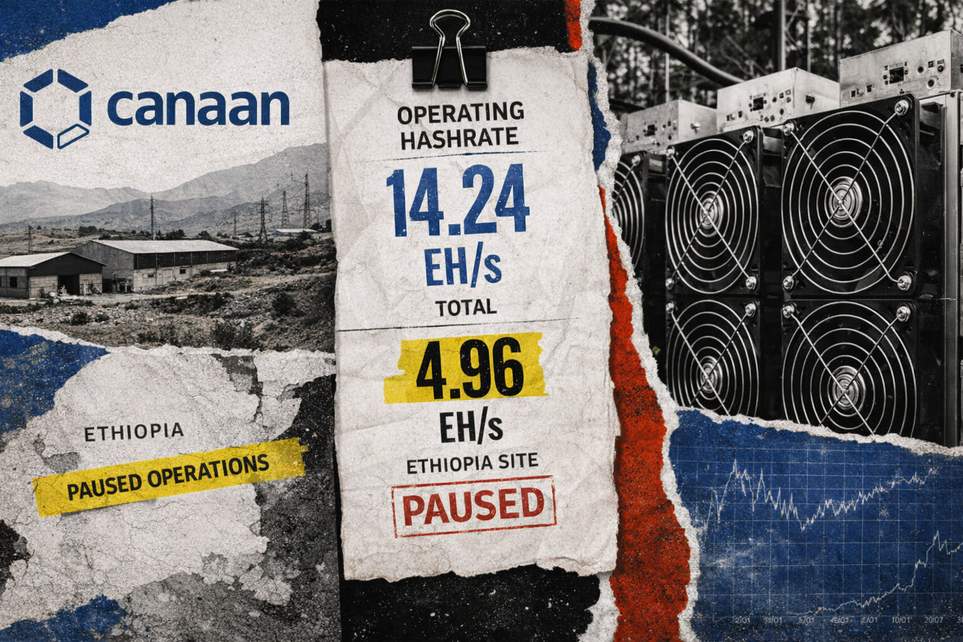
Canaan reported 14.24 EH/s of operating computing power for July — and tucked inside that total was a 4.96 EH/s line for projects in Ethiopia. Do the math and that Ethiopian slice is almost 35% of the reported operating figure. Cozy, right? Except, not so fast.
If you subtract the Ethiopia row from the rounded global number you get about 9.28 EH/s. That sounds like a neat “actual” total, but the company’s own definitions make this subtraction far from a simple live-hashrate tweak.
What’s really going on (and why it matters)
Canaan defines “operating computing power” as the theoretical output of energized machines assuming they’re all running. In plain English: it’s a potential maximum, not a live meter reading. That definition can include machines that are temporarily offline and applies to the company’s non-joint-venture operations. So just because a row shows up in the operating column doesn’t mean every machine was actually hashing on July 31.
For Ethiopia the filings add to the mystery. The July table put the full 4.96 EH/s in both the installed and operating columns, but a footnote also said mining in Ethiopia was paused. The disclosure didn’t clarify whether those paused units remained energized or how much — if any — was actively hashing at month-end.
To add context: on June 30 the company listed Ethiopia with only 0.36 EH/s of operating computing power against the same 4.96 EH/s installed. Earlier commentary from Canaan pointed to one mining site that went offline in mid-June for local power-grid maintenance. A month later, the table shows the full 4.96 EH/s back in the operating column while the footnote still described operations as paused — not exactly a neat, consistent picture.
There’s another wrinkle — joint ventures. Canaan reports separate metrics for its 49%-owned joint ventures in West Texas. Those joint-venture outputs are excluded from the company’s reported Bitcoin production and from its average all-in power-cost calculations, even though joint-venture capacity can appear in the global projects table. That makes direct comparisons between the capacity table and reported production trickier than it first appears.
For example, Canaan reported mining 46 BTC in July and listed month-end holdings (reported as part of its figures) that include inventory of BTC and ETH. Still, production numbers and the global capacity table aren’t apples-to-apples because of the way different rows are counted and excluded.
The bottom line: the 14.24 EH/s figure is best interpreted as a theoretical operating capacity under Canaan’s own definition, not a guaranteed “live” hashrate. If you want a precise live number you’ll need more granular confirmation than what the high-level table provides — ideally, a meter reading or a clear statement that those Ethiopian machines were actually, you know, mining.
Takeaway? Read the fine print, don’t treat column math as gospel, and enjoy the thrilling ambiguity of corporate hashrate reporting — it’s the spa music of crypto disclosures.
