
Can Olenox’s Off‑Grid Bitcoin Dreams Survive a $22.9M Shortfall?
Tiny wallet, big miners: what just went down
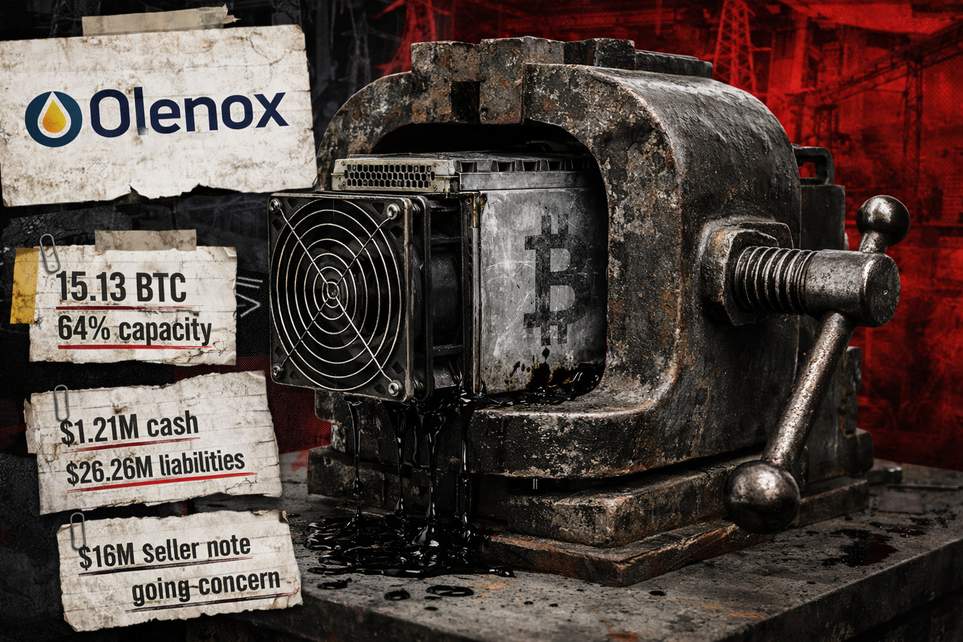
Olenox bought a Bitcoin-mining outfit in late May and promptly found itself juggling machines, invoices, and a surprisingly slim cash pile. The newly acquired miner produced about 15.13 BTC in July — roughly $1.16 million at recent prices — but that bit of glittering digital coin doesn’t translate directly into ready cash on the balance sheet.
At the end of June the company reported only about $1.21 million in cash and $3.4 million in total current assets, while current liabilities topped roughly $26.26 million. Operationally, the fleet was running at about 1.02 EH/s on average, which the company said was only about 64% of the fleet’s economic capacity. Blame summer heat, low-power modes and normal equipment availability for the gap. All of these figures were preliminary and unaudited — so take them with a pinch of salt.
In short: miners produced coin, but production isn’t the same thing as cash in the bank. Some of the BTC was taken in kind, and hosting bills, management fees and profit-sharing arrangements still need to be reconciled. That final hosting invoice for July looks like the missing link between headline production numbers and actual cash flow.
The money math: debt, notes, and a tight runway
Crunching the numbers leaves Olenox with a working-capital hole of roughly $22.9 million as of June 30. Not all of those liabilities are immediate deadweight — about $14.55 million are accounts payable and accrued expenses — but the rest includes things like lease maturities, amounts due to affiliates, credit lines, derivative liabilities, convertible and short-term notes, and current portions of long-term debt. Translation: there’s a lot of stuff on the liability side that will require attention.
The mining deal itself added more fixed obligations. The company paid about $30 million upfront for the acquisition: $14 million in preferred stock and $16 million in unsecured promissory notes, plus warrants and potential contingent stock payments. The seller notes carry a 10% annual interest rate, mature in May 2029, and kick off interest-only payments in August 2026 — which implies roughly $1.6 million of interest per year, give or take, and a quarterly payment structure.
Olenox flagged that its losses, negative working capital and negative operating cash flows raise ‘‘substantial doubt’’ about its ability to continue as a going concern. At the end of June it had no committed sources of additional financing, and warned that it might have to delay or scale back plans if fresh capital doesn’t show up. That’s corporate-speak for: the runway is short unless investors or lenders step in.
There’s a bit of optimism still in the plan. The company hopes to pivot from using grid power at third-party Texas facilities to running its own off-grid compute powered by natural gas, targeting power costs below $0.02 per kWh — which would be a bargain if achieved. But that strategy wasn’t part of the reported monthly results, and it’s future-facing rather than a fix for the present cash squeeze.
Oh, and one more thing: Olenox also floated a non‑binding letter of intent for another acquisition, priced at around $20 million in a mix of preferred stock, common stock, and cash. Ambition? Check. Immediate funding pressure? Also check.
The bottom line: the company has mining machines that can produce coins, a plan to get cheaper power, and a headline production number that looks decent on paper. The awkward part is the balance sheet — a sizable shortfall, looming seller-note payments, and no guaranteed financing. That combo makes the next few months pretty critical, and slightly nerve-wracking if you’re counting on the off‑grid mining dream to pay off.
