
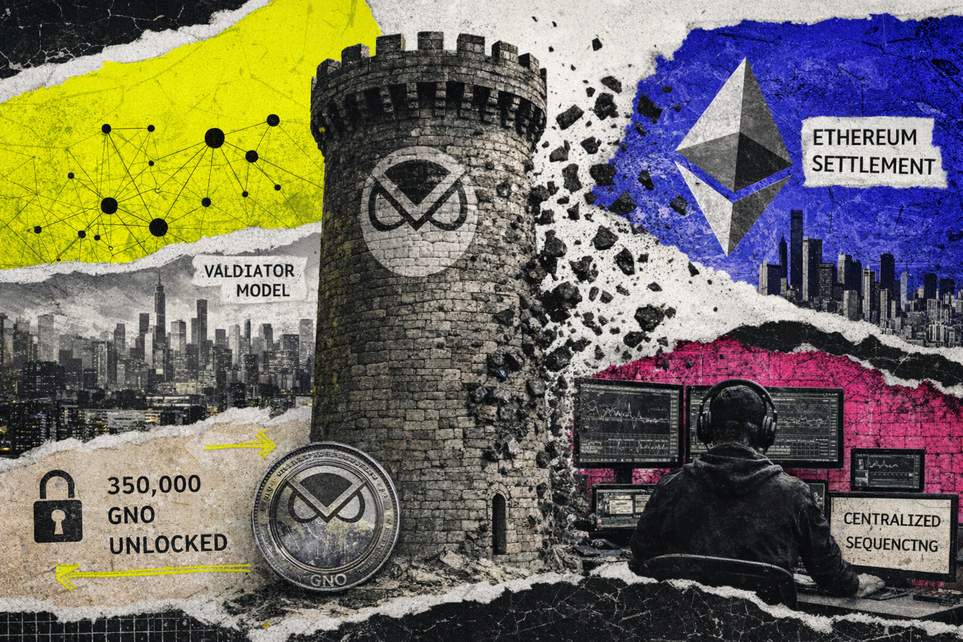
GnosisDAO votes to retire Gnosis Chain L1 and unlock 27% of GNO
Big pivot alert: GnosisDAO just green-lit a plan to retire Gnosis Chain’s standalone Layer 1 and turn it into an Ethereum Economic Zone rollup that settles to Ethereum every block. That shift would free roughly 350,000 staked GNO — about 27% of the circulating supply — turning those tokens from security collateral back into liquid coins.
What changed — and what it actually means
The approved proposal reimagines Gnosis Chain as a zero-knowledge-proven rollup that inherits Ethereum’s security instead of running its own independent validator set. Practically, validators would be phased out, settlement happens on Ethereum every block, and the staked GNO currently locking the network’s security would be returned to holders.
Markets noticed: GNO jumped roughly 10% around the governance decision, hitting levels not seen since earlier in the year. But don’t pop the champagne just yet — the vote is a directional go-ahead, not a finished product. Funding, engineering blueprints and a final launch window still need separate approvals, and the first version of the new environment is targeted around December 2026 to January 2027, depending on infrastructure readiness.
Trade-offs, token economics, and what’s next
Taking the validator set offline creates an immediate economic puzzle. Today, validator rewards are subsidized from the treasury because on-chain fees don’t fully cover security costs. That subsidy effectively dilutes non-stakers. Ending staking removes one clear utility for GNO and dumps a significant amount of locked supply back into the market, so the team needs a replacement plan.
Gnosis is kicking around ideas: tie GNO to rollup revenue through fee-sharing, orchestrated buybacks, or another mechanism. The exact design hasn’t been finalized — expect more governance proposals once the rollup’s operating economics are clearer.
On the upside, the technical goal is sweet: synchronous composability. In plain speak, that means a Gnosis contract could call an Ethereum contract and use the result in the same atomic transaction — no bridge gymnastics, no waiting around. As one of Gnosis’s co-founders put it, the move aims to make Gnosis dapps usable by anyone with a mainnet wallet in a single transaction: same block, no bridges.
Several DeFi teams have already signaled interest in building in this environment, from lending protocols to aggregators and smart wallet projects. That ecosystem support is exactly what Gnosis will need if it wants to trade staking utility for revenue-driven token utility.
There are decentralization trade-offs too: the initial plan expects a central party to run the sequencer that orders transactions, while proofs and final settlement live on Ethereum. So execution becomes less decentralized even as settlement becomes more secure. For GNO holders, the net effect is swapping a proven utility (staking/security) for a promised-but-unfinished revenue model, plus the market impact of a large unlocked token batch.
Bottom line: this is a bold reroute — cleaner UX and tighter Ethereum integration on one hand, new economic unknowns and centralization compromises on the other. If you hold GNO or are curious, keep an eye on the follow-up governance proposals and do your own homework before making any moves. Not financial advice, just a heads-up with a side of whimsy.
