
Justin Sun Keeps World Liberty Dispute Public While USD1’s Bank Waits Final OK
Judge keeps Sun’s claims public while bank approval remains conditional
In late August a federal judge in California shot down an attempt to shove all of Justin Sun’s claims into private arbitration, meaning his lawsuit stays on the public record. World Liberty had also tried to seal parts of the case, but the docket shows those efforts are still in play.
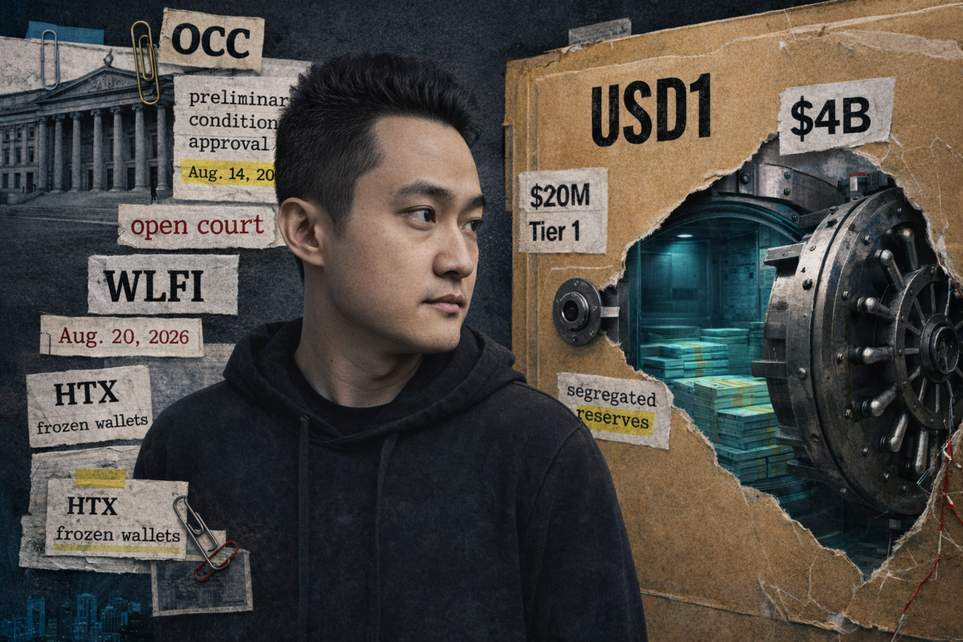
At the same time regulators gave a preliminary, conditional nod to a new trust bank meant to take over issuance of the USD1 stablecoin. That green light is far from final — the bank can’t open until it clears a pile of pre-opening requirements, and regulators reserved the right to pull or change the approval if something unexpected pops up.
So you’ve got two things happening at once: a courtroom fight over token control, and a regulator with the power to decide whether the bank actually gets to launch. That’s a recipe for suspense — or chaos, depending on your risk tolerance.
Why USD1’s setup matters — money buckets, freezes, and governance drama
The core dispute is about control of WLFI tokens and who had the authority to freeze or limit transfers. This disagreement goes back to late 2025, when the project restricted certain Sun-linked WLFI holdings as tokens were moving toward exchanges. Sun later sued, claiming his tokens were frozen and alleging tools were built to silently limit sales once tokens became transferable. World Liberty pushed back, saying Sun made improper transfers and acted against the project’s interests. The legal fight centers on who could do what, under which rules, and with whose oversight.
Things got even messier in June when the issuer froze wallets tied to an exchange during a separate dispute. That led the exchange to delist USD1 and convert customer balances to another stablecoin — a move that underlined how administrative powers can affect ordinary users, not just big-name holders.
The trust bank that’s seeking approval is slated to handle issuance and redemptions of USD1 and to manage the reserves that back the coin. Regulators have said the bank won’t be issuing or holding the WLFI token itself, but they also note overlapping ownership links across entities. That raises the obvious question: how clean is the wall between the stablecoin business and the rest of the group when executives, treasury decisions, and governance look like they might overlap?
Part of the confusion is money-bucket math. Public talk has pointed to USD1’s roughly $4 billion market capitalization, which sounds terrifying — until you remember the difference between a token’s market cap and the reserve pool that actually backs redemptions. Recent federal rules require stablecoin issuers to maintain clearly identified, one-to-one reserves separate from other company assets. On top of that, the regulator wants the proposed bank to hold a minimum buffer of capital separate from reserves, so there are multiple pots of money to keep straight.
Practically speaking, centralized stablecoins often come with admin tools like freezing or pausing addresses to comply with sanctions, court orders, or law enforcement requests. What matters now is who holds those controls, what internal checks exist, and whether putting USD1 inside a supervised bank will tighten governance — or simply rearrange the furniture.
There are two obvious outcomes to watch for. In the optimistic scenario, a written court order pares down Sun’s public claims, the trust bank proves the separation between token operations and bank governance, and regulators give final authorization. The pessimist’s playbook looks like filings that show token-control decisions bleeding into stablecoin governance, which would escalate the issue from a single dispute to a groupwide governance problem — right while the bank’s future hangs in the balance.
Keep an eye on the upcoming written court order and any follow-up filings — they’ll likely be the next place facts surface about how the different pieces actually relate to one another while the bank waits to open. In the meantime, pour yourself a coffee, enjoy the legal theater, and try not to bet your life savings on the drama.
