
Grayscale’s Zcash ETF: 2.5% Fee and a Potential 34% DCG Slice
The short version: fee, ticker, and what this filing actually does
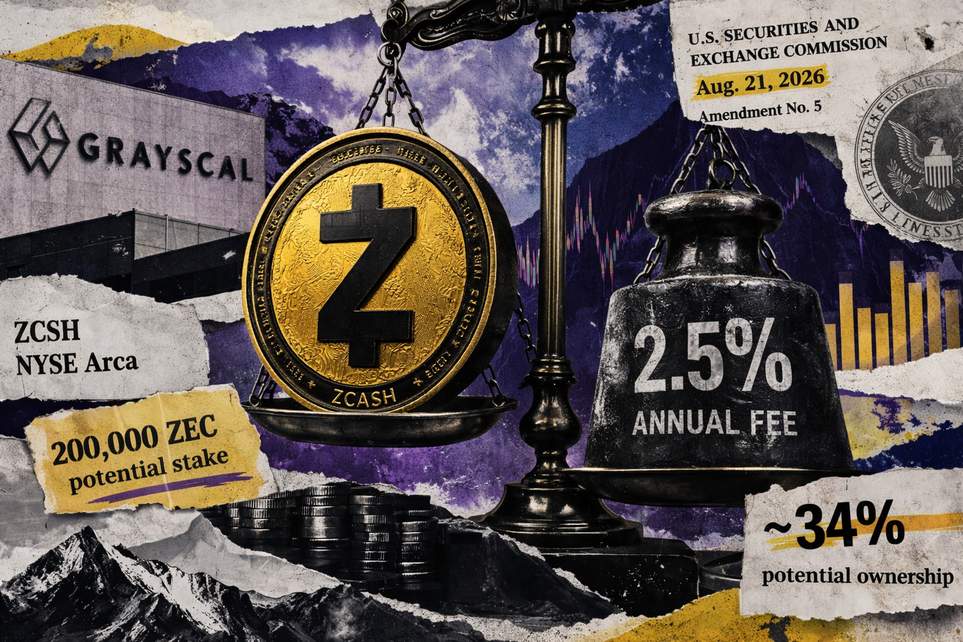
Grayscale is trying to convert its Zcash trust into an ETF-style vehicle that would charge a 2.5% annual sponsor fee. The paperwork would rename the trust “The Zcash ETF” and list it on NYSE Arca under the ticker ZCSH. The registration is still preliminary — the securities aren’t for sale under this registration yet, and the regulator has not signed off.
To help the ETF track the value of the underlying Zcash tokens (ZEC), the plan relies on authorized participants creating or redeeming 10,000‑share baskets when the market price drifts away from the fund’s net asset value. In theory, that arbitrage keeps share prices and token value closer together.
The DCG math and ownership drama
The filing flags a potentially awkward ownership scenario: a Digital Currency Group affiliate could end up with a large chunk of the fund. Using the trust’s June 30 snapshot, there were 4,829,300 shares outstanding and each share represented roughly 0.0805 ZEC. At that ratio, a hypothetical contribution of 200,000 ZEC would convert into about 2.485 million new shares — roughly 34% of the enlarged share total if nothing else changed.
The quarterly report also lists 757,202 shares as related‑party holdings. Combining that with the hypothetical contribution gives around 44.3% — a sizeable block but still below 50% in that static snapshot. Important caveat: these numbers are a one‑moment calculation. Different contributions, redemptions, or changes to the share base could push the percentages up or down, and discussions described in the filing are nonbinding.
Risks, tracking limits, and the weird bits you should know
Historically this trust has had wild gaps between market price and NAV. From Oct. 18, 2021 through June 30, 2026, shares once traded as much as 240% above NAV and as much as 55% below it. On average the premium side was about 53% and average discount about 19%, with shares closing below NAV on 700 separate days. The filing pegged the discount at about 1% on Aug. 20, before any ETF mechanics were active.
The sponsor fee accrues daily at an annualized 2.5% and is paid in ZEC, which means the number of tokens backing each share slowly shrinks over time. Grayscale says it plans to use fees it collects for marketing and initiatives to support Zcash development, marketing and education for up to 12 months after effectiveness — a voluntary, revocable plan that does not remove the fee itself.
Even with basket creation/redemption, perfect NAV tracking isn’t guaranteed. Real‑world problems — cash‑order constraints, a lack of willing liquidity providers, suspended creations or redemptions, tight ZEC market liquidity, or concentrated ownership — can all block arbitrage and let premiums or discounts persist. Big holders or the market’s fear of big sales can trigger volatility and deeper discounts.
For context, Zcash itself saw a double‑digit move recently (roughly +9.5% in the past 24 hours) and sits among the larger crypto projects by market cap. None of this is investment advice — it’s a quirky regulatory and market puzzle to watch if you like financial drama with a sprinkle of math.
Not investment advice. Do your own research before making decisions.
