
Coldcard now forces physical randomness — what to do if your seed might be exposed
Heads up: Coldcard pushed a firmware fix that now forces you to add physical randomness when creating a new seed. That means if you create a seed after the update, you’ll have to supply outside entropy — and if your seed was made with older, affected firmware, you may need to move your funds.
What changed and how to create a safe seed
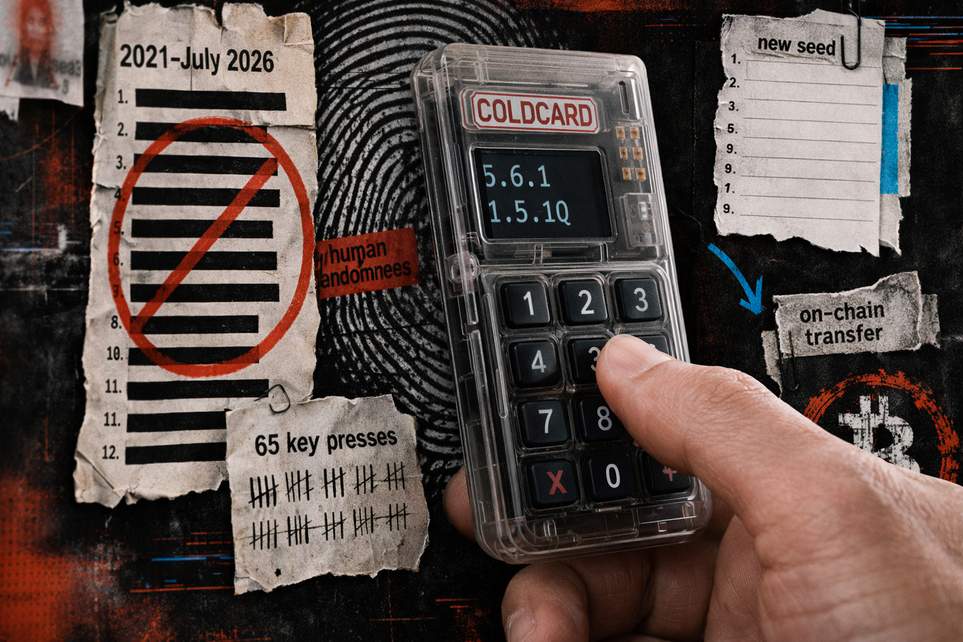
The new firmware requires one strong human-input source when making a fresh seed. You get three ways to satisfy it: a bunch of unpredictable key presses on the device, a set of physical die rolls, or a string of coin flips. The options are intentionally noisy so the device’s own random number generator isn’t the only source of entropy. Specifically, the hardened creation process expects about 65 unpredictable key presses, or roughly 50 rolls of a fair six‑sided die, or around 128 coin flips.
Install the fixed release and then make a brand-new seed if you want the hardened workflow. Note: installing the updated firmware itself does not change any seed you already made. Cloning or restoring an old seed to a device does not create a new, protected seed — you must perform a true new seed generation to get the extra protection.
If your seed was created with older firmware: migrate or prove you’re safe
If your wallet was created with firmware that might be vulnerable, the safe choice is to generate a fresh seed (using the new human-input options), confirm your backup and wallet fingerprint, verify a receiving address shown by the device, send a small test transaction, and then move every balance off the old seed. That’s tedious but necessary unless you meet the “dice exception.”
The dice exception is simple but strict: if when you originally created the seed you explicitly performed at least 50 fair, private, and independent die rolls in the affected workflow — and nobody recorded or could later reconstruct those rolls — you can treat the old seed as acceptable. Anything fewer than that, or any uncertainty about the conditions, means you should migrate.
Different Coldcard models and firmware lines have different version cutoffs for the vulnerable releases. The vendor’s recommended fixed versions cover multiple Mk and Q families; an independent analysis suggested an even broader boundary for some older Mk2/Mk3 releases. In short: if you’re on an older release and unsure where it falls, assume it’s risky and migrate.
Other firmware hardening, the bug origin, and the investigation
The update didn’t just add human input — it also plugs several other attack vectors. The firmware tightened how USB and transaction signing interact, re-validates transaction bytes before signing, disables a risky signing mode by default, restricts what can be downloaded over USB in a session, checks firmware file length, and adds persistent stops if the RNG looks faulty. There’s also a new boot-time hardware-RNG check and more isolation for special modes. These changes aim to make exploitation harder on multiple fronts.
Researchers traced the root cause of the RNG problem to a code path that could fall back to a deterministic MicroPython routine because a feature flag was mishandled. In plain English: under certain conditions, the device could end up using a predictable source when it should have used hardware randomness. The human-input requirement reduces the risk moving forward, but it does nothing for seeds already generated without enough outside entropy.
The vendor has published tests and traces showing the fixes and dice-roll handling, but they caution those materials are not the same as a full independent audit of every released binary. The company also reported customer losses and said law enforcement is looking into some incidents, but hasn’t published a verified total of affected users or funds.
If you’re a Coldcard owner and this sounds like your situation: don’t panic, but don’t shrug it off either. Generate a new hardened seed, verify everything carefully, test with a small transaction, and move funds if there’s any doubt.
