
AI Scammers Don’t Need to Hack Your Wallet — They’ll Just Trick You Into Using It
Why AI impersonation is exploding scams
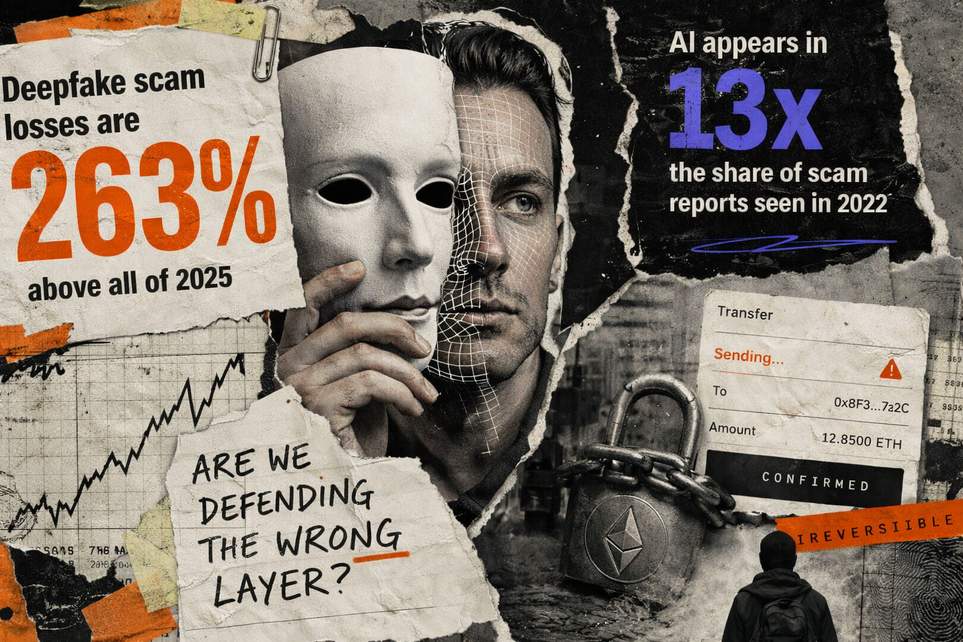
Scammers have stopped bothering to break the blockchain when they can just convince the human at the controls to hand over the keys. Recent industry reports show a dramatic jump in AI-powered fraud: scams where attackers themselves use AI tools — like deepfakes, chatbots and voice cloning — have surged roughly 13× since 2022, and broader counts of scam reports that mention AI are up around 25×. Losses tied to deepfake-style scams jumped about 263% in the latest reporting period compared with the prior year.
Other datasets point the same way: impersonation-style scams saw inflows spike by more than 1,400% year over year in one analysis, and scam operations with visible links to AI services have been shown to pull in several times the revenue of those without. Law-enforcement complaint logs also list tens of thousands of AI-related reports and hundreds of millions in associated losses, while crypto-related complaints remain in the billions.
Why the boom? AI makes impersonation cheaper, faster and scarier good. A single attacker can carry simultaneous conversations in multiple languages, stitch together convincing video for KYC checks, clone a CEO’s voice for a “final approval,” and produce consistent fake documents and profiles to back up the con. The result: everything might look technically correct — the exchange login, the hardware wallet signature, the smart contract execution — but somebody was tricked into saying yes.
Where it hurts and how to stop it
This kind of scam exploits the moment right before a transaction becomes irreversible — the human approval step. Blockchain monitoring and contract audits still matter for traditional hacks, but they don’t stop a person from willingly approving a transfer after a convincing fake call or video. That’s why the defensive focus is shifting earlier: harder checks at account recovery, stricter processes for treasury approvals, and more skepticism when anything smells off.
Practical moves that actually help:
– Treat recovery and onboarding as high-risk moments. Don’t let account-recovery flows be the path of least resistance: add layered verification and require multiple confirmation signals before changing withdrawal settings.
– Add friction where it counts. Time locks or delayed activation for newly added withdrawal addresses give staff and automated systems a window to detect fraud before money leaves.
– Use out-of-band confirmation. If someone approves a big transfer via video or chat, verify it through a pre-established channel you already trust — not the channel the attacker controls.
– Require multiperson approval for treasury moves. Multiple signers, pre-approved payee lists, and documented “proof of life” protocols for executives blunt social-engineering pressure.
– Watch for telltale signs of fakery: mismatched personal details, sudden new devices or locations, unexpected third-party webcam tools, resistance to multifactor authentication, and transactions that rush straight after account changes.
– Remember the limits of hardware wallets and on-chain tools. A wallet can prove a key signed a transaction, but it can’t tell you whether the human who signed it was convinced to do so. On-chain tracing helps after the fact; prevention needs human and process controls before approval.
For individuals: pause on impulse payments. If a stranger or “CEO” pressures you over a call or video, hang up and use a known contact method to confirm. For companies: bake confirmation channels and delay windows into treasury workflows so the attacker can’t hijack the approval path in real time.
Bottom line: as impersonation technology gets better, the most valuable security control isn’t always cryptography — it’s the moment you ask “are you really who you say you are?” and have a robust, out-of-band answer ready.
