
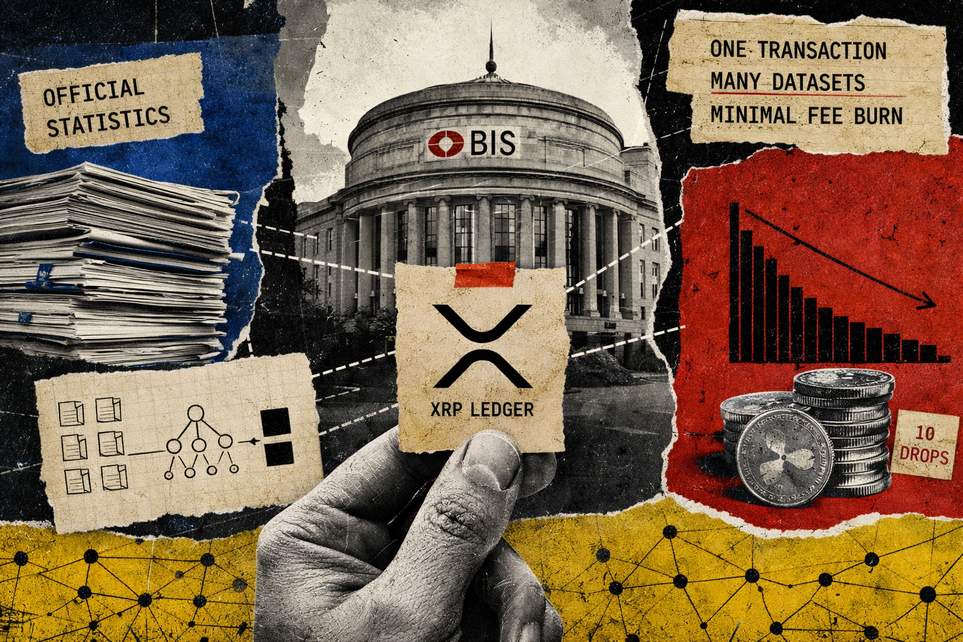
BIS prototype shows institutional XRPL use won’t trigger the XRP supply squeeze
Short version: the Bank for International Settlements built a proof-of-concept that can stamp the authenticity of official statistics onto the XRP Ledger, but the way it batches data makes any direct fee-burning effect tiny. Nice for auditors, not a guaranteed money-shredder for XRP holders.
What the BIS prototype actually does (and how)
The researchers turned statistical files into cryptographic fingerprints, then bundled those fingerprints into a Merkle tree so one compact value — the Merkle root — can represent a whole pile of datasets. That root gets recorded in the memo field of an XRPL transaction as a tamper‑evident timestamp. The underlying data and the proof material stay off‑chain; recipients get enough information to recompute the root and check it against the ledger entry.
Technically, the prototype normalizes standard statistical exchange files, hashes them (the project used SHA3‑512), and organizes the hashes into the Merkle structure. The ledger serves as a public notary rather than a data warehouse. The implementation is open‑source and explicitly experimental, running on a DevNet setup that uses test XRP and doesn’t produce real Mainnet token demand.
Performance tests on a single developer workstation showed pretty snappy timings in a controlled environment: median publish latency of about three to five seconds and verification in roughly one to two seconds. Those results are useful signals, but they exclude real‑world factors like sustained Mainnet load, hardware security modules, enterprise firewalls, and adversarial stress testing.
Why this probably won’t squeeze the XRP supply
Two mechanics matter here: per‑transaction fees (which are destroyed when a transaction is validated) and account/reserve rules (balances that a network holds as prefunding but does not burn). The prototype leans heavily on Merkle batching, which lets a single transaction represent thousands of datasets. That turns what could be many tiny burns into a single tiny burn.
In practical terms, using a minimal base fee (the project used a low baseline fee as its example) and batching large numbers of records means the per‑dataset on‑chain cost becomes vanishingly small. The prototype’s own arithmetic shows that with big batches, the direct transaction‑burn channel for each dataset is effectively negligible; storage, proof management, and off‑chain processing dominate the cost story.
There is a separate, conditional pathway that could increase held XRP without burning it: reserves. Each new account and each new ledger object can require a balance that is locked as a reserve. So a widescale deployment that created many institutional accounts or lots of ledger objects would increase the amount of XRP held on the network — but those funds would be prefunded reserves, not destroyed by fees. How big that effect is depends entirely on deployment architecture and validator policy, not on simple file volume.
Bottom line: the BIS prototype makes a strong case that XRPL is a practical, low‑cost anchoring layer for official statistics under controlled conditions. But because the design intentionally compresses recurring on‑chain commitments, it does not mechanically translate into a significant, automatic burn‑driven squeeze of the XRP supply. For any real token demand to emerge you’d need sustained Mainnet anchoring activity, lots of new prefunded accounts or other XRP‑centric operations — things this experiment did not demonstrate.
