
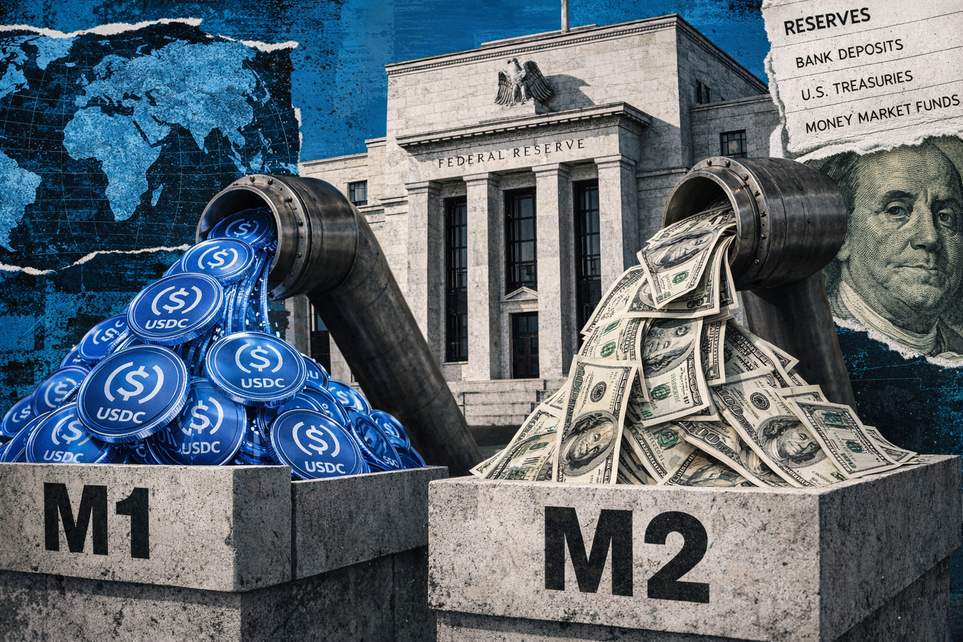
When One Dollar Tries to Be Two: How Stablecoins Could Twist M1 and M2
What the Fed staffers are actually saying
Short version: a Federal Reserve staff note lays out how regulated payment stablecoins might someday be folded into the official U.S. money measures, M1 or the broader M2. It’s staff research — think of it as brainy brainstorming, not a new rule. Current definitions haven’t changed, but the paper draws a map of the accounting headaches that would have to be solved first.
Quick refresher: M1 is the skinny, transactional money pile — physical cash and balances people can spend instantly. M2 is M1 plus the slightly sleepier stuff, like small time deposits and retail money market funds. Where a stablecoin lands depends on how people actually use it.
Function matters. If a stablecoin behaves like a daily lunch-money medium — the thing you use to pay for coffee and pizza — it leans toward M1. If it mostly sits in wallets as a trading bridge or a savings-like store, then M2 makes more sense. But the Fed’s proposed test isn’t just counting transfers; it wants evidence about real economic use.
Then there’s the “same-dollar” problem, which is the accounting plot twist. Many permitted stablecoin reserves could be held as bank deposits, Treasury bills, or government money funds — assets that might already be part of M1 or M2. If you count the token at face value and also count the backing that’s already in the money aggregates, you risk double-counting the very same dollars.
Why this matters (and the messy bits)
Think of it like wrapping cash in a shiny new token wrapper. If the wrapper is counted on top of the cash that never left the old ledger, headline money supply figures could jump without any new purchasing power being created. That would make the statistics noisier and less useful for anyone trying to judge true dollar liquidity.
Practical example: one major stablecoin issuer reported roughly 71.8 billion tokens outstanding and about 71.9 billion in backing at a recent month-end. Those snapshot numbers tell you there’s backing, but they don’t tell you which parts of that backing are already sitting inside M1 or M2, nor how much of the tokens are actually in U.S. hands.
Geography is a separate mess. Tokens travel freely on public blockchains, so transaction ledgers don’t reliably show which holdings belong to U.S. residents. A rule that applies to U.S.-regulated issuers doesn’t automatically mean all issued tokens should be counted in U.S. aggregates unless you can isolate U.S. circulation.
Transaction counting is tricky too. Academic and industry analyses find many on-chain transfers come bundled inside complex smart-contract activity — trades, arbitrage, lending, liquidity moves — where one user action can generate several transfer events. Treating each event as a standalone payment would overstate how much the coin is used as a medium of exchange.
So before any stablecoin is shoehorned into M1 or M2, three accounting tasks need to be nailed down: (1) decide whether the coin acts more like transaction money or more like savings, (2) reconcile and remove overlap between token values and reserves already included in money aggregates, and (3) separate U.S.-relevant circulation from global flows. That’s a lot of data, reporting, and judgment calls.
The good news? If done carefully, adding stablecoins to the money statistics could make the aggregates more accurate. The bad news? Do it sloppily and you’ll be watching a headline jump that mostly reflects bookkeeping acrobatics rather than actual fresh dollars changing hands.
Bottom line: treating tokens as money is more than a checkbox — it’s an accounting archaeology project. Until standard reporting, clear consolidation rules, and residency filters exist, stablecoins can complicate the picture more than they clarify it.
