
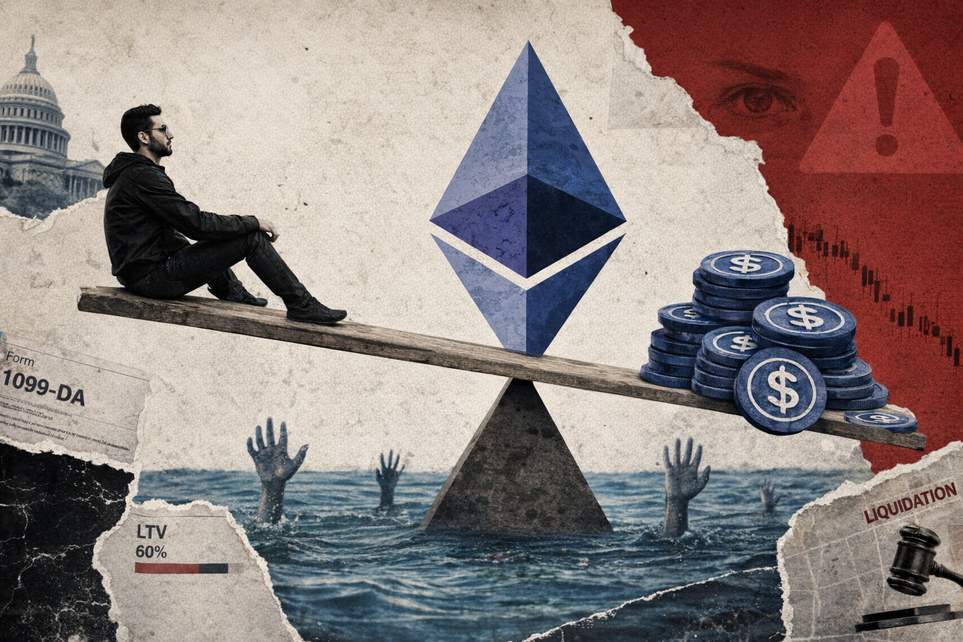
How the “buy, borrow, die” trick quietly loads DeFi pools with hidden credit risk
Buy, borrow, die — the neat tax dodge that makes DeFi pools nervous
Picture this: you bought one ETH for $1,000, it moonwalked to $4,000, and now you want $1,000 cash. You could sell a quarter of it and pay capital gains tax — or you could be clever and park the whole ETH as collateral in a lending protocol, borrow $1,000 in a dollar-ish stablecoin, and keep your upside. No sale, no realized gain, and you get spending power without giving up the shiny coin.
Sounds brilliant, until the market drops. That $1,000 loan started as 25% of a $4,000 pile of collateral. If ETH halves to $2,000, suddenly the same debt is 50% of the collateral. Interest keeps growing the debt, and if the loan-to-value (LTV) crosses the protocol’s limit, automated code lets a liquidator swoop in, repay part of the loan, and grab discounted collateral. Congratulations — you avoided a tax bill, but left a sticky credit problem for everyone else in the pool.
Stablecoins make this strategy especially tempting because they turn volatile collateral into dollar-like spending power while the original asset stays locked up. The problem? Smart contracts only see token balances and LTVs; they don’t see why a wallet holder will or won’t sell. Someone emotionally attached to a big paper gain — or legally incentivized to avoid a taxable sale — may let a risky loan linger until it’s someone else’s headache.
What the Venus study revealed — wallets, defaults, and a tax-law nudge
Researchers Lisa De Simone, Peiyi Jin, and Daniel Rabetti dug into this on a real protocol called Venus (on BNB Smart Chain). They looked at the biggest tokens on the platform from late 2020 through mid-2022: roughly 13 million transactions that turned into about 1.36 million daily borrower observations. Using a definitions-based approach, roughly 3% of traders experienced what the paper calls a default.
The authors defined default not like a missed mortgage payment but as loans that stayed above Venus’s 60% LTV limit for at least seven days without the borrower borrowing more or depositing extra collateral. The paper’s $133.34 million figure measures accumulated daily outstanding defaulted debt — so a single troubled loan can add to multiple days’ totals.
To separate pure market chaos from tax-motivated behavior, the researchers used a clever natural experiment: the infrastructure law passed on November 15, 2021, which increased expectations that crypto transactions would eventually be reported to tax authorities. The idea is simple — the law made U.S. taxpayers more likely to avoid taxable sales, while international users had no such nudge.
Because blockchains don’t hand out citizenship, the team inferred probable U.S. wallets by looking at activity concentrated in U.S. business hours, unusual behavior on U.S. holidays, and holdings of U.S.-regulated stablecoins. None of those are perfect on their own, so the study uses several definitions and a stricter combined filter too.
The headline results: after the law’s passage, wallets likely tied to the U.S. traded about 24.5% less than international counterparts. Borrowers using stablecoins to do their spending-and-stay-long trick cut trading another ~23% on top of that. The drop in activity was strongest among wallets with bigger unrealized gains and higher starting LTVs, and activity rose again once holdings passed the one-year mark that unlocks lower long-term capital gains rates.
Less trading turned into worse loan outcomes. Using the law as an instrument for tax-driven illiquidity, the study estimates that a 1% increase in tax-induced illiquidity was associated with an 11.2% increase in defaulted accounts and a 39.6% increase in defaulted loan value. In plain terms: tax-driven reluctance to sell can materially raise the amount of unpaid, risky debt sitting in a pool.
Why this matters for DeFi and for your humble pool of lenders
Automated lending platforms are spectacularly efficient at enforcing collateral rules, but they’re blind to why a borrower behaves a certain way. The smart contract checks prices, LTVs, and interest — but it doesn’t know purchase price, tax exposure, or emotional attachment to a token. That mismatch can concentrate risk among borrowers least willing to fix a bad position.
When liquidations function smoothly, outside actors repay loans and remove collateral before the pool gets hurt. When they don’t — thanks to sudden price crashes, thin markets, or congested blockchains — losses can trickle back to protocol reserves, token holders, or the people who supplied assets to the pool. In other words, a private tax avoidance tactic can become a communal finance problem.
The study is naturally specific to one protocol and one market cycle, and different platforms with better liquidity or different rules might behave differently. Still, this work exposes a structural blind spot: bringing private-bank-style borrowing onto a public blockchain widens access, but it also spreads the consequences of human tax incentives to everyone involved.
Bottom line: DeFi code is impartial, humans are not. The lending machinery can’t read tax forms or feelings, so the system ends up pricing financial risk without accounting for an important behavioral driver. That’s a bug in the social layer of the protocol — and a feature to watch if you’re supplying capital, taking loans, or just enjoying the wild ride.
