
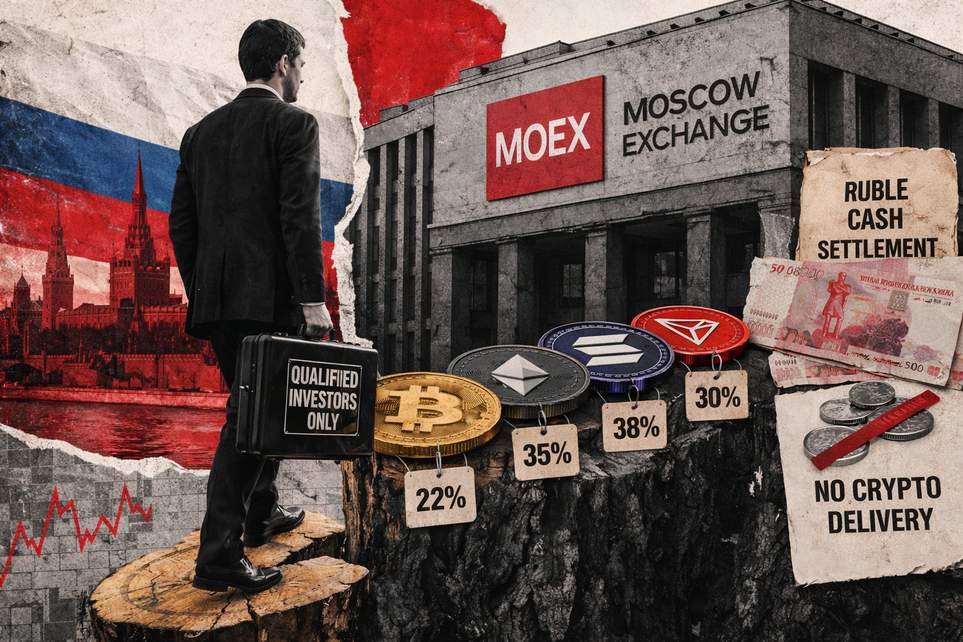
MOEX Launches Five Perpetual Crypto Futures — Ruble Cash, No Coin Delivery
On Sept. 22, the Moscow Exchange (MOEX) rolled out five new perpetual futures contracts that let qualified investors follow crypto price moves without actually owning any tokens. The contracts are designed to give continuous exposure to Bitcoin, Ethereum, Solana, XRP, and Tron — but with a distinctly Moscow Exchange twist: they’re quoted against U.S. dollar indexes and settled in Russian rubles, not delivered as crypto.
What’s launching?
The five tickers are BTCUSDF, ETHUSDF, SOLUSDF, XRPUSDF and TRXUSDF. Each contract tracks its own MOEX crypto index and automatically rolls over every trading day, so traders don’t have to shuffle positions from one dated future to the next. Think of it as subscription-based exposure to price moves: continuous, autopilot, slightly smug.
These are cash-settled derivatives — under no circumstances do you get Bitcoin, Ether, Solana, XRP, or Tron dropped into your wallet. Profits and losses are measured against the USD-denominated indexes but converted and paid out in rubles. Access is limited to qualified investors, and brokers will set the exact trading terms available to each client.
Why it matters — margins, limits, and the fine-ish print
MOEX already runs dated crypto futures and says more than 72,000 qualified investors have used those products. Cumulative turnover in the exchange’s digital-asset futures has topped 600 billion rubles, so this launch builds on an active derivatives market rather than opening crypto spot trading to everyday retail.
Traders should be ready to post collateral. Initial margin rates for the new perpetuals are relatively steep: Bitcoin 22%, Ether 35%, Solana 38%, XRP 43%, and Tron 30%. In plain speak: XRP requires the largest up-front bite of your position as margin.
MOEX also set concentration limits (LK1 and LK2) to control large positions. Those limits range from as low as 961 and 4,807 contracts for the XRPUSDF pair up to 124,490 and 622,450 contracts for the ETHUSDF pair. Because each contract has its own size and specification, those raw numbers aren’t apples-to-apples measures of exposure — but they give a sense of how the exchange caps big players.
The perpetuals use funding parameters set at K1 = 0% and K2 = 0.35%, and remember: these instruments simply mirror price movements in a regulated contract form — you get exposure without custody of the underlying coins.
Bottom line: if you’re a qualified investor who wants regulated, ruble-settled exposure to major crypto swings without dealing with wallets and private keys, these new MOEX perpetuals are built for you. Not investment advice — just a friendly heads-up from someone who thinks financial products are secretly drama shows in tuxedos.
