
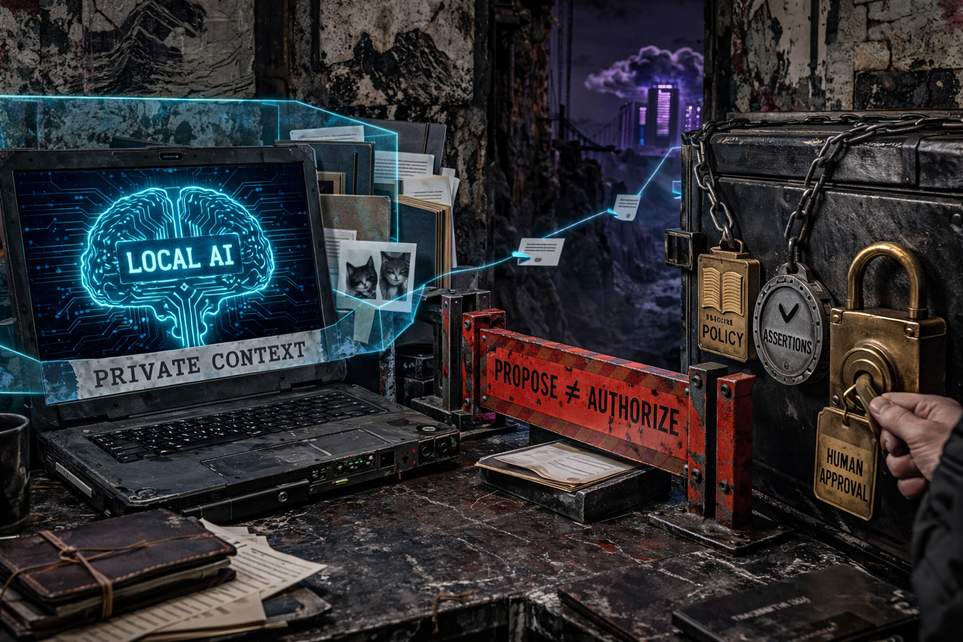
Local AI on Your Laptop: Fast, Private — Just Don’t Hand It the Keys
Why your laptop AI suddenly feels useful
Big brains are getting small. Recent improvements in local model tech and tools like llama.cpp have pushed powerful AI to laptops in a way that actually feels snappy. Practically speaking, people are now seeing local systems sail through lots of everyday tasks—think drafting, summarizing, and coordinating work—without pinging a cloud for every tiny thing.
Benchmarks shared by early testers show input-processing speeds in the low hundreds of tokens per second and generation speeds in the teens to low thirties. In plain English: the local models respond quickly enough to be a real-time assistant for routine workflows on a high-end laptop.
That shift matters because a locally running model can act as an information filter: it decides what to send to a remote server instead of blasting your entire inbox or file system into the cloud. That’s a big privacy win if you’re not into broadcasting your whole life every time you ask a question.
Cool, but don’t let the AI control your money
Speed and privacy are great—but wallets and money are a different beast. A helpful assistant can explain transactions, prep calldata, and point out obvious scams, but making irreversible moves (like signing and sending funds or granting token approvals) should be protected by separate, enforceable controls.
Practical safeguards look like a layered approach: keep the model as the friendly interface and planner, but let deterministic rules and hard limits enforce who can be paid, how much, and how often. On top of that, require a human confirmation step for risky actions. In other words, the assistant suggests and prepares; the human (or another fixed authority) signs off.
There are also design ideas that check what actually happened after a transaction—post-transaction assertions that compare expected state changes with reality. If the final state doesn’t match the agreed rules, the system can flag or reject the outcome. That’s a neat backstop, but it only works if the assertions cover everything relevant; a half-baked check gives a false sense of security.
Even with stronger reasoning and faster local inference, models can still be nudged by malicious prompts tucked into web pages, messages, or contract metadata. That’s why prompt-injection resistance, clear policy enforcement, and strict wallet authorization rules remain essential.
One practical testbed: a project funded to build a fully local macOS smart-account wallet with a light client and an on-device assistant. It’s an encouraging prototype for running useful AI locally while trying to keep signing power locked behind safer controls.
Bottom line: local AI on laptops is finally good enough to be helpful and private for many everyday tasks, but treating it as a trusted wallet-signing authority is still premature. Let it be your planner, not your bank manager—at least until the control layers are iron-clad and the human stays firmly in the loop.
