
XRP volume explodes to $7.4B, and a massive CME short squeeze is blamed
XRP spiked to an intraday high of $1.60 on Sept. 22 while trading volume screamed up to about $7.4 billion. That kind of action makes people point fingers fast — and one of the obvious suspects was a big move in regulated futures on the CME. But the story gets much more interesting (and messier) when you pull apart the data.
What the futures numbers actually showed
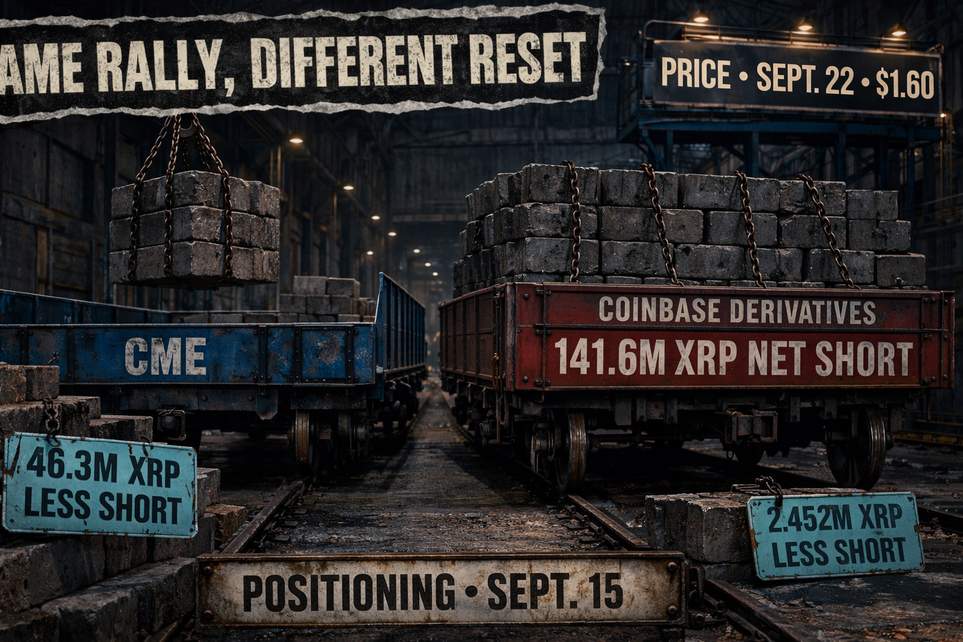
The U.S. regulatory snapshot from mid-September showed leveraged funds dramatically reducing a net short position on CME XRP futures in the space of a week — a drop worth roughly 46.3 million XRP. On the CME each standard future contract controls 50,000 XRP. As of the Sept. 15 report those funds held 1,585 long contracts and 2,304 short contracts, leaving them net short by 719 contracts (about 35.95 million XRP). A week earlier they were much more short: 1,280 longs versus 2,925 shorts, a net short of 1,645 contracts (about 82.25 million XRP). The change came from more long positions (up ~305 contracts) and fewer shorts (down ~621 contracts).
Open interest on CME actually fell over the week by about 509 contracts, which equals roughly 25.45 million XRP — meaning some traders closed positions even as the leveraged-fund category added long exposure.
Now pivot to another venue: Coinbase’s regulated products behaved very differently. After converting all of Coinbase’s reported instruments into XRP-equivalent units, the same trader category barely budged overall — cutting net short by only about 2.45 million XRP and still remaining substantially short (roughly 141.6 million XRP). The breakdown matters: Coinbase’s standard contract is smaller (10,000 XRP per contract) and its nano-style contracts are tiny (500 XRP per contract). One of Coinbase’s products, a regulated five-year cash-settled futures contract that includes funding adjustments, actually became about 1.29 million XRP more net short in the week.
So: CME showed a sharp reduction in net shorts by leveraged funds; Coinbase barely moved and even had some products go the other way. On Sept. 15 Coinbase’s combined net short was nearly four times the size of the CME net short, and it changed only a sliver over the same week.
Why that doesn’t prove a single dramatic short squeeze
Data is neat but it isn’t a mind reader. The CFTC’s leveraged-funds label covers a category of traders, not their intentions. Shorts can exist for all kinds of reasons: bearish bets, hedges against spot exposure, pieces of spread trades, or parts of basis and relative-value strategies. Shrinking a short can mean bullish conviction, hedge tinkering, a relative-value unwind, or simply risk reduction. Public aggregates don’t identify individual firms or the exact reason for each contract.
There are other caveats too. Some XRP product activity may sit outside the particular reporting rows we looked at (micro-XRP products or markets below reporting thresholds can hide activity). And timing matters: the CFTC snapshots reflect positions as of a Tuesday and are typically published on Fridays, so the Sept. 15 numbers were already in the pipeline before the Sept. 22 price burst. The next report (covering Sept. 22 positions) will show whether the cross-venue split persisted through the rally.
Bottom line: three simple facts are true and don’t need to be mashed into a single causation claim — XRP rallied hard, leveraged funds on CME had already cut a sizable net short, and Coinbase’s aggregated positioning barely moved. That divergence is interesting and worth watching, but it stops short of proving a neat, one-size-fits-all “short squeeze” story.
In plain terms: yes, something notable happened in the futures markets around the same time as the XRP pop — but calling it definitive proof that a CME short squeeze alone drove the rally is jumping to conclusions. Keep an eye on the next CFTC release if you want to see whether the split across venues tightened up or widened further.
