
Sentora Proposes Running an Aave V4 Hub — 50/50 Fees, Suppliers Might Eat the Loss
The proposal in plain English
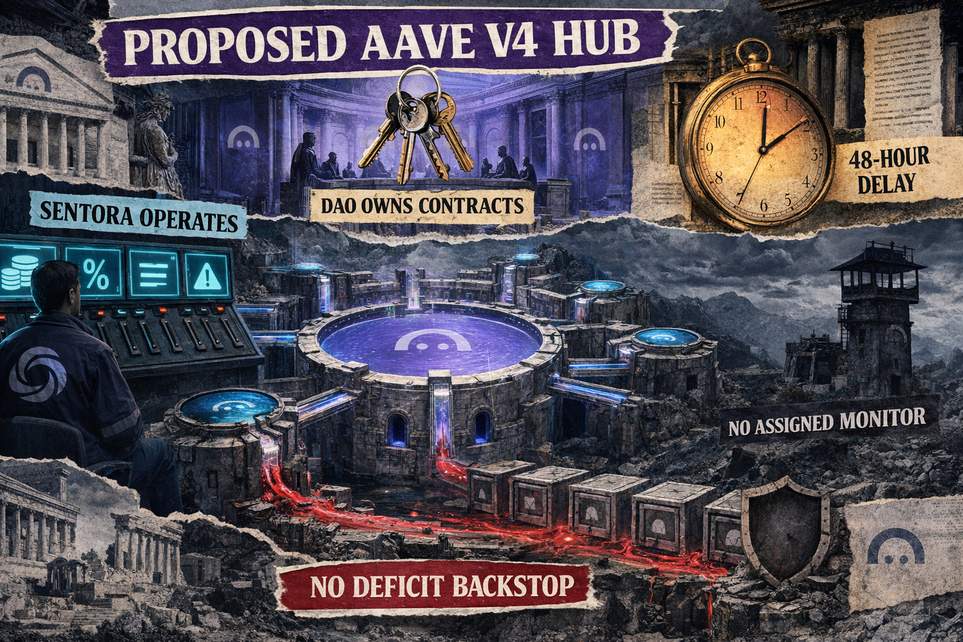
Here’s the short version: Sentora wants to operate an isolated Aave V4 Hub and its attached Spokes. The Aave DAO would keep legal ownership of the contracts, but Sentora would get the day-to-day keys to pick collateral, tweak interest curves, set liquidation rules, and choose price oracles. In return Sentora and the DAO would split protocol revenue 50/50.
Operationally, Sentora would run its own Ethereum Hub with Spokes that draw from that Hub’s liquidity. There would be no credit lines between this Hub and other DAO Hubs, so loans from Sentora’s Spokes stay inside Sentora’s bucket.
Important procedural bits: certain risky or unclear changes would be visible to the DAO with a 48‑hour delay before they execute (this mainly covers risk increases, rate models, and liquidation tweaks). The DAO keeps the power to revoke Sentora’s roles, but doing that itself requires an on-chain governance action, so it’s not instantaneous.
Why suppliers could end up holding the bag
If a liquidation doesn’t fully cover a borrower’s debt, the Spoke reports the shortfall back to the Hub that supplied the asset. That deficit is recorded against the Hub asset and, under the current V4 deficit rules, the suppliers who provided that asset in the Hub ultimately absorb the loss.
Crucially, the proposal doesn’t assign any independent Aave risk service provider to actively monitor, recommend parameters, or run incident response for this instance. Providers could flag problems on their own, but there’s no required watcher or paid reviewer, so a silent rollout wouldn’t guarantee anyone actually checked the changes.
The proposed market would initially limit borrowable assets to RLUSD, PYUSD, and OUSD and would explicitly leave out big stablecoins like USDC and USDT. The final asset list and which oracle feeds get used are still open items — and those choices will heavily affect how risky the Hub actually is for lenders.
On coverage: separate umbrella proposals exist in the broader V4 discussion for deficit offsets and staked coverage on some core assets, but this Sentora Hub isn’t named in those protections and Sentora isn’t proposing a Sentora-funded first-loss layer for its Hub. That gap means suppliers shouldn’t assume there’s extra insurance just because the DAO owns the contracts.
What to watch (and what to panic about, quietly)
If you’re thinking of supplying assets to this Hub, three things matter most: the final list of accepted collateral, which price oracles are chosen, and whether any explicit deficit coverage or first-loss buffer is ever added. Those variables will determine how much downside sits behind the DAO’s contract keys.
Also remember: Sentora gets operational control (and half the fees) but not contract ownership; the DAO can revoke roles, but only via governance. There’s a 48‑hour visibility window for some risky changes, but no mechanism to surgically stop a single scheduled action inside that window.
TL;DR — It’s a business deal that hands real-time risk decisions to Sentora, splits revenues evenly, and leaves suppliers on the hook for any Hub shortfalls unless a later proposal plugs the coverage gap. So yes, it’s an intriguing arrangement — and yes, bring a helmet if you’re supplying liquidity.
