
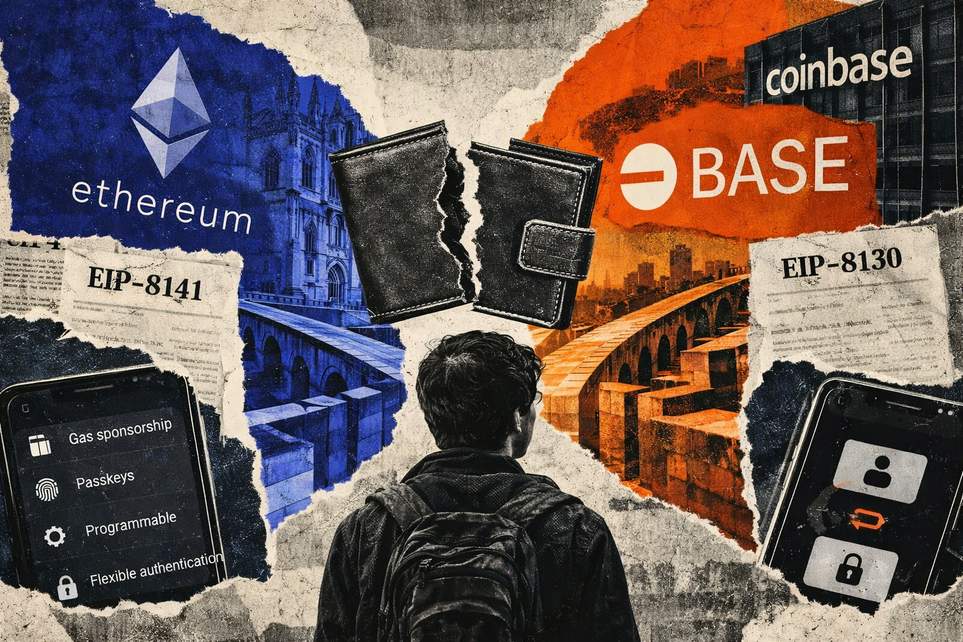
Base vs. Ethereum: The Great Wallet Schism (and why your wallet might need a personality upgrade)
The split: Frames and Base went their separate ways
Last week, a collaboration to standardize the next generation of crypto wallets quietly unraveled. Developers trying to reconcile Ethereum’s Frame Transactions idea with Base’s alternate plan couldn’t find common ground, and the teams went their own ways. In plain English: two different visions of how wallets should behave didn’t agree on the same rules.
One camp champions Frame Transactions — a flexible, code-driven approach that would let accounts be defined by software instead of just by a cryptographic key. Think pluggable logic, key rotation, and a future-friendly route toward post-quantum signatures. The other camp, led by Base’s proposal, favors a more regimented structure: transactions identify the authenticator up front so the chain can check what validation work is needed before letting arbitrary wallet code run. It’s like one side wants improv theater and the other wants a tightly choreographed musical.
The disagreement wasn’t just technical hair-splitting. It boiled down to a difference in priorities: Ethereum’s approach leans on censorship resistance, open-source extensibility, privacy, and long-term security, while high-throughput L2s like Base care a lot about predictability, performance, and being able to tell quickly which authentication methods are allowed on-chain.
Why this matters (and why wallets might get a lot fatter)
Short version: wallets may soon need to be bilingual. If Ethereum and major L2s adopt different native transaction formats, wallet software will have to support multiple transaction architectures, or users will need different wallets for different networks. Neither option is great for UX.
This split also highlights a bigger trend: layer-2 networks are growing into semi-independent ecosystems with their own users, business incentives, and release schedules. Market pressure nudges them to ship features fast, which in turn makes divergences more likely. As one core developer put it, competition forces L2s to move quicker than L1 can, and incompatibilities pile up — which could be a strength or a headache depending on how it plays out.
There are still attempts to keep things portable. Some proposals allow alternative transports or canonical sets of authenticators to help move wallets and accounts between chains, and designers are aware that complete isolation would be a poor outcome. But when protocol-level choices diverge, a lot of the glue needed to keep ecosystems interoperable might shift into tooling, wallets, or bridges instead of living in the base specs.
On the political/economic side, this split fuels a debate about whether L2s naturally make the underlying L1 stronger. L2s can attract users, apps, and fees, but they can also capture sequencing economics and make independent product decisions. That means success on an L2 doesn’t automatically translate into more power or value for L1 — at least not in a neat, predictable way.
So what should you watch? Keep an eye on wallet updates and standards conversations. If you’re a developer, expect to support multiple auth/tx formats or build adapters. If you’re a user, brace for wallets to get feature-richer (and a little bulkier) as they try to speak every chain’s language. For anyone who likes drama: this is the sort that shapes platforms — slow, nerdy, and ultimately consequential.
In short: welcome to the era where wallets need an identity crisis to stay useful. Grab popcorn or a hard hat — depending on whether you enjoy cryptographic theater or prefer to brace for incompatibility cleanups.
