
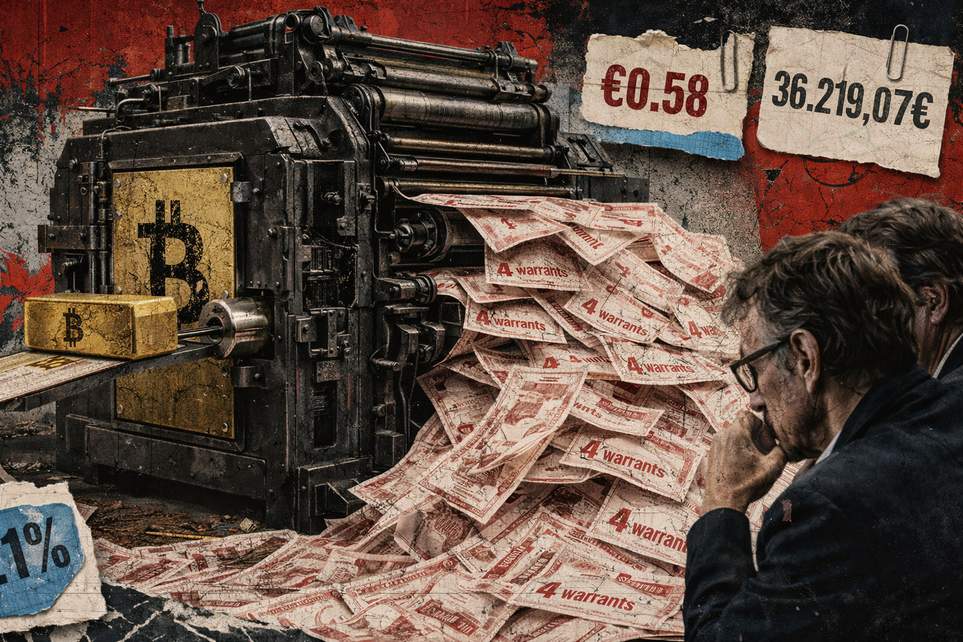
Capital B’s €21 million Bitcoin raise comes with heavy warrant dilution risk
Capital B — a company that holds Bitcoin as its main asset — announced a private placement to raise about €21 million by selling 36,219,070 new units at €0.58 each. The company said it would combine the new cash with existing operating funds to buy roughly 270 more BTC, potentially boosting its reported treasury from about 3,145 BTC to roughly 3,415 BTC. The deal was expected to close at the end of August, and neither the shares nor that planned Bitcoin purchase were complete at the time of the announcement.
Quick recap — what this transaction does right away
On the face of it, the immediate math barely moves the needle. Using the company’s own diluted-share metrics, the Bitcoin-per-million-shares figure drops almost not at all: from about 7.4725 BTC per million shares before the placement to about 7.4711 BTC per million after — a decline on the order of 0.02%. In plain English: the new shares plus the planned Bitcoin purchase basically cancel each other out, at least at first glance.
Gross proceeds from the placement are roughly €21.01 million, with an estimated €19.9 million remaining after fees. The fresh cash plus operating funds would buy the stated extra Bitcoin that produces the 3,415 BTC scenario.
Why the warrants are the sneaky dilution party-crashers
Here’s the twist: the new units carry detachable warrants (a lot of them), and those are what can seriously change the long-term picture. If every warrant attached to the placement were eventually exercised, the company’s displayed diluted share count would balloon by 144,876,280 shares and the company would receive an additional roughly €135.82 million in exercise proceeds.
That hypothetical full-exercise outcome would stretch the projected 3,415 BTC across about 601,973,171 diluted shares, which works out to around 5.6730 BTC per million shares — about 24.1% lower than the pre-placement ratio. So while the immediate transaction looks neutral, the warrants introduce substantial contingent dilution that could meaningfully cut the Bitcoin-per-share metric if investors choose to exercise.
For individual holders, the impact can be noticeable. Someone owning 1% of the company before the placement would see their stake fall to about 0.9% on the ordinary post-placement tally and to roughly 0.72% on the company’s displayed diluted basis if they don’t participate. If all the new warrants are exercised, those ownership numbers would shrink further to about 0.65% and 0.55%, respectively.
The company also notes that its displayed diluted calculation leaves out several other potential sources of shares — older option families, certain warrants tied to convertible bonds, and unissued capacity under a separate program — so the full eventual dilution picture could be broader than the one presented in the headline scenario.
Separately, shareholders previously authorized very wide financing power for the company, including large potential capital increases and credit instruments, so Management has flexibility to raise more capital down the road if needed.
Bottom line: the current placement + BTC buy moves the immediate needle hardly at all, but the attached warrants are a conditional wildcard. If they stay unexercised, nothing dramatic happens; if they’re exercised en masse, the Bitcoin-per-share story could dent substantially. In short: neutral now, but keep an eye on those warrants — they’re the sneaky party-crashers of this deal.
