
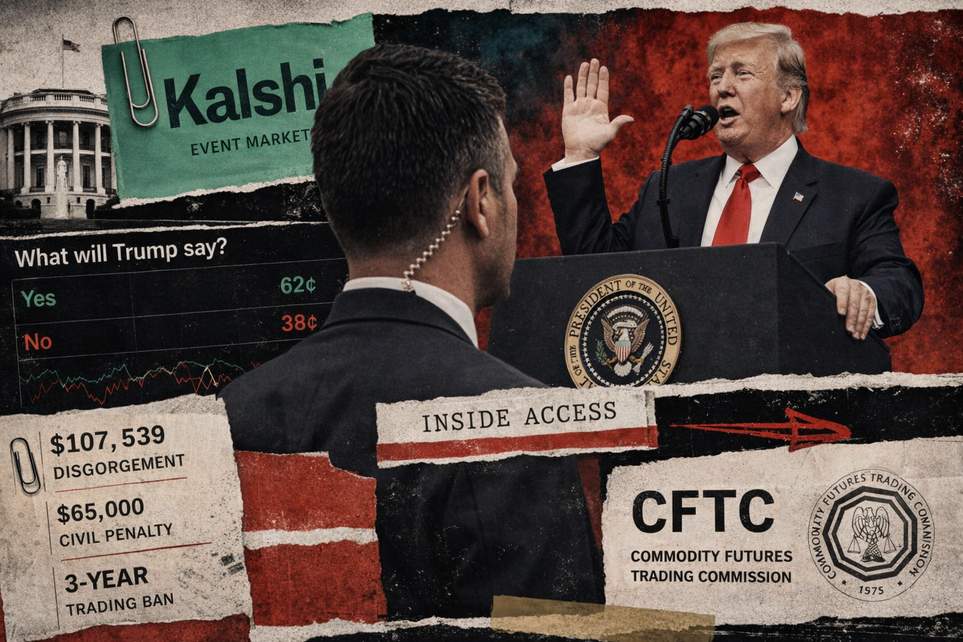
Teleprompter Operator Ordered to Return $107,539 After Betting on Presidential Speeches
Short version: a White House teleprompter operator who saw prepared speeches before they were delivered used that inside peek to trade on prediction markets and earned himself a very expensive learning moment.
What happened
Between December 2025 and February 2026, Gabriel Perez — a White House teleprompter operator — traded on so‑called “mention” contracts that paid out depending on whether the President would say particular words or phrases. Because he had advance access to the scripted text, regulators concluded Perez had material nonpublic information and used it for personal gain.
The Commodity Futures Trading Commission (CFTC) required Perez to give up $107,539.02 in trading profits, pay a $65,000 civil penalty, stop trading for three years, and accept a cease‑and‑desist order. The agency described the matter as a settled civil regulatory action (not a criminal conviction) and said Perez’s penalty was reduced substantially because he cooperated with investigators.
Public documents say an exchange’s surveillance team flagged and referred the suspicious trades to the regulator, and the CFTC credited that assistance in its final release. The agency did not announce charges against the exchange itself or state that it found a surveillance failure.
Why it matters (and what changed afterward)
This case is a neat little spotlight on insider‑type risk in prediction markets: traders who already know a speech’s wording start with a built‑in advantage when the market is trying to price the probability that a phrase will be spoken. The CFTC says designated contract markets have an independent duty to keep audit trails, watch for bad behavior, and enforce the rules — and the agency retains authority to investigate and prosecute illegal trading.
After Perez’s trading window, the exchange introduced measures intended to tighten market integrity: risk scoring for markets with higher insider or manipulation risk, employment verification for some participants, and expanded whistleblower tools. Those controls came after the December–February trades, and regulators note the public record doesn’t establish whether the new steps would have actually blocked this particular activity.
Bottom line: peeking at the script and betting on it is now an expensive hobby. Perez lost the profits, picked up a substantial penalty, and is grounded from trading for three years — which, in market terms, is a long timeout.
