
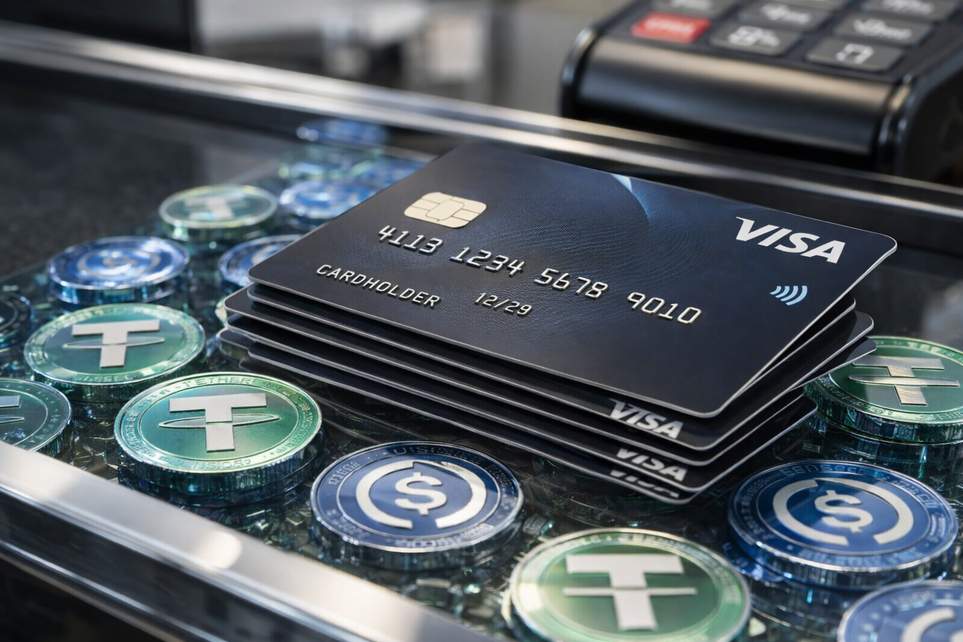
Stablecoins were supposed to bypass credit cards, but now Visa is winning crypto card payments
How stablecoins ended up feeding Visa (not eating it)
Remember the pitch: stablecoins would cut out the middlemen, zap away card rails, and let crypto wallets pay merchants directly like financial rebels. Plot twist — the fastest-growing way consumers spend stablecoins today uses the exact thing stablecoins were meant to displace. Welcome to the world where crypto hands its cash to Visa at checkout and says, “Thanks, we’ll take it from here.”
To put numbers on the weirdness: crypto-card spending has been running at roughly $600 million a month, with about $7.2 billion of cumulative on-chain card volume so far. That activity spans roughly 24 million transactions and 1.36 million wallets. And get this — roughly 90% of those transactions are routed through Visa. Stablecoin-wise, USDT makes up about 62.5% of the volume being settled.
Products like the Jupiter Card explain a lot: you top up a card with USDC, it converts behind the scenes to dollars, and merchants get paid regular fiat. The blockchain never has to show up at the cashier. Cards that link a wallet balance to Visa rails are live in a growing set of countries and are planning much wider rollouts, letting people spend crypto balances without changing how merchants accept payments or how users tap and go.
What Visa brings to the party is hard to beat: acceptance at millions of merchants, compliance connections, fraud controls, chargeback systems, and decades of conditioning consumers to reach for a plastic (or digital) number when they pay. Stablecoin cards simply give Visa another source of balances to clear — while keeping the trusty checkout layer intact.
Why this matters (and why it’s quietly hilarious)
The original idea was that stablecoins would slash bank prefunding, chop up forex middlemen, and even shake up correspondent banking. That is happening in some corners — especially in B2B cross-border flows — but consumer payments have taken a less dramatic path. When a consumer pays for coffee with a card funded by USDC, the novelty is in the source of the funds, not the checkout. Visa still gets the interchange fee, the transaction data, and the relationship with the merchant and cardholder.
Some big-picture estimates give context. One consultancy pegs B2B stablecoin payments at around $226 billion a year — roughly 60% of stablecoin payment volume in that estimate — while consumer-facing stablecoin card spending is much smaller but growing fast (about $4.5 billion in 2025, a big jump from the year before).
On supply, forecasts diverge. One bank’s optimistic scenario imagines stablecoin supply ballooning toward $2 trillion in a few years, while a more cautious view sits closer to $500 billion. If card spending stays at the current ~2.2% slice of stablecoin supply, the bullish supply case could imply tens of billions a year flowing through crypto cards. If adoption doubles in emerging markets and rewards programs kick in, that number climbs even more — but it still looks like a rounding error compared with Visa’s multi-trillion annual volume.
There are downside paths, too. If rewards cool, compliance tightens, and converting on-chain funds into fiat remains fiddly, crypto-card growth could slow to the low double-digits, leaving annual volumes in the single-digit billions. In that scenario, network shares likely consolidate toward the big incumbents — Visa in particular — because merchants and users prefer stability and reach over experimental rails.
Policy and regulation are nudging this outcome as well. Newer regulatory moves tend to favor identifiable, compliant rails — which are exactly the things card networks provide. Central banks have also warned about the banking-effects of growing stablecoin use, from deposit stability to lending capacity. Euro-denominated stablecoins remain tiny by market share, underscoring how dollar-denominated stablecoins are the real game right now.
Bottom line: stablecoins are doing plenty of interesting stuff in cross-border trade and treasury use cases, but at retail checkout they’re currently looking more like a new topping on the old Visa sundae than a bulldozer taking over the ice cream shop. Which, to be frank, is both a win for everyday usability and a kind of delicious irony for anyone who imagined crypto would just ghost the card networks overnight.
So yes — stablecoins might rewrite some parts of finance, but for everyday purchases they’re handing the steering wheel right back to the networks that already run the roads.
