
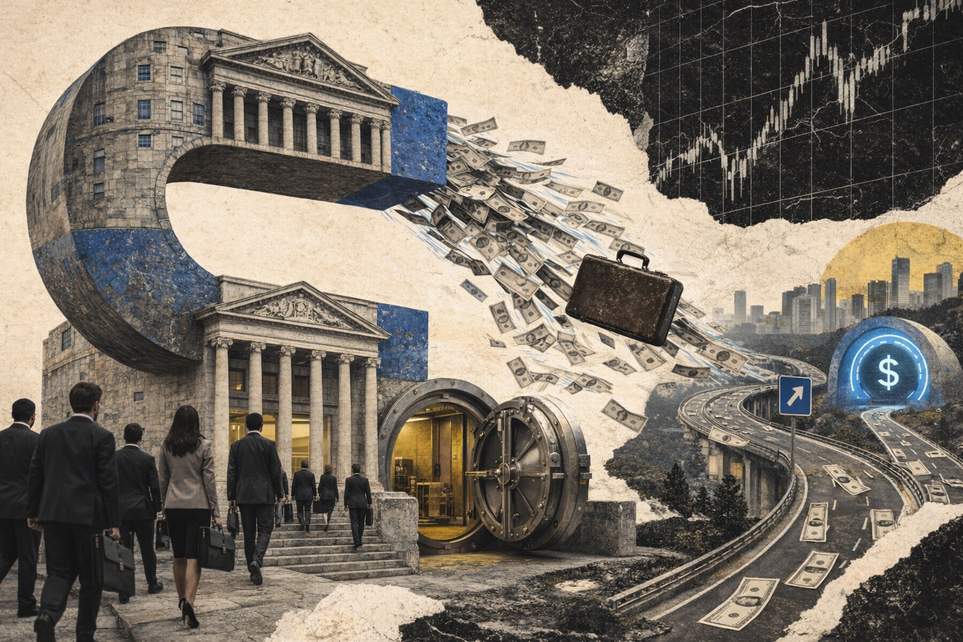
Wall Street’s Tokenized Deposits: Making Cross‑Border Cash Less of a Headache
Ever had the exact amount needed to pay a bill…but it’s sitting in the Singapore account while the invoice wants New York money yesterday? Welcome to corporate cash logistics: plenty of cash, terrible timing.
What banks are testing and why it matters
Banks are experimenting with “tokenized deposits” — basically a digital token that represents money a company has with a bank — to speed up cross-border transfers. In an experiment on Sept. 5, DBS and Citi’s New York arm moved a dollar payment between Singapore and the U.S. in minutes using a digital-ledger system built into existing banking rails. It’s not a mass product yet, but it shows the idea works in practice.
Why bother? Because slow settlement forces businesses to game the system: move funds early, hoard extra balances in many countries, or borrow in one place while cash sits idle elsewhere. All that tying up of capital costs real money and makes treasurers grumpy.
How faster settlement helps — and what it doesn’t fix
Here’s a quick example of why timing matters. Say a company moves $10 million two days early to be sure a payment clears, and that cash is effectively financed at 5% a year. Holding it those two extra days costs roughly $2,740 (that’s $10,000,000 × 5% × 2 ÷ 365). Multiply that across many payments and accounts, and the wasted liquidity adds up.
Tokenized deposits promise faster availability so companies can keep less money parked where it isn’t needed. But there are caveats. If you have to preload a special account to use the fast network, the cash is still stuck — it’s just in a different bucket. Instant rails can also create momentary spikes in funding needs unless systems include ways to offset obligations.
Netting helps: if Bank A owes Bank B $10 million and B owes A $8 million, they can just settle the $2 million difference instead of moving both full amounts. That reduces the cash each party must have on hand. Any fast-payment service competing for corporate cash has to be judged on the total cost — fees plus how much liquidity clients must keep available.
Tokenized deposits keep the conventional bank-customer relationship intact: the bank still owes the balance, and the token is just a handy, machine-readable record the payment system uses. That looks and feels familiar to companies that already work with big banks.
By contrast, reserve-backed stablecoins are a different animal. Those tokens are meant to be supported by assets held by the issuer, and they can move on public or private networks independently of a bank account. The difference matters when you want to know who you can call and how you get your money back — insurance, legal protections, and redemption rules vary by product and jurisdiction.
Large banks aren’t putting all their chips on one approach. A group of major financial institutions has announced plans for a dollar stablecoin project aimed at rolling out a product in the coming years, while others pursue tokenized-deposit networks. That makes sense: some suppliers and partners will prefer bank accounts; others already accept token-based payments.
Another wrinkle is the receiving end. Faster dollar transfers are great, but converting those dollars into a local currency may still follow local market hours. If the recipient’s bank or service doesn’t accept the token you used, someone has to act as a bridge or customers end up juggling more accounts.
Existing systems already offer parts of this promise. For example, certain regional instant-settlement services are available around the clock for some currencies. New token-first services will need to compete on the routes they support, how much they cost overall, and whether they actually make funds spendable where companies need them.
The prize for banks is big: keep corporate balances, keep currency conversion and lending fees, and keep the customer relationship. For businesses, the payoff is fewer frantic transfers, less dead cash, and fewer mornings when you have the money but can’t spend it. If tokenized systems can be reliable and affordable, that one successful Saturday payment could turn into the new normal.
So yes: it’s technology, but it’s really about timing, trust, and whether your treasurer can finally stop doing spreadsheet surgery at 6 a.m.
