
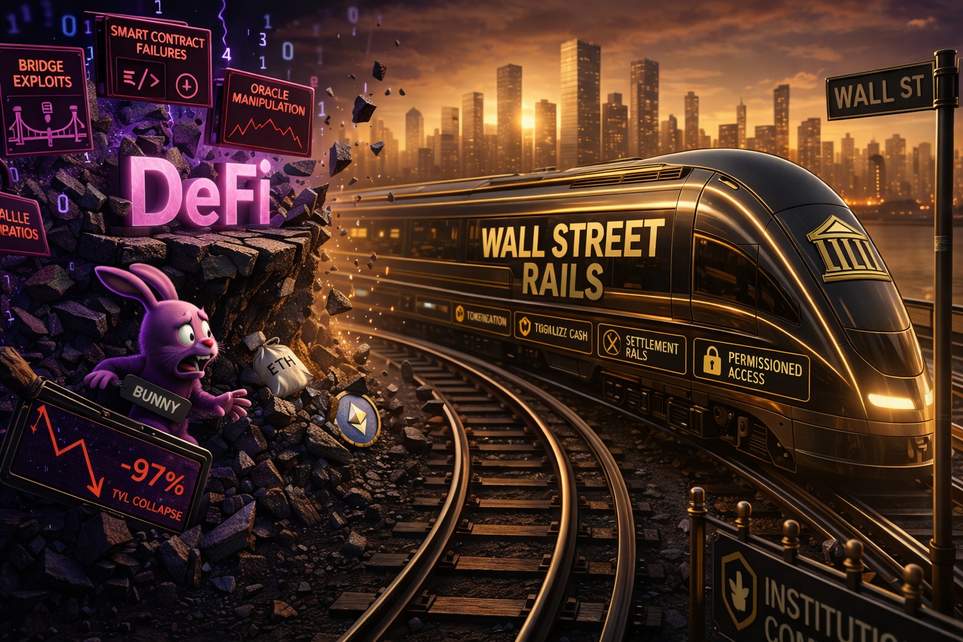
DeFi losses are now 8,500% higher than TradFi breaches per dollar moved
The dream, the glitch, and the trust switch
Remember the early DeFi romance? Keep your own keys, let code run the show, and watch markets open up like a never-ending vending machine of financial magic. Instead, what we got was partly brilliant, partly chaotic, and sometimes downright terrifying. Public ledgers and composable contracts proved they could scale — hooray. But somewhere between multisigs, front-ends, oracles, bridges, and governance votes, trust didn’t disappear so much as relocate.
Decentralization turned out to be layered. A protocol can be architecturally distributed but politically controlled by a tiny cast of humans or organizations. That’s not theory — it’s how a lot of the ecosystem actually looked. You still need people to make upgrades, pick oracles, list collateral, choose emergency knobs, and spend treasuries. Those human decisions create concentrations of power and new failure points, even if the contracts themselves are neat and tidy.
Hackapalooza: bridges, keys, and the rise of drama
Look, hacks have been the soap opera of the space. There were headline-grabbing years where billions went poof — multi-billion-dollar tallies in back-to-back years — and the plot keeps changing. Early waves were all about protocol exploits and bridge drains; more recently attackers have been zeroing in on private keys and centralized touchpoints. Add a dash of AI-powered tooling and the attack surface keeps getting smarter while some defenses lag behind.
Some classic patterns are painfully familiar: rapid yield-fueled growth, a creative exploit (flash loans, forged cross-chain messages, or oracle manipulation), a giant TVL collapse, and a token chart that never quite recovers. If you want a tiny case study in emotional whiplash, remember a project that went from multibillion TVL to a dramatic drain after a flash-loan manipulation, wiping out millions and sending the token price into orbit—downwards.
Big platforms can suffer too. A recent incident involving a forged cross-chain message released a large amount of a bridged asset, some of which ended up on a major lending protocol. The lending protocol’s actual contracts weren’t hacked, but the protocol still had to model hundreds of millions in hypothetical bad-debt, freeze assets, tweak interest rates, and coordinate emergency governance moves. That sequence shows something obvious and uncomfortable: DeFi systems can behave perfectly and still catch contagious stress from an asset, a bridge, or an oracle they accepted.
The awkward math: why the headlines sting
Here’s where the optics get weird. On raw dollar terms, exploit losses in a year can look similar between DeFi and traditional finance. But DeFi moves far less value overall than the old financial world. Do some napkin math and the losses per dollar moved in DeFi look much worse — something like an 86x higher loss rate, which people shout as “8,500% higher” because it sounds dramatic (and it is).
Part of the reason is transparency. When a pool empties on-chain, everyone sees it instantly and can follow the stolen funds in real time. That’s honest and brutal. A bank hack or data breach can sit in internal systems for months while legal and regulatory teams decide what to tell the public. So DeFi isn’t necessarily objectively less secure in every way, but it’s spectacularly visible when it fails, which is awful for PR and terrifying for users.
And the numbers aren’t the only problem. The ecosystem still relies on a sprawling stack: wallets, signing tools, bridges, front-ends, oracles, and custodial services. Any weak link turns the user’s dream of sovereignty into a brittle risk stack. The remedy? Better primitives, smarter onboarded risk checks, circuit breakers, guardians, redundant infrastructure, and yes — human governance that actually acts fast when things go sideways.
So is DeFi dead? Not really. It’s proven some of the original technical promises — public settlement, composability, and automated markets — but it hasn’t yet proved that those properties alone make finance safer or more inclusive. The future of DeFi looks narrower than some early manifestos promised: less about absolute abolition of intermediaries and more about rebuilding trust with better engineering, clearer accountability, and fewer single points of failure. Until then, buckle up and maybe don’t keep your life savings in the hottest yield farm hoodie.
