
Ethereum Shrinks Its DeFi Pie — New Chains Are Slicing In
DeFi’s shifting map — numbers and who’s winning
Ethereum’s share of the decentralized finance (DeFi) total value locked (TVL) has dropped from roughly 63.5% at the start of 2025 to about 54% by early May. That puts it near its lowest point this year, even though the network still commands a massive $45.4 billion in TVL and remains the go-to place for blue-chip lending protocols and the deepest stablecoin liquidity pools.
Meanwhile, a clutch of other chains have parked themselves in the buffet line and started taking bites. Here’s the short, snackable menu:
Solana: around 6.66% of DeFi TVL, running like a turbocharged trading venue with huge daily trading flows that feed DEXs, memecoins, staking products and tokenization projects.
BNB Chain: about 6.60% of TVL and roughly $5.55 billion locked; it leans heavily on exchange-linked distribution and big DEX volume—market integrations have pushed its trading activity way up.
Bitcoin (as a DeFi player): roughly 6.35% dominance with $5.34 billion in TVL and notable 30-day growth; its DeFi role is more about capital parked for yield and collateral than high DEX traffic.
Tron: near 6.17% of TVL and around $5.19 billion locked, but it’s best known for enormous stablecoin supply (dominated heavily by a single major stablecoin), acting more like a dollar-settlement rail than a playground of varied DeFi apps.
Base: roughly 5.44% of TVL with about $4.58 billion and strong stablecoin presence; built inside the broader Ethereum technical stack, Base funnels activity into an Ethereum-compatible security model while using its own consumer-focused distribution.
Hyperliquid: a smaller TVL footprint (about 1.81%), but a beast for perpetuals — massive perpetuals volume, big open interest, and order-book-based on-chain execution make it a self-contained liquidity engine rather than just another TVL stat.
Why this matters — and what could happen next
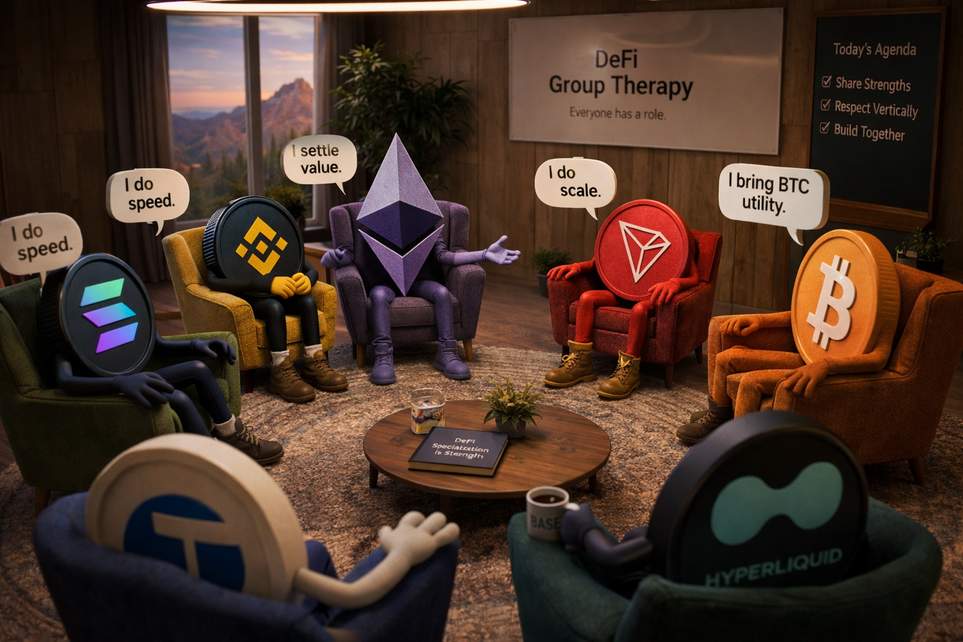
The takeaway is that DeFi isn’t collapsing into a single hub anymore. It’s turning into a network of specialized rails: some chains excel at settlement and custody, others at high-throughput trading, some at stablecoin flows, and a few at exchange-linked distribution. Different chains are optimizing for different jobs, and that’s reshuffling market share.
Recent month-over-month momentum also shows the market is still growing: over 30 days Ethereum’s TVL rose by about 13.9%, Bitcoin grew around 13.4%, Base roughly 10.5%, Hyperliquid 7.3%, Tron 6.8%, and BSC about 2.9%. So this isn’t a zero-sum implosion — it’s expansion with specialization.
Two plausible futures stand out. In one, Ethereum’s massive stablecoin base (about $165.5 billion worth) and its deep institutional integrations help it claw back share toward roughly 55%–58% by late 2026. In the other, if exchange-driven flows deepen, Base keeps being pushed through consumer apps, BTC-based collateral use keeps growing, and perpetual-focused venues hold their ground, Ethereum’s share could compress to the mid-40s to 50% range. In that case Ethereum still acts as DeFi’s settlement and custody backbone while most user-facing action happens on specialized rails.
Bottom line: Ethereum’s lead is big and its balance-sheet role is core, but the fast-growing use cases are happening where distribution and execution are the best — and those lives increasingly off-chain or on other chains. In plain English: don’t be surprised if your favorite DeFi activity lives somewhere other than Ethereum soon — the ecosystem is getting delightfully messy and specialized.
