
Why SRX’s 4.3% AI Win Looks Cute — But the Books Tell a Different Story
TL;DR: Nice-sounding model number, murky real-world picture
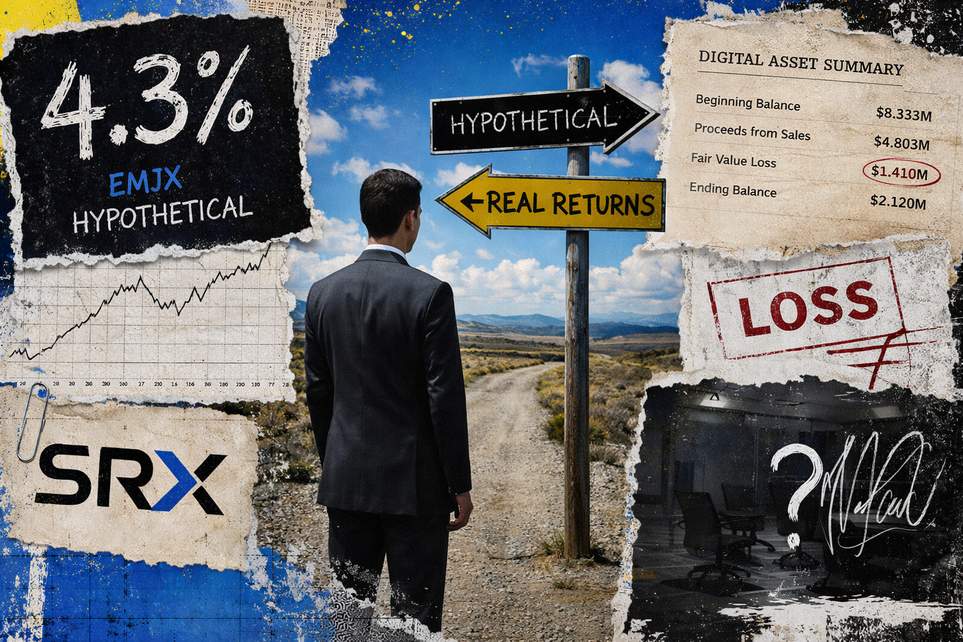
SRX put out a headline-grabbing 4.3% gain tied to an AI-driven model over a short two-week window right after it closed an acquisition. Fun! Problem is: the company itself called that figure “hypothetical” and “system-generated,” and explicitly said it wasn’t actual trading performance on SRX’s money. So you’ve got a model flexing in press-release clothing, while the company’s financial statements show something else entirely.
The numbers that actually show up on the balance sheet
Here’s what the quarter’s books reveal, in plain human-speak: the company’s digital-asset holdings began the quarter at about $8.333 million. During the period it reported no purchases, roughly $4.803 million in sale proceeds, a $1.410 million fair-value loss on digital assets, and ended the quarter with about $2.120 million of digital-asset balance. Those line items are company-wide; the filing did not report any separate EMJX segment revenue, operating expenses, or segment results for the June 16–30 ownership window.
On the income statement side, SRX recorded a consolidated net loss from continuing operations of about $4.140 million for the quarter. That breaks down to roughly a $3.201 million operating loss and $0.939 million in other net expense (which included the digital-asset fair-value change). In short: the 4.3% number is a model output over 14 days, while the $1.410 million is the quarter’s company-wide fair-value movement. They answer different questions.
What actually matters to investors (and what to ask)
Model gains are cute — real money gains are what pay the bills. If you want to judge whether the AI strategy actually works for SRX shareholders, ask for three things: a clearly defined pool of capital that EMJX actually manages, the exact deployment dates for that capital, and the returns attributable to those deployed funds. That lets you compare model runs to real-money results instead of guessing.
Management has said deployments will be phased and that it will share performance after there’s a meaningful history, but it didn’t say how much capital needs to be at work or when that history will exist. Until SRX ties the model output to an identified pool of its own capital and shows how that pool performed, the 4.3% claim remains a simulated headline, not proven investment performance.
So: enjoy the flashy AI stat, but don’t confuse a simulated backtest with real profits until the company hands over the receipts.
