
CLARITY Act hits the brakes as the crypto ethics fight goes off the rails
Why the CLARITY Act stalled
Okay, imagine a bill chugging down the Capitol tracks and then, suddenly, someone yanks the emergency brake. That’s basically what happened to the CLARITY Act this week. Bipartisan negotiations over ethics rules in the bill fell apart after Republicans and the White House reportedly backed away from an enforcement approach Democrats thought was on the table. The disputed idea was simple but spicy: let state attorneys general sue the Justice Department if federal enforcers ignored ethics rules. Cue constitutional hand-wringing and a whole lot of second-guessing.
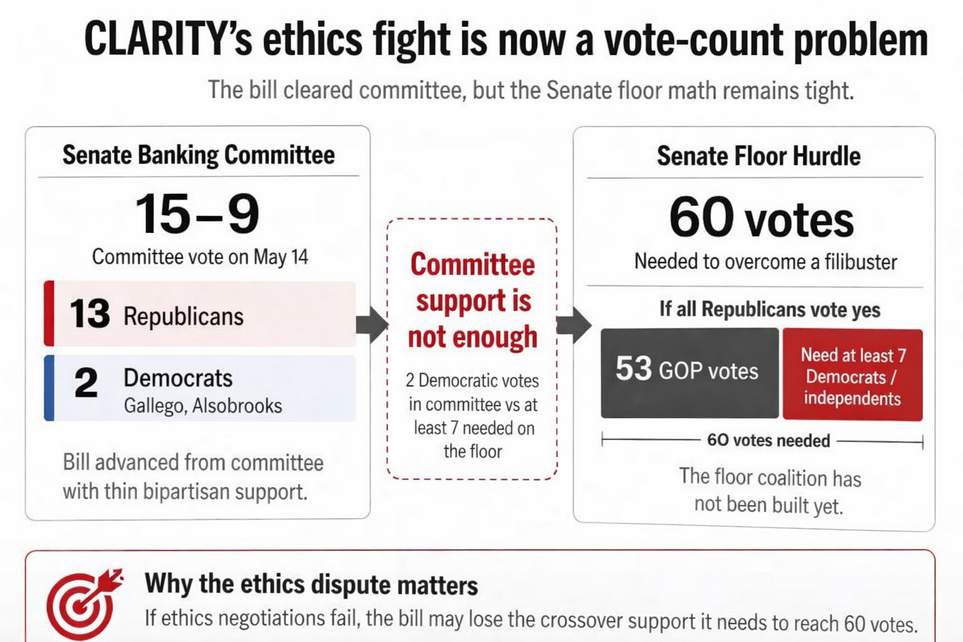
The bill did clear the Senate Banking Committee earlier with a 15–9 vote — all 13 Republicans plus two Democrats — but surviving committee approval and clearing the Senate floor are two very different beasts. To beat a filibuster the measure needs 60 votes, so losing even a couple of Democrats would be a dealbreaker. Two swing-vote senators who backed the committee vote have warned they won’t rubber-stamp anything that looks toothless on ethics.
From a timeline perspective, the ethics language has been on a slow diet: demanded in a fall framework, watered down in a draft, then dropped entirely in a later version. An amendment that would’ve barred top officials from having crypto business ties failed in committee, with opponents saying ethics was outside the committee’s job and could be added later on the floor. Republicans now say they and the White House are uncomfortable with the state-AG enforcement idea, and some senators raised constitutional worries about letting state officials sue federal actors.
What’s at stake and what happens next
If the enforcement tool that Democrats negotiated gets weakened or chopped out, the bill probably doesn’t hit 60 votes. Democrats want enforcement mechanisms they can credibly point to — not language that reads like wishful thinking. Reported alternatives include impeachment or new judicial routes, but those are politically messy and might not satisfy holdout senators.
Beyond the ethics showdown, several other big-ticket items remain unsettled: anti-money-laundering provisions are still being debated, an amendment to give Treasury sanctioning power over DeFi was rejected at markup, and the definition of “non-decentralized” for DeFi protocols keeps drawing fire from multiple directions. There’s also a working compromise on stablecoin yield rules that limits bank-like interest but allows certain reward-style mechanisms. Procedurally, the Senate Banking text must be reconciled with a parallel Agriculture Committee version, and the House already passed its own bill last year, so there’s a lot of stitchwork left before anything becomes law.
Timelines matter here. If the Senate can’t get the ethics fight nailed down before the August recess, supporters warn the next realistic window could slip to 2027 or even farther out. One analyst group recently put the bill’s chance of passage this year around the 60% mark — optimistic, but not guaranteed. Bottom line: the CLARITY Act is paused in diplomatic limbo, and unless negotiators can find enforcement language that enough senators view as real and binding, the train might stay in the station for a long time.
