
Hyperscale Sells Bitcoin to Fund AI — AI Will Be Under 20% of 2027 Revenue
Quick take: Bitcoin sold, AI is still the baby
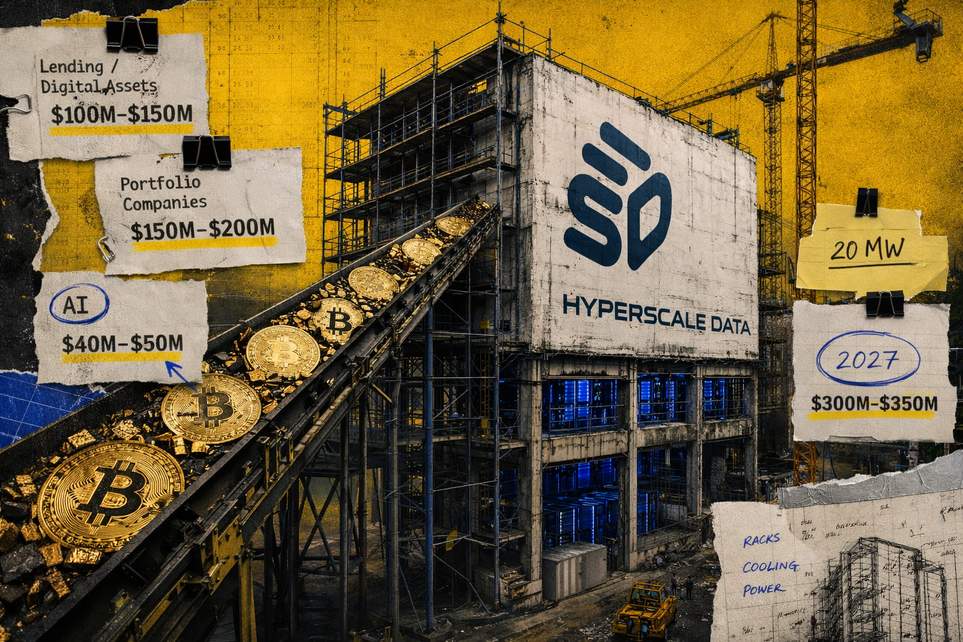
Hyperscale just announced guidance that looks like a growth spurt on paper: revenue is forecast at $300–$350 million for 2027 with adjusted EBITDA around $60–$80 million. Sounds impressive until you realize the shiny new AI plans will contribute only a sliver of that — roughly $40–$50 million, or about 11%–17% of the total. In plain English: they’re selling some of their Bitcoin to fund an AI dream that won’t be the main money-maker next year.
In the past week the company sold about 150.5 BTC for roughly $9.6 million, trimming its stash to around 958.5 BTC (roughly $60.8 million at the time). It also borrowed about $30 million using part of the treasury as collateral, at a variable rate near 4.9%. Management calls 2027 a “transition year” — the AI stuff is coming, but it’s being phased in, so don’t expect it to pay the bills just yet.
Where the real revenue will come from (and why this isn’t reckless)
Hyperscale is essentially trading short-term Bitcoin liquidity for longer-term AI capacity. The company says building the first 20 megawatts of its Michigan AI data center will cost about $100–$120 million. The rollout is staged: the first 10 MW should be up by the end of 2026 and the next 10 MW in early 2027, so full revenue from that capacity won’t show up immediately. Management is targeting $110–$120 million of data center revenue in 2028 once more capacity is online.
The long-term deal sweetens the picture: a customer contract for an initial 20 MW over 10 years (with two five-year extensions available) could be worth more than $1.2 billion if the customer stays the full term. If that customer expands to the full optional capacity, total potential could climb north of $3 billion. So the near-term sacrifice of selling Bitcoin is meant to seed a much larger, multi-year revenue stream.
Still, most of Hyperscale’s 2027 revenue is expected to come from more traditional and financial businesses. Lending, financial services and digital-asset activities are modeled to generate roughly $100–$150 million, while portfolio companies (think equipment rental, defense electronics, hotels, power electronics) are expected to bring in about $150–$200 million.
Some notable details: the lending arm focuses on private credit and structured financing, often bringing partners into bigger deals so Hyperscale can earn fees and interest without sinking all the capital itself. Management says that line of business can show very high pre-capital margins — they’ve mentioned figures approaching 85% before counting capital and staffing. The digital-asset side is broader than just Bitcoin: trading, tokenization of real-world assets and infrastructure services have already produced revenue and margins and are expected to scale.
The portfolio companies give the whole thing a steadier base. For example, a crane and equipment rental operation in the group produces roughly $50 million of revenue and about $10–$12 million of EBITDA without needing more capital. A defense-electronics business generates about $40 million a year. Those predictable cash flows help offset volatility from crypto, trading, and lending activity.
Bottom line: Hyperscale is deliberately cashing in some crypto to fund a transition into AI infrastructure. Near-term revenue for 2027 will still be led by lending, digital-assets, and its operating businesses — AI is a strategic gamble for bigger payoff later, not the immediate income engine.
